The short answer
Size the console from the television — roughly 30–50 cm wider, with a top around 45–55 cm for seated viewing — and keep 40–45 cm of depth for media equipment. Give the electronics a way to breathe: slatted doors, an open back, cable grommets and a few centimetres of clearance behind the unit. Solid teak, not teak veneer over MDF, is what holds a wide span flat over time, and made-to-order sizing is the normal answer when the wall, the screen or the equipment is unusual.
1. Start with the screen, then size the console
Measure the television across its frame rather than trusting the diagonal figure. A 55-inch screen is usually about 122 cm wide, a 65-inch about 145 cm, and a 75-inch about 168 cm. A console roughly 30–50 cm wider than that frame gives the unit enough visual weight to sit under the screen properly: about 150–170 cm for a 55-inch panel, 175–195 cm for a 65-inch, and 200–220 cm for a 75-inch. A console narrower than the screen looks improvised, while one much wider starts to dominate a small living room.
- Measure the television's frame width, not just the diagonal
- Console 30–50 cm wider than the frame reads as furniture
- Clearance of 5–10 cm at each end of the wall
- Confirm the delivered piece can reach the room
2. Height and depth: the numbers that decide comfort
Height is a viewing decision. A console top at 45–55 cm puts the centre of a typical screen close to seated eye level, which is why low media units feel relaxed and tall sideboards feel formal. If you watch standing, or the room doubles as a kitchen or bar area, 60–65 cm is the more comfortable band. Higher than that and the screen starts to sit above eye level, which is fine for a wall-mounted panel but tiring when the unit is doing the lifting.
- 45–55 cm top height for seated viewing
- 60–65 cm if you watch standing
- 40–45 cm depth for media equipment
- 5–8 cm behind the unit for cables and air
3. Slatted doors or open shelves: how the front works
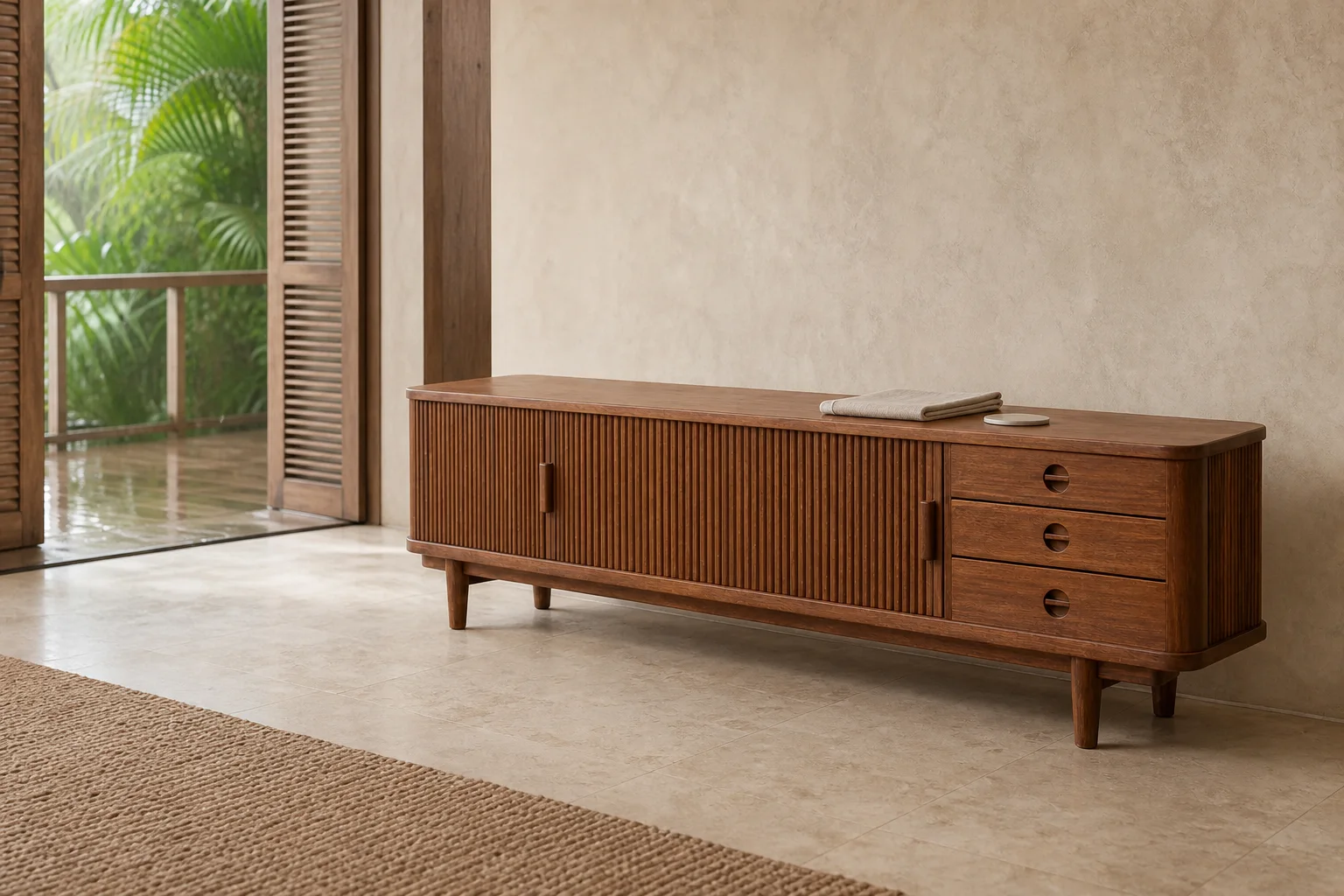
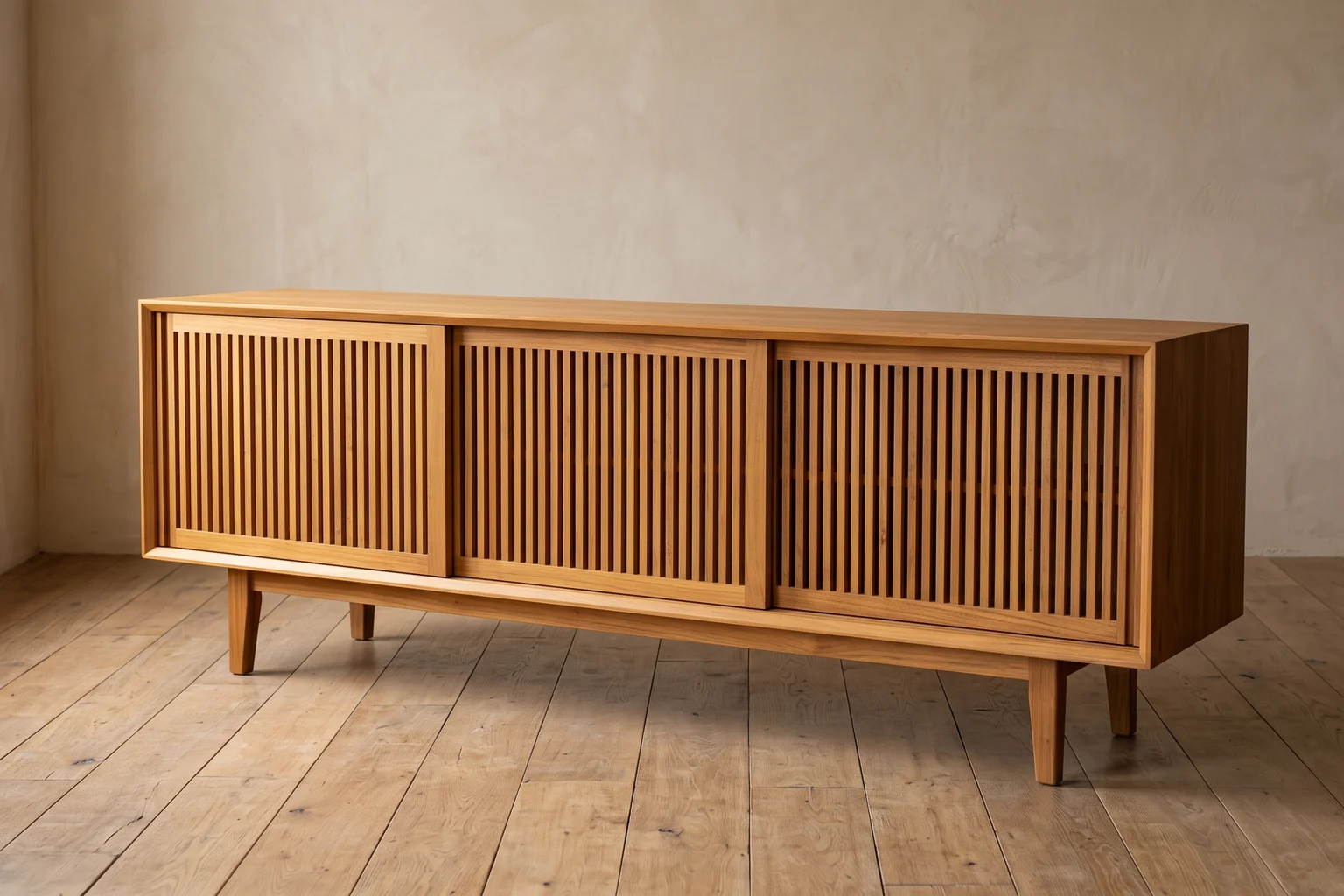
What is on the front of a media console decides how it lives day to day. Open shelves give hardware the most air and the quickest access, but they also display every cable and dust the equipment. Closed doors hide everything, which is why a wide console with sliding panels can disappear into a wall, but a fully sealed compartment is the worst place for a running amplifier or console. Slatted or louvered fronts solve both problems: they read as solid wood, they let heat escape and they usually still allow an infrared remote to reach the device behind them.
- Slatted or louvered doors for heat and remote signals
- Never seal a running amplifier or console in a closed compartment
- Decide the soundbar position before ordering
4. Solid teak construction: what to check
A wide, low piece is a load-bearing piece. The span between supports is longer than on a tall cabinet, so the top and the frame have to resist creeping downward under a panel and its equipment. Solid teak is stiff for its weight and stable across humidity swings, which is exactly why it holds a two-metre console flat in a way that a veneered board of the same thickness rarely does. Solid timber can also be sanded and refinished years later; veneer can be repaired on the face but not along its edges.
- Which parts are solid teak and which are veneered
- Long span supported at or near the middle
- Drawer runners and bottoms inspected, not assumed
- Back panel set in to stiffen the carcass
5. Cable management, ventilation and daily life
The difference between a tidy media unit and a tangle is decided in the design, not after delivery. Grommets or slots in the top or the back let cables pass without a visible snake, and an open or slatted back gives power strips somewhere to live. Plan the positions of the sockets, the router and the power supply before the unit is built, then confirm that the layout you want actually fits the depth you have chosen.
- Grommets or slots planned for the cable route
- Open or slatted back for power strips and airflow
- Socket and router positions confirmed against the depth
- Felt pads to protect floors and level the unit
6. Made-to-order sizes, finish and order details
Media walls are rarely standard, and neither are the screens and the equipment that go on them. Made-to-order work lets a console follow the exact wall length, match the height of a window sill or a neighbouring piece, and carry the drawer and door layout you will actually use. Send the wall width, the screen frame width, the equipment list with its dimensions, and the finish you prefer; a single shallow drawer, a slatted door and an open shelf are all decisions that are easier to build in than to add later.
M Furniture & Decor has been making solid teak and hardwood furniture for more than five decades, from the main showroom on Phet Kasem Road in Cha-am, Phetchaburi, with a second viewing location in Bangkok. Dimensions, timber and finish are agreed per order, and the species and source records are confirmed for the actual pieces. For export orders we quote FOB or CIF and coordinate packing, freight, customs and insurance. The fastest route is WhatsApp on +66 614 456 154.
- Wall width and screen frame width sent together
- Equipment list with real dimensions, not just names
- Drawer, door and shelf layout agreed in writing
- Finish, timber and export terms confirmed before production
Frequently asked questions
How wide should a TV console be?
About 30–50 cm wider than the television frame. A 55-inch screen is roughly 122 cm across, so a 150–170 cm console looks deliberate; scale the same rule up for 65- and 75-inch panels, and keep 5–10 cm of wall clearance at each end.
How high should a teak TV console be?
Around 45–55 cm to the top suits seated viewing because it brings the centre of the screen near eye level. If you watch standing, or the room doubles as a kitchen or bar, 60–65 cm is usually more comfortable.
Can electronics go inside a closed teak cabinet?
Only with real ventilation. Amplifiers, games consoles and streaming boxes generate heat, so choose slatted or open-back designs, leave a few centimetres of clearance and never seal a running device into a closed compartment.
Is solid teak better than teak veneer for a media console?
For a wide unit, yes. Solid teak resists sagging over a long span and can be sanded and refinished later; veneer over MDF is lighter and cheaper, but its edges cannot be repaired the same way. Ask which parts are solid.
Can a teak TV console be made in a custom size?
Yes. Custom dimensions are normal for made-to-order solid teak work — provide the wall width, the screen frame width, the equipment you need to house and the finish, and the unit is built to those numbers.
Size it from the screen, then let the design follow
A teak TV console works when the numbers are right before the drawing starts: a length 30–50 cm wider than the screen, a top low enough for seated viewing, depth that fits the equipment and space for the heat it makes. Then choose the doors, the drawers and the finish around how the room is actually used. Confirm the solid parts, the drawer hardware, the cable route and the finish in writing, and the unit becomes the piece the whole room is organised around rather than something you work around.