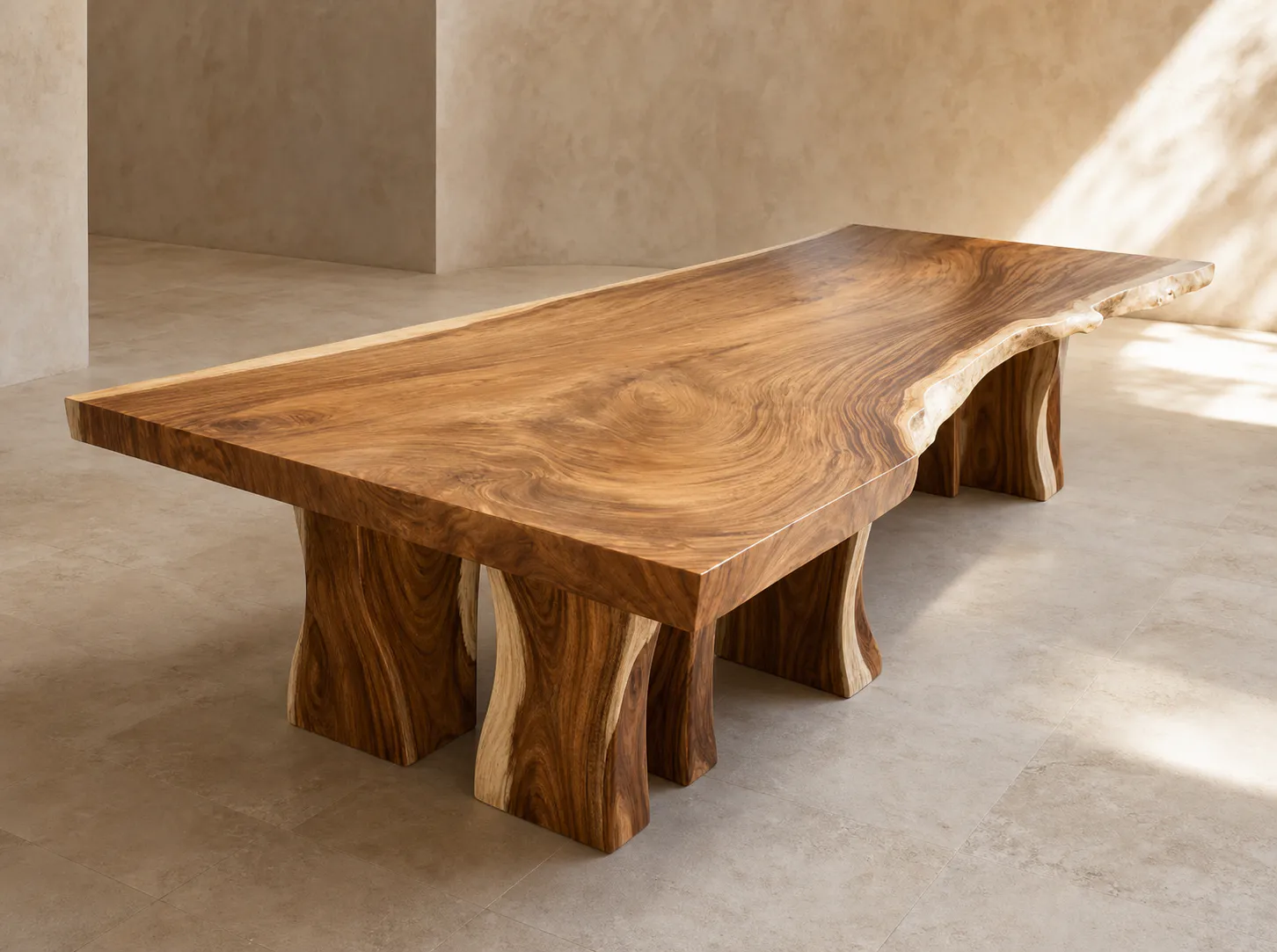
Custom-built teak furniture should accommodate normal wood movement while holding controlled tolerances for fit, alignment, stability, and finish. The practical benchmark is not a perfectly motionless object: teak
Tolerance is component-specific. A wide solid-teak tabletop, a mortise-and-tenon chair frame, and a drawer front need different allowances because grain direction, span, hardware, and humidity exposure differ.
Custom teak furniture must allow cross-grain seasonal movement rather than forcing every panel to remain fixed. Specify moisture content at fabrication, the expected interior humidity range, and where movement will occur. For wide tops and doors, concealed slots, clips, or floating panels are preferable to rigid fasteners that can cause splits, distortion, or joint stress.
Teak changes dimension primarily across, not along, the grain as its moisture content changes. For climate-controlled interiors, a project may set a target around 8–12% moisture content, but the correct number depends on the destination and acclimatisation plan. A 2–4 mm perimeter allowance can be appropriate for a floating panel or fitted insert, yet it is not a universal rule. The USDA Forest Products Laboratory Wood Handbook explains why species, grain orientation, and moisture change must be considered together. Record the reference conditions so later seasonal movement is not mistaken for defective workmanship.
Sound teak joinery should be fully seated, structurally appropriate, and free from visible open glue lines, rocking, or forced assembly. Specify measurable limits for frame squareness, tabletop flatness, drawer operation, and hardware alignment. Tighter numbers are not automatically better when they prevent solid wood from moving or conceal unstable material selection.
Use tolerances that relate to function. A dining table should sit without rocking on a verified level reference surface; a cabinet door should open without binding; and a drawer should travel smoothly without excessive side play. For precision-machined non-moving frame components, a 0.5–1 mm alignment tolerance is often a practical discussion point, subject to scale and hardware. Mortise-and-tenon shoulders should close cleanly, while breadboard ends, tabletop buttons, and slotted holes must preserve movement. The Architectural Woodwork Institute standards are a useful vocabulary reference, although furniture-specific acceptance criteria should remain in the purchase specification.
Specify visible gaps and moving parts by location, viewing condition, and operating function. Door reveals and drawer fronts should look consistent at the agreed reference humidity, while hinges, runners, pulls, and catches must operate without rubbing or looseness. Leave concealed clearance for expansion where grain direction or adjacent materials demand it.
Separate aesthetic reveals from expansion gaps. A consistent reveal around adjacent drawer fronts can be defined with a nominal dimension and a permitted variation, whereas a solid-wood panel needs concealed room to move. State whether measurements are taken before packing, after acclimatisation, or after installation. Hardware introduces its own tolerance stack: hinge cups, slide mounting, carcass squareness, and door weight all affect operation. Specify the hardware brand or performance grade where relevant, particularly for hospitality furniture with repeated use. Confirm that stone, metal, glass, or upholstery interfaces do not restrain teak across the grain; different materials react differently to temperature and humidity.
A teak furniture tolerance schedule should identify each component, its reference dimensions, moisture condition, permitted variation, measuring method, and remedy. It should also distinguish natural grain and colour variation from manufacturing defects. This document aligns the client, designer, maker, and installer before production, pre-shipment inspection, and final site acceptance.
Build the schedule from drawings rather than relying on a general promise of quality. Include overall dimensions, diagonal or squareness checks, level-surface stability, visible reveals, finish expectations, and packing or installation constraints. Define the inspection tools: calibrated moisture meter, straightedge, feeler gauge, tape, and level reference surface. Photograph approved finish samples because teak colour can mature after exposure to light. For commercial projects, identify who approves deviations and whether repair, remake, credit, or site adjustment applies. This approach follows the measurable acceptance mindset used in American Wood Council guidance, while keeping the project focused on furniture performance rather than structural design values.
There is no single moisture-content number that suits every destination. For many conditioned interiors, a documented target around 8–12% is commonly used, but the project should match fabrication moisture to expected service humidity. Measure representative components with an appropriate meter, allow acclimatisation, and record when and where the reading was taken.
Some gaps are necessary and acceptable when they intentionally allow teak to expand and contract, especially around floating panels, tabletop fasteners, and mixed-material interfaces. Random open glue lines, inconsistent drawer reveals, or gaps caused by poor joinery are different. The specification should identify each gap’s purpose, nominal size, variation, and inspection condition.
A teak tabletop should be judged on a stable reference surface, its overall span, grain construction, and intended use. Specify a measurable flatness limit instead of demanding absolute flatness, which solid wood cannot maintain through every humidity change. Also confirm that the base, floor level, and installation method are not causing apparent distortion.
Measure and document drawer and door operation before shipping, then inspect again after destination acclimatisation and installation where practical. Transport, site humidity, carcass level, and hardware adjustment can affect reveals and operation. The contract should state which stage controls final acceptance and who is responsible for permitted site adjustments.
This resource provides general specification guidance, not engineering, legal, or conservation advice. Final tolerances should be agreed in project drawings, samples, contracts, destination-climate requirements, and applicable local standards.