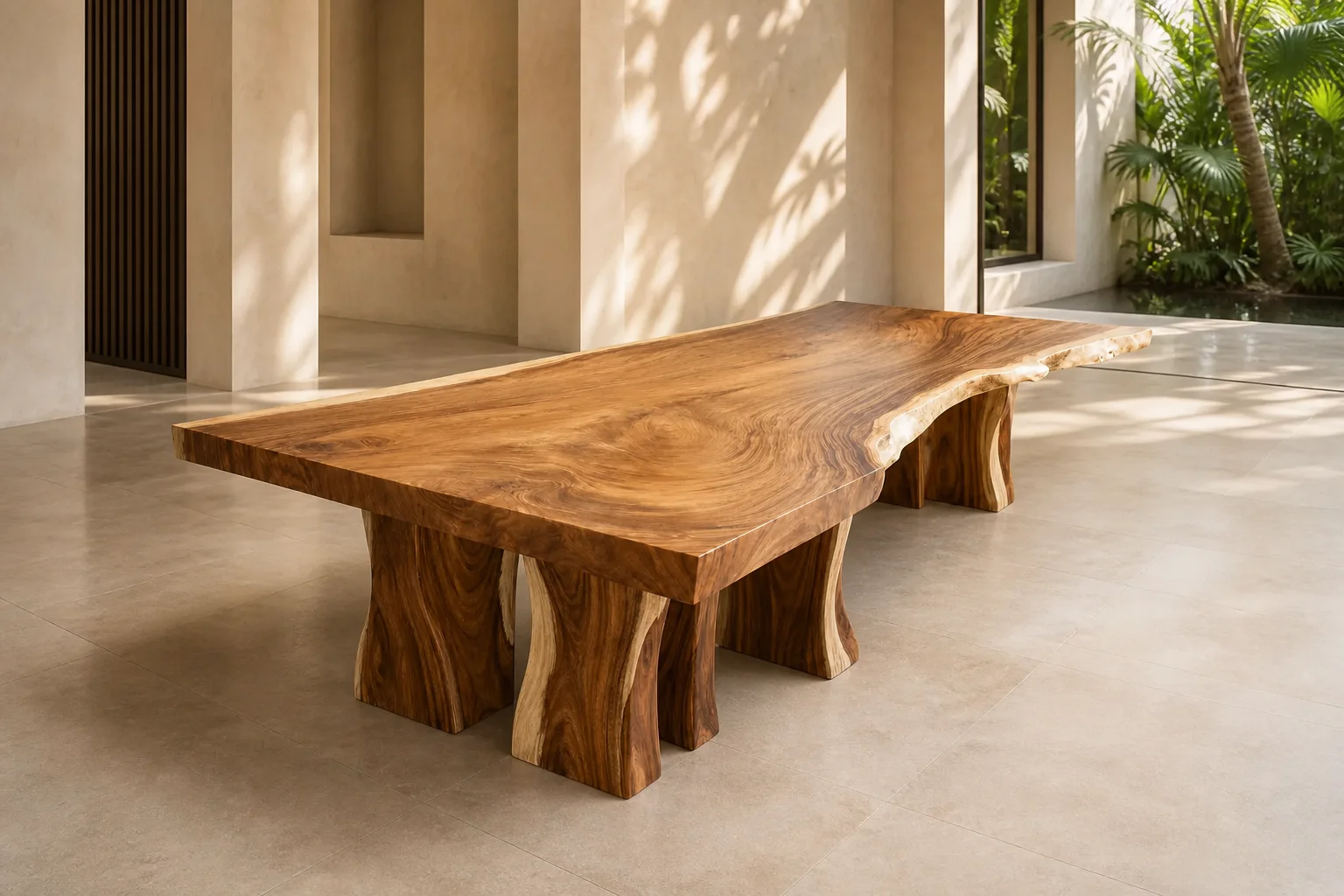
A **25–30 mm solid teak tabletop** is the suitable choice for most residential dining tables because it balances stiffness, durability, timber yield, and a convincing solid-wood profile. Thickness
Teak is stable relative to many timbers, but it is still wood: a tabletop must be allowed to expand and contract across its width rather than being rigidly fixed to its base.
For a solid teak dining tabletop, 25–30 mm is the practical default. Choose 30–40 mm when the table is large, has long clear spans, receives hard commercial use, or must look visibly substantial. A 20 mm top is reserved for small, well-supported pieces rather than general-purpose dining tables.
At **25 mm**, a teak top can be refined without appearing flimsy when an apron, rails, or a closely supporting base reduce its unsupported span. A **30 mm** top is a versatile specification for many six- to eight-seat dining tables and gives more allowance for edge profiling or future refinishing. Select **40 mm** when visual mass is a central design requirement or the base leaves broad areas unsupported. The USDA Wood Handbook explains why wood design decisions must consider species properties, moisture, and structural configuration together.
Use 20 mm teak for compact, continuously supported furniture; use 25–30 mm for most dining tables and desks; and use 30–40 mm for large tops, statement pieces, or demanding hospitality settings. Base geometry and clear span can justify a thicker top even when table length alone does not.
A **20 mm** solid teak panel can work for a side table, coffee table, bedside table, or desk with frequent support below the top. For a dining table, **25–30 mm** is usually more forgiving of everyday loading and creates a stronger edge proportion. Consider **30–40 mm** for communal tables, conference tables, island-style bases, and hotel dining applications. The American Wood Council emphasizes that wood-member performance depends on span, loading, connections, and support conditions; tabletop thickness is therefore not a stand-alone structural rating.
Support and movement control matter because even a thick solid teak tabletop can cup, split, or distort if it is poorly dried or fixed so it cannot move seasonally. Use an appropriate underframe, permit cross-grain movement, and evaluate the longest unsupported area before increasing thickness alone.
Solid teak changes dimension primarily across the grain as its moisture content responds to its surroundings. A maker should acclimate stock, arrange boards thoughtfully, and use attachment methods such as elongated slots, figure-eight fasteners, or suitable tabletop clips where required. Fixing a wide top rigidly across its width can create stress regardless of whether it is 25 mm or 40 mm thick. The USDA Forest Products Laboratory's guidance on moisture and dimensional change is a useful reference for this basic wood-science principle.
Yes, 25 mm is commonly adequate for a solid teak dining tabletop when the base supports it appropriately and the span is modest. It is not a universal span rating: apron design, rail placement, tabletop width, leg positions, expected loads, and seasonal movement provisions determine whether 25 mm performs reliably.
A 20 mm teak top can work on a small side table, coffee table, or tightly supported desk. It needs a stable underframe, sensible spans, and fastening that permits wood movement. For dining tables, a thicker 25–30 mm top generally provides greater stiffness, durability, and visual weight.
Not necessarily. A thick top can still cup, split, or distort if boards are poorly dried, restrained across their width, or exposed to abrupt humidity changes. Correct moisture conditioning, grain selection, joinery, finishing, and elongated attachment slots matter alongside thickness, especially in air-conditioned or coastal settings.
Thickness recommendations are general furniture-specification guidance. For unusually long spans, cantilevered designs, stone inserts, or high-load commercial installations, confirm the final construction with the furniture maker or a qualified structural professional.