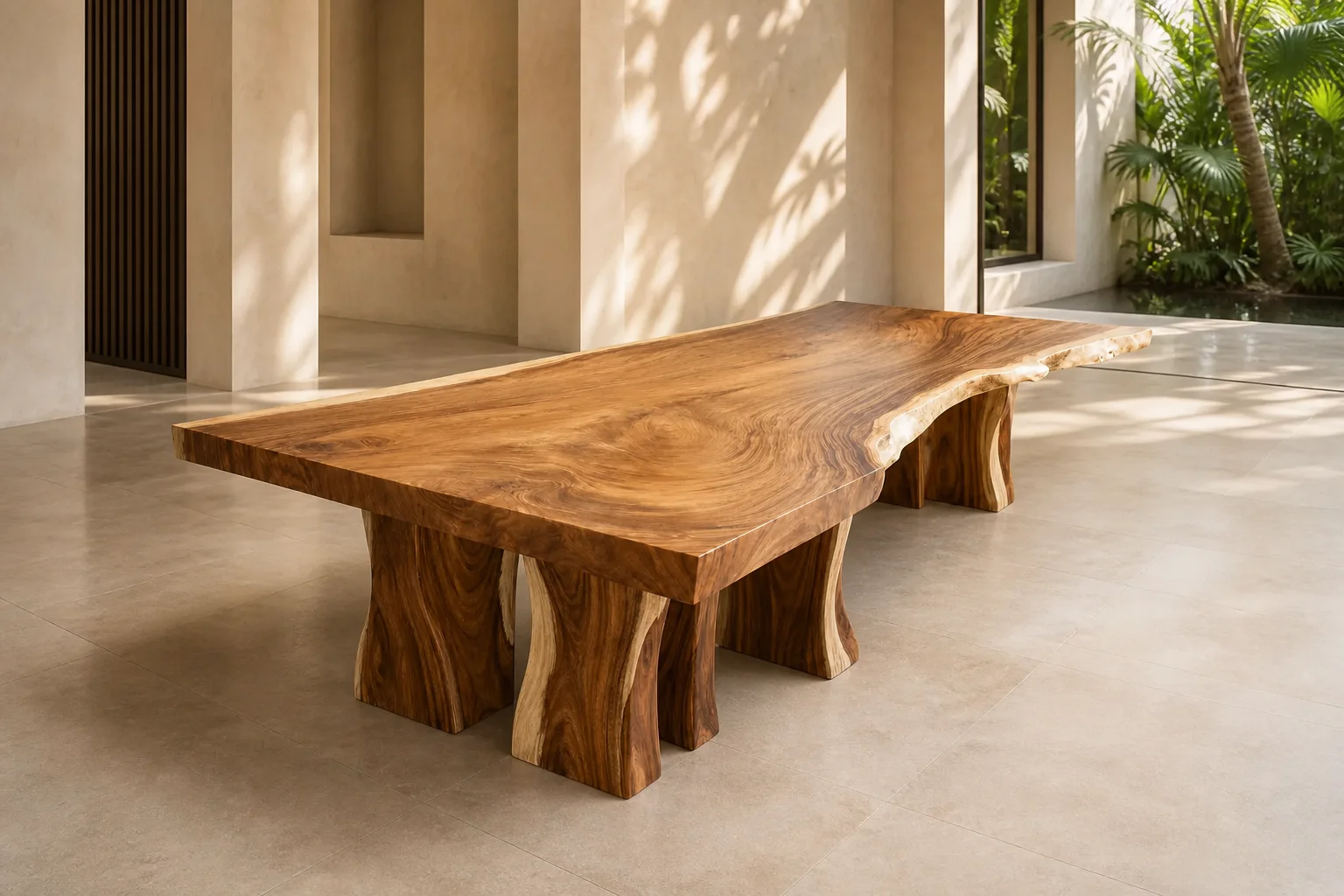
Teak wood movement allowances are built into tables by fastening a solid top firmly in the vertical direction while leaving it free to slide across the grain. Makers
A table top does not need to be loose. It needs a defined movement path so normal humidity changes do not force stress into the top, apron, or leg joints.
Solid teak changes dimension mainly across, rather than along, the grain as its moisture content adjusts to surrounding relative humidity. A table therefore needs a fixed reference point and flexible attachments elsewhere. The goal is not to stop movement, but to let the top move without splitting, bowing, or levering the apron apart.
At M Furniture & Decor, this principle affects the relationship between a solid teak top and its apron base. The USDA Wood Handbook explains that wood shrinkage and swelling are directional properties, while the USDA Forest Products Laboratory treats moisture content as a practical design condition. Lengthwise change is comparatively small; cross-grain change is the detail that joinery must accommodate. A veneered or plywood top behaves differently because its layered construction restrains movement.
Most solid-wood tables use mechanical connections that grip the top vertically but slide sideways. Common examples are figure-eight fasteners, Z-clips in a groove, screws through elongated apron holes, and sliding battens. Each method creates controlled travel across the grain while the aprons, legs, and joinery remain structurally stable.
Figure-eight fasteners rotate at their waist; one leaf is screwed to the apron and the other to the underside of the top. Z-clips hook into a kerf in the apron, while slotted holes let a screw shank shift as the panel changes width. The USDA Wood Handbook provides the underlying dimensional-stability context. Hardware is spaced across the base, but the maker avoids a continuous bead of glue between the base and top.
Movement allowance is calculated from the top’s cross-grain width, expected moisture-content change, grain orientation, and the climate where the table will live. Wider flatsawn panels usually need more travel than narrow or quartersawn components. A maker acclimates stock, chooses attachment travel, and preserves an expansion gap at restrained interfaces.
Allowance is not a fixed 2 mm or 10 mm recipe. A 1,000 mm-wide top, for example, needs an assessment of species behavior and its expected seasonal moisture range, not a copied clearance from a narrower table. Teak’s natural oils influence finishing and adhesion, but they do not eliminate hygroscopic movement. USDA moisture guidance supports conditioning wood to its service environment. Record grain direction before routing slots, then keep the slot’s long axis across that grain.
Construction succeeds when the finish, base design, and installation all respect the same movement path. Finish every face of the teak top, keep fasteners serviceable, and avoid rigidly trapping the panel with cross-grain trim. Seasonal inspection should confirm that slots remain free, screws are snug, and no joint is carrying movement stress.
Seal the underside, edges, and top face with a compatible finish to make moisture exchange more even, not to make the timber dimensionally inert. During assembly, confirm that a washer can slide in each slot and that a breadboard end or cross-grain trim has its own movement strategy. The American Wood Council provides wood-design references useful for broader moisture considerations. After delivery, maintain indoor humidity as consistently as practical and retighten only loose hardware.
Usually, no. Gluing a wide solid teak top directly to an apron locks cross-grain movement and can cause cracks or distorted joinery. Glue is appropriate within a panel when boards are arranged with compatible grain movement. Connect the completed top to its base with sliding hardware, slots, or cleats instead.
When using screws through an apron, orient an elongated hole perpendicular to the tabletop grain, because that is the direction the top changes width. Use a washer when appropriate and avoid overtightening. A center attachment may locate the top; attachments toward each end need room to travel in their slots.
Acclimate teak parts in conditions close to the table’s intended environment before final machining and assembly. Measure moisture content with a suitable meter, allow time after shipment or kiln drying, and recheck wide boards. The exact target varies by destination, so local equilibrium-moisture guidance is more useful than one universal percentage.
This educational resource is published by M Furniture & Decor. Wood movement requirements vary with design, material dimensions, moisture content, and installation climate; consult a qualified furniture maker for project-specific construction decisions.