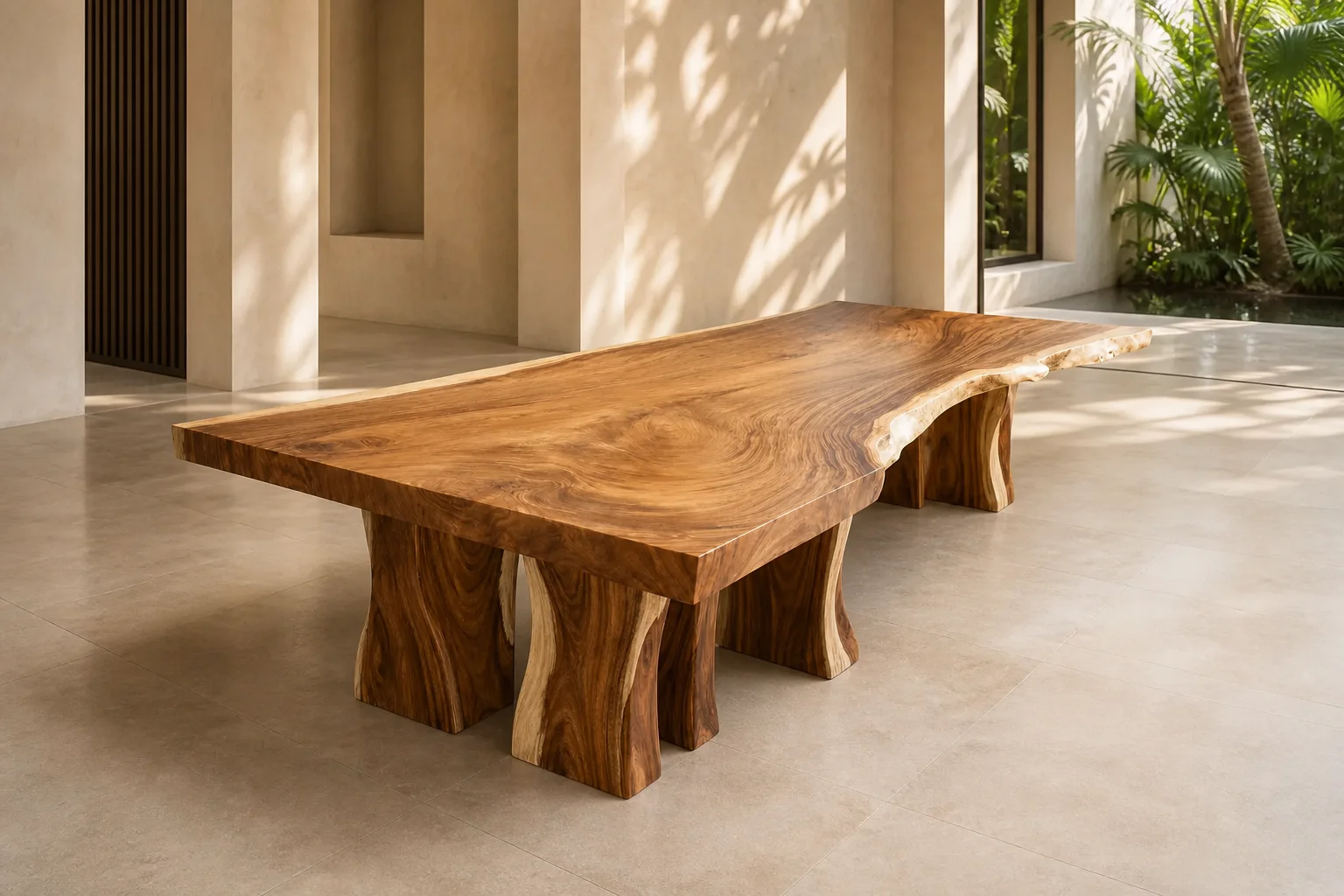
Large teak tops are stabilized when the base resists tipping and side-to-side racking while the top remains free to move across its grain. A sound design combines a
{'type': 'image', 'src': 'https://mfurniturethailand.com/images/resources/teak-table-base-large-top.jpg', 'alt': 'M Furniture teak table base supporting a large solid teak dining top', 'caption': 'A wide stance, rigid frame, and movement-aware top attachment help stabilize a large teak table.'}
Large teak tops stay steady when a base provides a footprint wide enough for expected edge loading, a low center of gravity, rigid connections between legs and aprons, and reliable contact with the floor. Stability comes from this system, not from simply making one component thicker or heavier.
On a rectangular table, legs and aprons create a box that resists sideways distortion; lower stretchers and corner blocks can further shorten unsupported spans. The relevant test is not a universal overhang percentage, but whether foreseeable edge force keeps the combined center of gravity within the supports. The USDA Forest Products Laboratory Wood Handbook explains that moisture affects wood properties. For heavy hospitality use, makers should test the assembled table on its intended flooring, including lateral pushes and edge loading.
Teak base joinery controls racking by transferring sideways forces through mortise-and-tenon shoulders, corner blocks, aprons, and stretchers rather than screws alone. The top requires controlled freedom: clips, figure-eight connectors, or screws in elongated slots secure it vertically while allowing seasonal cross-grain movement.
Mortise-and-tenon construction gives a teak frame mechanical shoulders that resist twisting before glue is considered. Screws, bolts, threaded inserts, and steel brackets can supplement this construction, particularly in demountable tables, but hardware should be sized for its load path. The American Wood Council provides wood-design references useful for understanding member behavior. At the top, slotted cleats or tabletop clips let *Tectona grandis* change width as humidity changes, avoiding stress concentrated in the apron or a fixed cross-grain joint.
Appropriate proportions depend on finished-top dimensions, thickness, weight, base mass, seating clearance, and foreseeable edge loads. Rectangular tables commonly gain stiffness from four aprons and stretchers; round tables may use four legs, a cross base, or a broad pedestal spider. Levelers correct floors but never replace structural sizing.
A large rectangular top usually benefits from supports placed near major load paths, with aprons on all four sides and stretchers where the visual design permits. Round tops need special attention because users can apply edge force from any direction; a narrow single post is often less stable than a broad spider or cross base. Adjustable nylon or metal glides remove small floor irregularities after installation. ASTM International offers test-standard resources that can inform a project-specific acceptance plan for unusually heavy, stone-inset, or commercial tables.
A base may be too narrow if a person leaning or placing weight near the edge produces lift, sliding, or visible deflection at an opposite support. Assess the finished assembly, not tabletop width alone: top mass, base mass, overhang, floor friction, and intended use all change the safe footprint.
Mortise-and-tenon joinery is often suitable for permanent teak frames because tenon shoulders resist racking and long-grain glue surfaces spread loads. Bolts, threaded inserts, or steel brackets can be appropriate for demountable designs. The choice should match member dimensions, expected loads, service access, and whether joints are glued or designed to be retightened.
Yes. Solid teak changes dimension chiefly across its grain as moisture content changes. Use tabletop clips, figure-eight connectors, or screws through elongated slots so the top stays located while it moves. Avoid a continuous cross-grain glue joint or fixed screws in every hole, which can split the top or distort the frame.
Adjustable glides remove minor rocking caused by uneven floors and help distribute load among supports after installation. They do not widen the support polygon, strengthen joinery, or prevent a table from tipping under an excessive edge load. Select a load-appropriate glide, lock or protect its adjustment where needed, and inspect it periodically.
This guide provides general furniture-construction information. Large, unusually heavy, stone-inset, or high-traffic commercial table designs may require review by a qualified furniture engineer or fabricator.