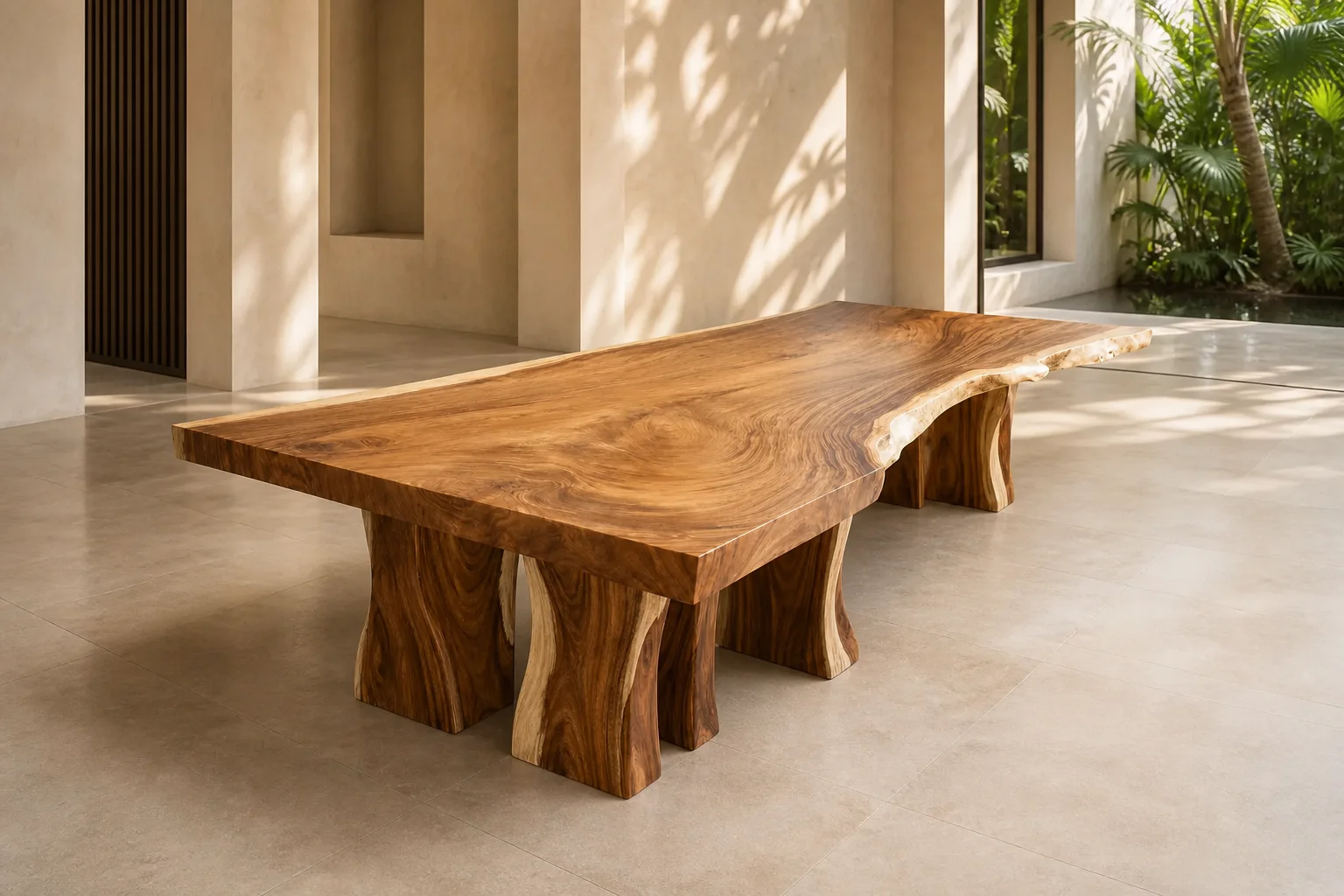
Teak is generally more stable than mango wood furniture through changing humidity, but the species name alone does not guarantee performance. Proper drying, grain orientation, joinery, and the
For any substantial solid-wood piece, request the final moisture-content specification and details of how wide panels are allowed to expand and contract.
Teak is usually the safer choice for dimensional stability because its shrinkage characteristics and proven service performance favor repeated humidity changes. That advantage is not absolute: species variation, board orientation, moisture content at manufacture, and construction details can outweigh a wood label, especially for indoor mango furniture.
The U.S. Forest Products Laboratory’s Wood Handbook lists teak at about 2.6% radial and 5.8% tangential shrinkage from green to oven-dry condition. Those values support teak’s reputation for movement control, but they do not forecast one finished table. Mango sold for furniture may represent several *Mangifera* sources, with properties influenced by growth, sawing, drying, and grading. Teak is *Tectona grandis*; confirm the actual species and material specification.
Furniture stability depends as much on moisture management and engineering as on teak or mango. A well-kiln-dried mango cabinet with sound joinery can remain stable indoors, while poorly dried teak can check, warp, or open joints after delivery into a different humidity environment.
Specify final moisture content rather than accepting “kiln dried” as a complete answer. For many climate-controlled interiors, 8–12% is a common purchasing range, yet the appropriate target follows the destination’s equilibrium moisture content. The USDA Wood Handbook explains that wood changes dimension primarily across, not along, grain. Wide mango or teak tops therefore need slotted fasteners, clearance, and acclimatization before installation. Quarter-sawn boards can reduce visible width movement relative to flat-sawn boards.
For buyers, teak is the prudent stability choice where moisture swings or semi-outdoor use are expected; mango is a valid indoor option when the build is well controlled. Compare documented moisture content, grain orientation, panel attachment, and acclimatization plan before treating either species as inherently trouble-free.
Choose teak where furniture will face variable humidity, covered outdoor exposure, or long service expectations and budget permits. Choose mango for a stable indoor setting when a maker documents drying and allows movement in the design. Inspect panel gaps, tabletop attachment, end-grain treatment, and finish coverage; these reveal more than color alone. The USDA Forest Products Laboratory provides the underlying wood-science context for these checks. Ask for care guidance matched to Bangkok, coastal, or heated indoor conditions.
Not automatically. Mango wood can be dependable for indoor furniture when it is correctly kiln dried, acclimatized, and joined to allow seasonal expansion. Teak generally offers a wider margin of tolerance for humidity variation, but a specific maker’s lumber selection and construction quality matter more than a generic species claim.
Teak’s natural durability and lower movement make it more forgiving for covered outdoor furniture, but no solid wood is maintenance-free outdoors. Standing water, ultraviolet exposure, end-grain sealing, hardware, and drainage affect results. For exposed installations, confirm the finish schedule and design details with the manufacturer rather than relying on species alone.
Request the species name, kiln-drying method, final moisture-content range, board orientation, and warranty terms. For a large table, also ask how the top is attached to its base so it can move across the grain. These details provide a more useful stability forecast than appearance or price alone.
This educational resource is published by M Furniture & Decor, a teak furniture maker. Material recommendations should be evaluated against the specific product specification, installation environment, and maintenance plan.