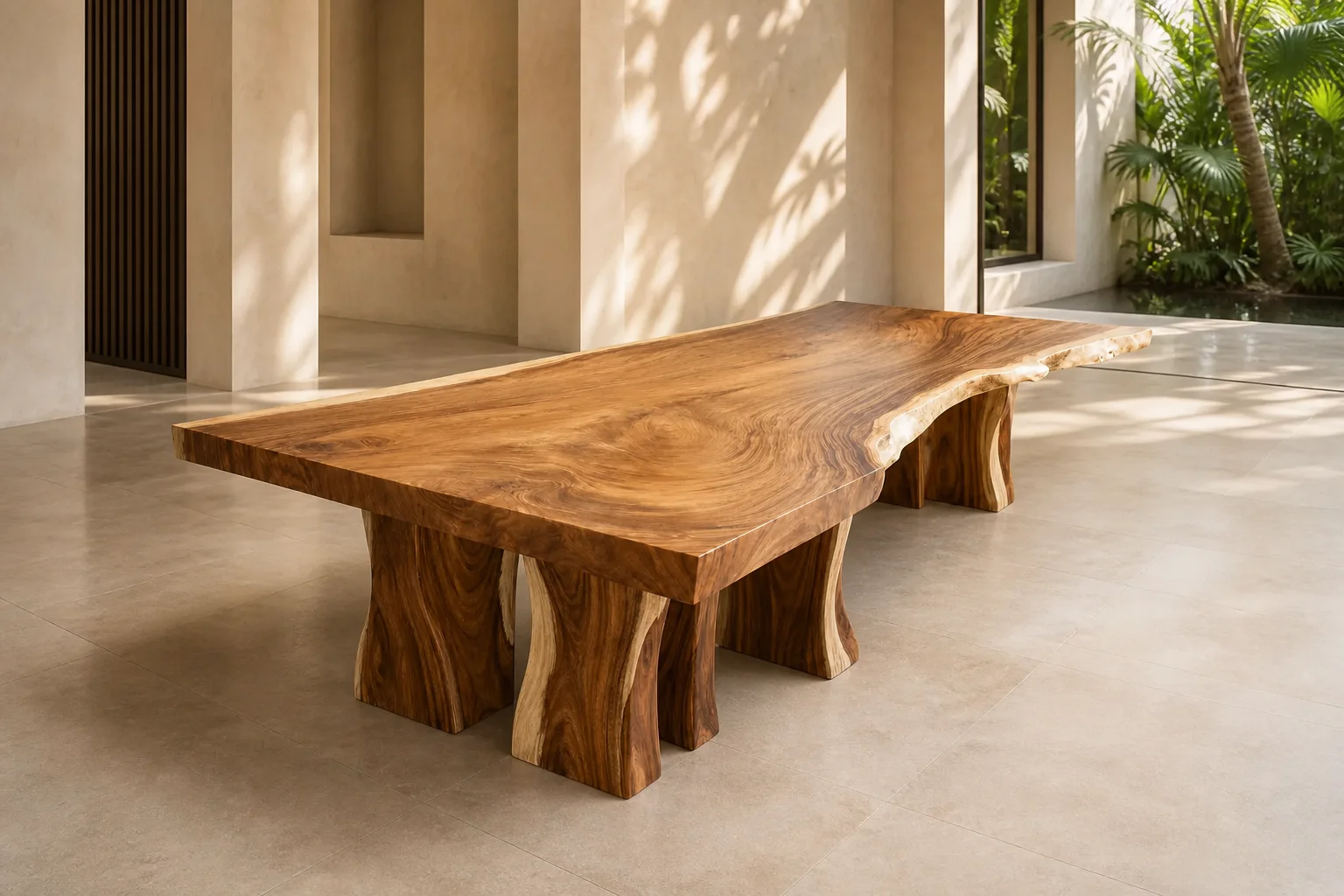
A teak dining set is a coordinated table-and-chair group made from teak, commonly *Tectona grandis*, selected for its strength, dimensional stability, and naturally durable heartwood. It can serve
Ask the seller whether table tops, legs, chair frames, and visible rails are solid teak, and request documentation for the timber’s legal and responsible origin.
A teak dining set normally includes one dining table and a matched number of chairs, usually four, six, or eight. Quality is defined less by matching colour than by solid timber components, stable joinery, comfortable proportions, and a table size suited to the room or terrace where people will use it.
Start with the table: a solid-teak top, substantial legs, and aprons or stretchers should resist racking when pushed from the side. Chairs need supportive back rails, secure seat frames, and feet that sit evenly on the floor. The USDA Forest Products Laboratory Wood Handbook explains why wood movement follows moisture changes; allowance at wide tops is therefore a construction detail worth asking about.
Assess a teak dining set by confirming the species, inspecting grain and joinery, and requesting traceable sourcing information. Solid teak does not mean flawless colour; natural variation is normal. More meaningful signals are sound construction, appropriately dried timber, repairable parts, and credible documents describing the wood’s origin and custody.
Ask whether the maker identifies the timber as *Tectona grandis* and whether the piece uses solid wood, veneer, finger-jointed panels, or a combination. Inspect under the tabletop and beneath chair seats, where materials and fasteners are easier to see. Responsible-origin claims should be supported by invoices or chain-of-custody information; Forest Stewardship Council certification can be one useful verification route when applicable. Avoid treating a dark stain as proof of teak species or age.
Choose a teak dining set from usable room dimensions, not only the number of seats advertised. Measure the tabletop, chair depth, and walking clearance together. A four-seat layout suits compact spaces, while six- and eight-seat sets require wider circulation zones and should be tested with chairs pulled out before purchase.
A rectangular table about 150 cm long commonly seats six in a compact arrangement, while a 180 cm table generally gives diners more elbow room; chair width changes the result. Mark the proposed footprint on the floor with tape, including chairs pulled back. For terraces, account for columns, planters, doors, and drainage. A round table can improve circulation in a square space, whereas an extension table gives occasional capacity without permanently consuming floor area.
{'type': 'table', 'caption': 'Planning allowances for common dining layouts', 'headers': ['Layout', 'Typical tabletop size', 'Clearance target'], 'rows': [['Four seats', '120–140 cm rectangular', '90 cm around chairs'], ['Six seats', '150–180 cm rectangular', '90 cm around chairs'], ['Eight seats', '200–240 cm rectangular', '90–110 cm around chairs']]}
Care for a teak dining set by removing spills promptly, washing gently with mild soap and water, and avoiding harsh pressure, bleach, or abrasive pads. Indoor pieces mainly need dust control and stable humidity. Outdoor pieces may weather to silver-grey; oil or sealer is an appearance decision, not a substitute for regular cleaning.
Use coasters, placemats, and breathable covers where practical, especially with hot dishes and standing water. For outdoor furniture, clean pollen and food residue before they become embedded, then let the wood dry fully. Teak can develop a grey patina under ultraviolet exposure without losing its basic function. Products from manufacturers such as Osmo or Rubio Monocoat should be tested on an inconspicuous area and applied only according to their instructions, because finishes affect colour and future maintenance.
Teak is well suited to outdoor dining furniture because its heartwood has natural durability and it tolerates weather changes better than many timbers. Outdoor suitability still depends on sound joinery, drainage, a level location, regular cleaning, and avoiding trapped moisture. Expect sun exposure to gradually change unfinished teak to a silver-grey colour.
Ask for a written species and materials specification, then inspect undersides, edges, and chair frames. Solid teak should show continuous wood through components rather than a thin surface layer over another core. Grain variation alone cannot verify species. Confirm whether panels are solid, veneered, or engineered, and request sourcing documentation from the seller.
Oil is optional and primarily changes colour, usually deepening teak’s golden-brown appearance. It does not eliminate the need to clean spills, keep surfaces dry, or protect a table from physical damage. For outdoor tables, decide whether you prefer a maintained brown tone or natural silver-grey weathering, then follow the finish manufacturer’s instructions consistently.
Choose the shape from circulation and seating needs. Rectangular teak tables use long rooms efficiently and can accommodate extension leaves. Round tables simplify conversation and suit square spaces, but require more central floor area. Before ordering, tape out the table plus fully pulled-back chairs and maintain about 90 cm of clearance around the layout.
M Furniture & Decor manufactures teak furniture. This guide is educational and recommends that buyers verify materials, dimensions, finishes, and sourcing documentation for any supplier before purchasing.