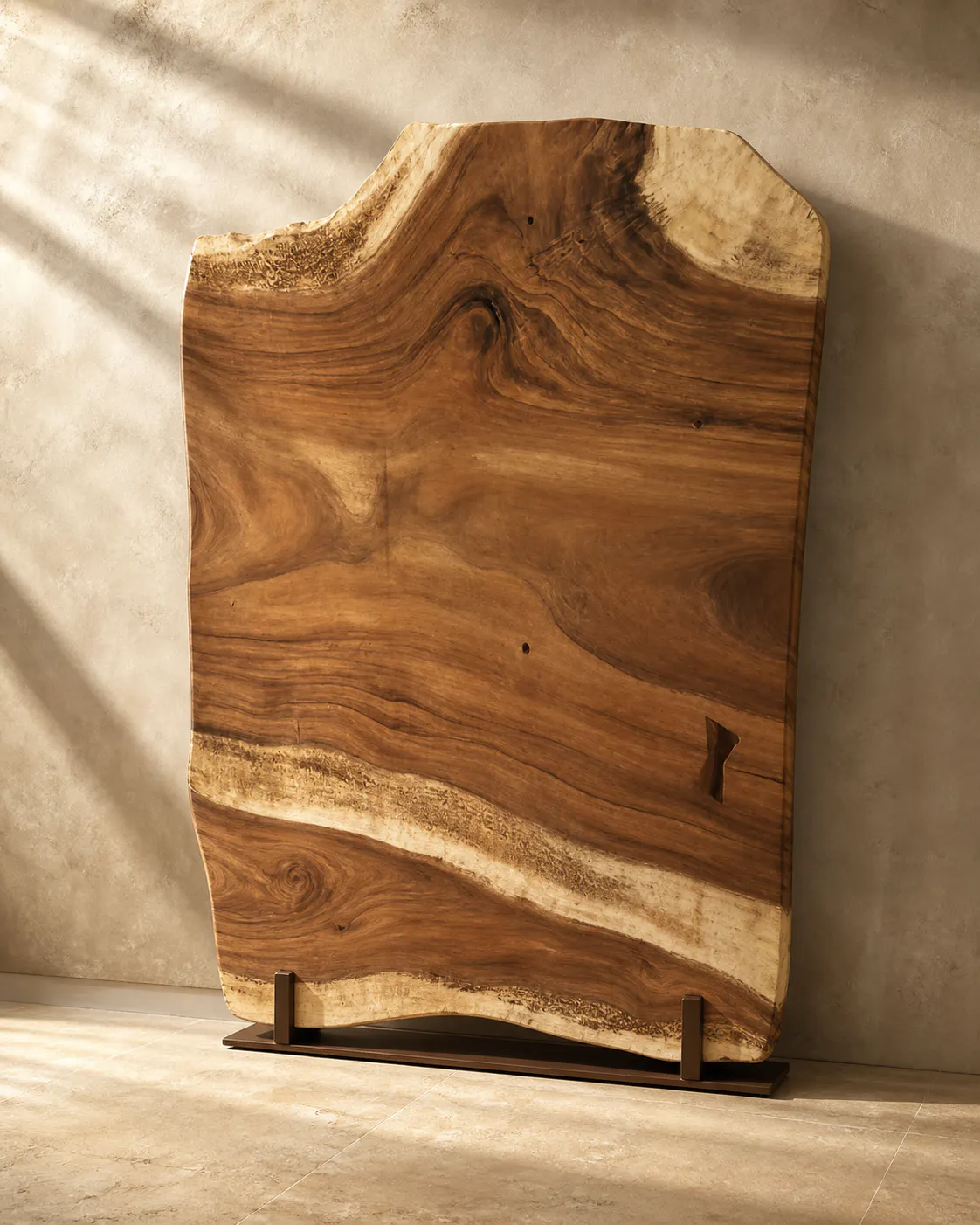
A teak cutting board is a solid-wood food-prep surface made from *Tectona grandis*, valued for its dense grain, natural oils, and warm golden-to-brown appearance. It is a practical
{'type': 'image', 'src': 'https://mfurniturethailand.com/images/resources/teak-cutting-board.jpg', 'alt': 'Teak cutting board shown in a clean kitchen preparation setting', 'caption': 'A teak cutting board should be hand-washed, dried upright, and periodically conditioned.'}
Teak can work as a cutting board because *Tectona grandis* is a dense hardwood with natural oils and good dimensional stability. Those traits help it tolerate routine kitchen moisture, but they do not make a board self-sanitizing or dishwasher-safe. Use it for ordinary prep, clean it thoroughly, and avoid prolonged soaking.
Wood properties matter, but kitchen hygiene depends on handling. Teak's oily extractives can slow water uptake relative to many woods; they are not a substitute for washing after each task. The USDA Food Safety and Inspection Service advises keeping cutting boards clean and replacing them when they become excessively worn. Use separate surfaces for raw proteins and ready-to-eat foods when practical. The USDA Forest Products Laboratory Wood Handbook also documents how wood species and grain structure influence moisture movement and stability.
Clean a teak cutting board by hand with warm, soapy water, rinse it briefly, and dry it immediately. Condition dry-looking wood with food-grade mineral oil or a board-specific oil-and-wax blend. Never soak teak, leave it flat while wet, or use a dishwasher, because moisture and heat can distort wood and glue joints.
After preparing food, scrub both faces, edges, and any handhold so one side does not remain wetter than the other. Towel-dry, then stand the board on edge for airflow. When water no longer beads on the surface, apply a thin coat of food-grade mineral oil, allow roughly 15 to 30 minutes for absorption, and wipe away excess. Avoid cooking oils, which can become rancid. The FDA's safe food handling guidance supports prompt cleaning and separation practices, especially after raw meat, poultry, seafood, or eggs.
Choose a teak cutting board with a flat surface, smooth edges, tight glue joints, and enough thickness to resist movement in normal use. Edge-grain and end-grain boards are common constructions. Ask for species, wood origin, adhesive details, and traceable sourcing rather than assuming teak alone establishes quality or food-contact suitability.
Inspect the board in good light for open seams, deep sanding scratches, finish odor, or pronounced rocking on a level counter. A two-sided board can distribute wear, while feet may improve airflow but limit usable faces. Look for documented sourcing and a supplier able to identify the timber as *Tectona grandis*. FSC chain-of-custody certification can support traceability claims, although it does not by itself certify a product for food contact. Confirm that any adhesive and finish are specified for the intended kitchen use.
No, a teak cutting board should not go in a dishwasher. Heat, long water exposure, and aggressive detergent can stress wood, soften or damage glue joints, and promote warping or checking. Wash it by hand with warm, soapy water, rinse briefly, towel-dry, then stand it on edge so both faces dry evenly.
Food-grade mineral oil is a common conditioner for teak cutting boards because it is stable and does not readily turn rancid. Apply a thin coat to clean, fully dry wood, let it absorb for about 15 to 30 minutes, and wipe off residue. Board oil-and-wax blends may also work when their food-contact instructions are clear.
Yes, teak can be used for raw meat when it is washed thoroughly immediately afterward and kept in sound condition. Do not rely on wood species as a sanitation claim. Use a separate board for ready-to-eat foods when possible, clean grooves carefully, and replace boards that have deep cuts, splits, or loose joints.
A well-finished teak board is generally gentler on knife edges than glass, stone, or ceramic surfaces. However, teak can contain silica, and a rough, dry, or heavily worn board may feel less forgiving than a smoother wood board. Keep the surface conditioned, avoid chopping through bone, and use appropriate knife-sharpening practices.
This resource is published by M Furniture & Decor, a Thai teak furniture maker. It provides general material-care information and does not replace food-safety guidance from local authorities or product-specific instructions from a board manufacturer.