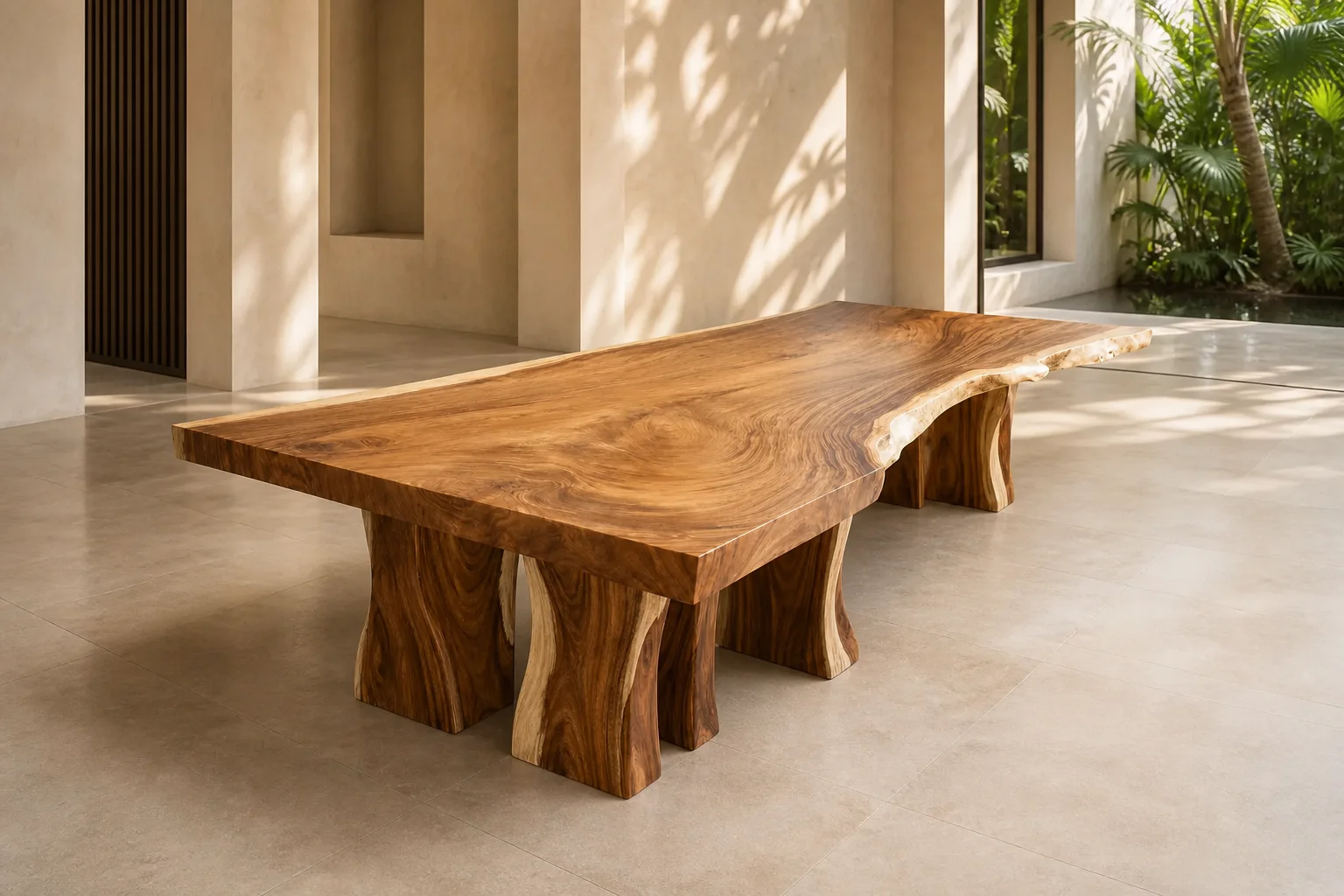
Teak is usually the stronger fit for humid or semi-covered dining settings, while oak is often the harder and more cost-conscious choice for a protected indoor table. Both
For dining furniture, assess wood species alongside moisture conditioning, tabletop construction, finish coverage, and verified sourcing.
Teak and oak can both make durable dining furniture, but they solve different conditions. Teak's oily, dense heartwood better tolerates humidity and spills; oak is typically harder and often more economical. Compare the precise species, construction, finish, and room exposure, because “oak” and “teak” describe variable materials rather than uniform performance grades.
Teak usually means *Tectona grandis*, while dining oak may be white oak (*Quercus alba*), red oak (*Quercus rubra*), or another oak. That distinction changes pore structure, color, and working behavior. The USDA Wood Handbook treats properties by species, not trade label. Teak’s golden to medium-brown heartwood and oak’s open, visible grain create markedly different table personalities before any finish is applied. Their species-specific differences should guide expectations for a finished dining table.

White and red oak commonly rate harder on Janka tests than plantation-grown teak, which can help against dents from daily use. Yet dining-table longevity also depends on joinery, tabletop thickness, humidity control, and finish maintenance. Hardness is not a complete proxy for stability, moisture tolerance, or resistance to movement at joints.
In standard published reference data, teak is about 1,000 lbf on the Janka scale, versus roughly 1,290 lbf for red oak and 1,360 lbf for white oak. Those figures help compare dent resistance, not guaranteed table quality. The Forest Products Laboratory explains that wood properties vary with moisture content, density, and material selection. A thick, well-supported top and properly fitted leaf hardware often outlast a harder wood used in weak construction.
For a dining table near open windows, kitchens, or tropical air, teak's extractives and natural oils provide a meaningful maintenance advantage. Oak performs well indoors when sealed on every face and protected from standing water. Neither wood is maintenance-free: promptly wipe spills, use coasters, and renew the selected finish according to its manufacturer.
Teak's natural extractives are valued where moisture exposure is routine, while oak's larger pores make a complete finish system especially important around glasses and food spills. USDA Forest Products Laboratory guidance notes that moisture content affects wood movement, so acclimation before manufacture matters in Bangkok and elsewhere. Use pads for hot dishes, wipe liquid promptly, and avoid harsh cleaners that can cloud lacquer or strip oil-based finishes. Re-oiling does not make an oak tabletop equivalent to teak.
Choose teak when humidity, frequent wiping, golden-brown color, or semi-covered outdoor placement are central requirements and verified sourcing fits the budget. Choose oak for a protected indoor table when higher dent resistance, lighter grain options, and lower material cost are priorities. In either case, solid-wood construction and responsible procurement deserve equal weight.
Price varies by grade, dimensions, origin, and workmanship, but teak frequently commands a premium because suitable mature material and traceable supply are limited. Evaluate documentation rather than assuming a species guarantees responsible forestry. FSC certification can help buyers assess chain-of-custody claims; it does not replace inspection of moisture conditioning, machining, and joinery. Match the wood to the room, then compare quotations with equivalent specifications.
Teak is generally the safer choice for a covered patio or dining area exposed to humid air because its heartwood contains water-repellent extractives. Still, outdoor performance depends on drainage, airflow, finish, and construction. Oak can work only with careful protection; neither species should sit in persistent standing water.
Oak typically has a higher Janka hardness rating than teak, especially white oak, so it may resist indentation better in comparable construction. Actual scratch visibility also varies with grain, stain, sheen, and finish chemistry. A quality catalyzed or hardwax-oil finish and sensible use can matter as much as species.
Start with the intended location, not a wood-name preference. Ask for the botanical species, moisture content, joinery details, finish system, and care instructions. For teak, request evidence of legal, responsibly managed sourcing. For oak, confirm whether it is white or red oak, since appearance and properties differ.
M Furniture & Decor manufactures teak furniture. This resource provides general material-comparison information and recommends evaluating species, construction, finish, and sourcing documentation before purchase.