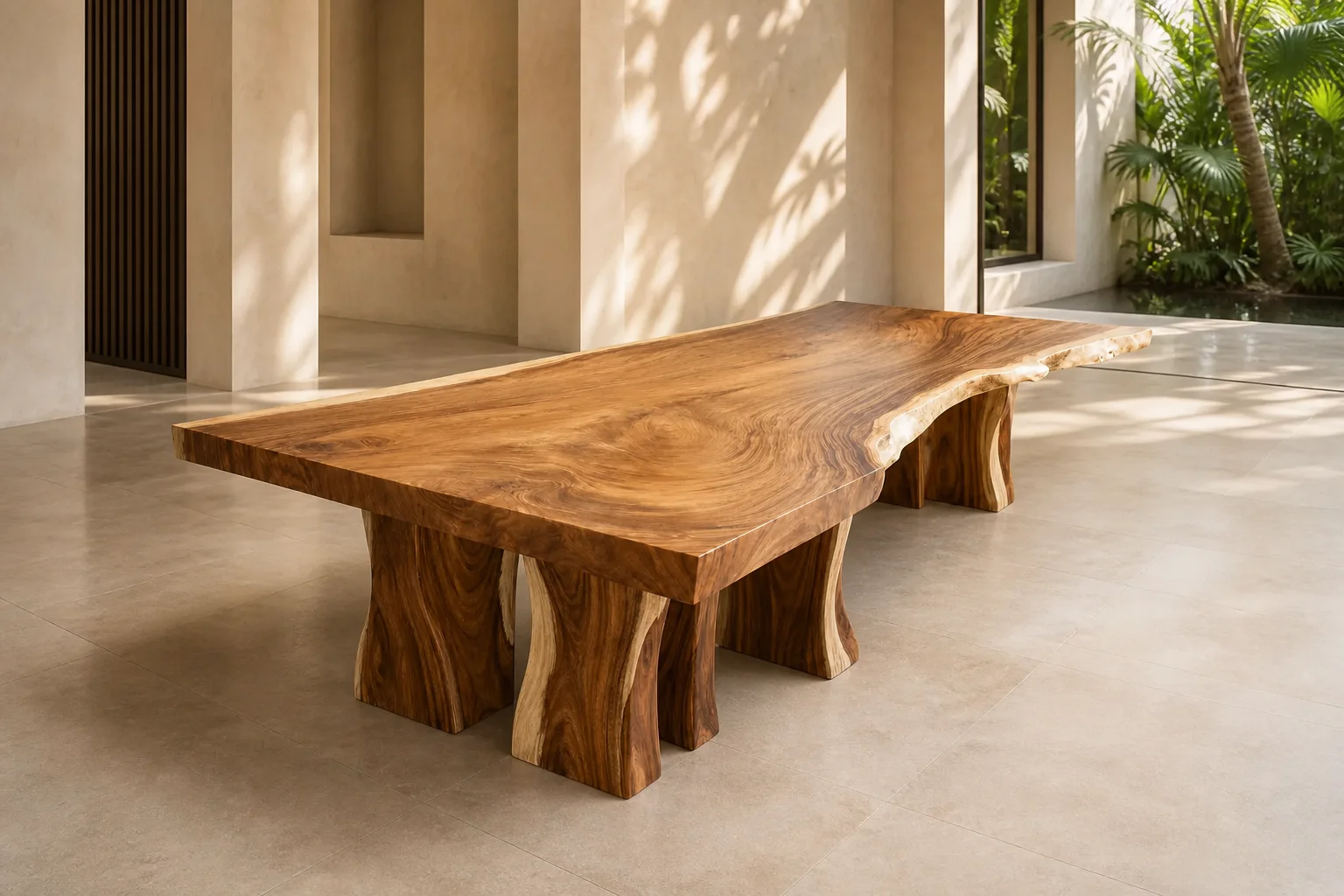
Wide plank solid wood floors are stable enough for many homes, villas, and hospitality interiors when moisture is controlled from production through occupancy. The tradeoff is that wider
Many flooring programs aim to keep interiors near 30% to 50% relative humidity, because wood movement tracks moisture change far more than board width alone.
For wide plank solid wood floors, stability means predictable seasonal movement without major cupping, crowning, excessive gaps, or bond failure. A stable floor still expands and shrinks as humidity changes, but proper drying, machining, acclimation, and site control keep that movement within acceptable visual and performance limits over time.
In flooring practice, stability does not mean a plank stays perfectly still. Solid wood is hygroscopic, so it gains and loses moisture as indoor air changes across wet and dry seasons. The USDA Forest Products Laboratory and the National Wood Flooring Association both frame wood performance around moisture balance, not absolute rigidity. A floor can therefore be stable while still showing minor winter gaps or a tighter fit in humid months, especially where HVAC control is moderate rather than exact.
Wide plank boards make normal movement easier to see because each board contains more wood across its width. That visibility often causes buyers to confuse seasonal behavior with product failure. The more useful question is whether the floor was sawn, kiln dried, stored, delivered, and installed for the climate it will actually face. When those variables are aligned, wide solid planks can perform reliably for decades.
Wider solid planks move more because wood expands and contracts across the grain, and a wider board accumulates more total dimensional change. If moisture content shifts by the same amount, a 220 mm plank will usually show more visible seasonal width change than a 90 mm plank of the same species and cut.
Wood movement is anisotropic, meaning it behaves differently along and across the grain. For flooring, across-grain change is the main concern. Data summarized in the USDA *Wood Handbook* shows that tangential and radial movement are far greater than longitudinal movement, which is why width matters so much in planks. A wider board does not move faster per millimeter. It simply adds up more total expansion and contraction across a broader face, making joints, edges, and gaps easier to notice.
This also explains why plain-sawn wide boards can be more prone to cupping when humidity rises from below. Wider planks expose more surface area to moisture imbalance between the top and bottom faces. Good subfloor dryness, vapor control, and building conditioning matter as much as the timber itself. In many projects, failures blamed on width are actually failures of moisture management, sequencing, or installation discipline rather than an inherent flaw in wide planks.
The main stability factors are species, sawing method, board width, moisture content at delivery, subfloor moisture, installation method, and indoor relative humidity. Consistent performance usually comes from combining well-dried lumber, accurate moisture testing, compatible site conditions, and an interior climate kept within the flooring supplier’s recommended range year-round.
{'type': 'table', 'caption': 'Main variables that influence wide plank solid floor behavior', 'headers': ['Factor', 'Lower-risk condition', 'Higher-risk condition'], 'rows': [['Species', 'Teak, white oak, or other proven flooring species', 'Movement-prone species used at extra-wide widths'], ['Saw cut', 'Quarter-sawn or rift-sawn boards', 'Plain-sawn boards with strong cathedral grain'], ['Moisture at install', 'Board and subfloor readings within specification', 'Unverified or mismatched moisture readings'], ['Indoor climate', 'Steady HVAC and moderated relative humidity', 'Large swings between dry and humid periods'], ['Installation', 'Installer follows NWFA-style moisture and expansion practices', 'Rushed installation over a wet or unprepared subfloor']]}
Species matters because each wood has different density, tangential shrinkage, radial shrinkage, and natural extractives. Teak is often valued in Southeast Asia for dimensional reliability, while white oak is widely trusted in North America and Europe for flooring performance. Walnut, maple, and acacia can also work, but the same species can behave very differently depending on kiln schedules, storage, machining quality, and final moisture content at shipment.
Installation conditions matter just as much as species selection. The NWFA emphasizes subfloor testing, jobsite readiness, and moisture measurement before boards are fixed in place. Concrete that is still emitting moisture, incomplete drying after wet trades, or buildings with intermittent air-conditioning all increase risk. In climates such as Thailand, Singapore, or coastal Florida, a floor should be specified around expected occupancy and HVAC patterns, not just showroom appearance on installation day.
Yes. Species with favorable movement characteristics and quarter-sawn or rift-sawn cuts are generally more stable than plain-sawn material. Teak and white oak are commonly chosen for wider planks because they have strong flooring track records, while less stable species or flatter cuts can show more gaps, cupping, and edge stress.
Quarter-sawn boards place growth rings closer to vertical, which usually reduces width change and improves seasonal consistency. Rift-sawn stock can offer similar behavior, though it often costs more because yield is lower. Plain-sawn boards provide the cathedral figure many buyers prefer, but they typically show greater tangential movement. For wide plank solid flooring, that tradeoff matters because grain pattern, stability, and visual change are closely connected.
Species choice should be based on published movement data and field experience, not assumptions. Teak is frequently selected for luxury interiors because of its durability and reliable behavior in demanding climates. White oak is a standard reference species in many Western flooring markets. Maple can be less forgiving where humidity fluctuates sharply, and some tropical hardwoods vary by source, density, and drying quality. Supplier process control often matters nearly as much as species name.
Engineered wood is usually more dimensionally stable than wide plank solid wood because its cross-layered construction reduces across-grain movement. Solid wood can still perform well, but engineered boards are generally the safer specification for very wide formats, radiant heat, concrete subfloors, and interiors where relative humidity cannot be held consistently within a narrow band.
Engineered flooring uses a hardwood wear layer over plywood or a multi-ply core, with grain directions alternating between layers. That structure helps resist seasonal width change better than a single-piece solid plank. APA and many flooring manufacturers point specifiers toward engineered construction where slab moisture, radiant heating, or occupancy-driven humidity swings create additional stress. Once widths reach roughly 180 to 220 mm, many projects default to engineered boards unless building conditions are unusually well controlled.
Solid wood still offers clear advantages, including full-thickness material, traditional construction, and the ability to refinish multiple times. But on stability alone, engineered wood usually wins. The comparison is not about authenticity versus imitation; it is about risk tolerance and site conditions. If a project sits over concrete, near the sea, or in a home that is only part-time air-conditioned, engineered flooring is commonly the more forgiving choice for wide-plank visuals.
Stability improves when installers verify subfloor moisture, acclimate boards correctly, allow proper expansion space, manage vapor, and maintain steady indoor humidity after handover. Most wide plank problems come from moisture mismatch and climate swings rather than the concept of solid wood itself, so disciplined installation and operation are the main controls.
Before installation, the building should be enclosed, wet trades finished, and HVAC operating long enough to normalize temperature and humidity. Installers should moisture-test both the flooring and the subfloor, then compare the readings against supplier specifications and recognized guidance from organizations such as the NWFA. Expansion gaps at walls, thresholds, and fixed elements are not optional details. They are part of the system that allows a solid wood floor to move without distress.
After installation, owners should keep interior humidity reasonably steady, often around the 30% to 50% relative humidity range used by many flooring programs unless the manufacturer specifies otherwise for local climates. Seasonal humidification or dehumidification may be necessary. Spills should be removed promptly, and cleaning methods should avoid overwetting. A stable floor is not only specified and installed well. It is also operated consistently through changing seasons and occupancy cycles.
Wide plank solid wood floors are a good choice when a project values authentic solid timber, uses a suitable species, and can maintain consistent indoor conditions. They are less suitable where humidity control is irregular, slab moisture is uncertain, or buyers want extra-wide boards with minimal visible seasonal movement throughout the year.
Wide solid planks make the most sense in well-conditioned homes, villas, and hospitality interiors where owners accept normal seasonal character and are willing to maintain a controlled environment. In those settings, they deliver a calm visual with fewer seams and strong material authenticity. Teak, white oak, and other proven flooring species can perform very well when sourced from mills that manage kiln drying, machining tolerances, grading, and moisture content carefully.
They are a weaker fit in vacation properties left without climate control, on slabs with unresolved moisture transmission, or in interiors where buyers expect a perfectly static appearance all year. In those conditions, engineered flooring usually offers more tolerance. The practical issue is not whether wide solid floors are stable in theory. It is whether the total system, from species choice through building operation, supports stable behavior in everyday use.
Most solid wood floors show some seasonal gapping when indoor air becomes drier, and wider planks make those gaps more noticeable. Small, consistent gaps can be normal. Large, uneven, or persistent gaps usually point to sharp humidity swings, poor acclimation, moisture mismatch, or installation conditions outside the recommended range.
Not automatically, but risk generally rises as width increases. A 200 mm or wider solid plank can perform well if the species is suitable, the lumber is dried correctly, and indoor humidity stays controlled. Where slab moisture or climate control is uncertain, engineered flooring is usually the lower-risk specification.
Teak is often considered a stable option for wide planks because it has a long track record in demanding climates and is valued for dimensional reliability. Even so, teak still moves with humidity changes. Drying quality, final moisture content, machining accuracy, and building operation remain essential to good long-term performance.
It can be done in some assemblies, but concrete adds moisture-related risk and usually requires stricter testing, vapor management, and installation detailing. Many specifiers choose engineered flooring over concrete because it tolerates site movement better. Wide solid planks need a carefully designed system and slab conditions verified before installation.
This resource is for general information and does not replace project-specific advice from a qualified flooring installer, wood technologist, or manufacturer. Product behavior varies by species, cut, drying, milling, climate, subfloor condition, and installation method.