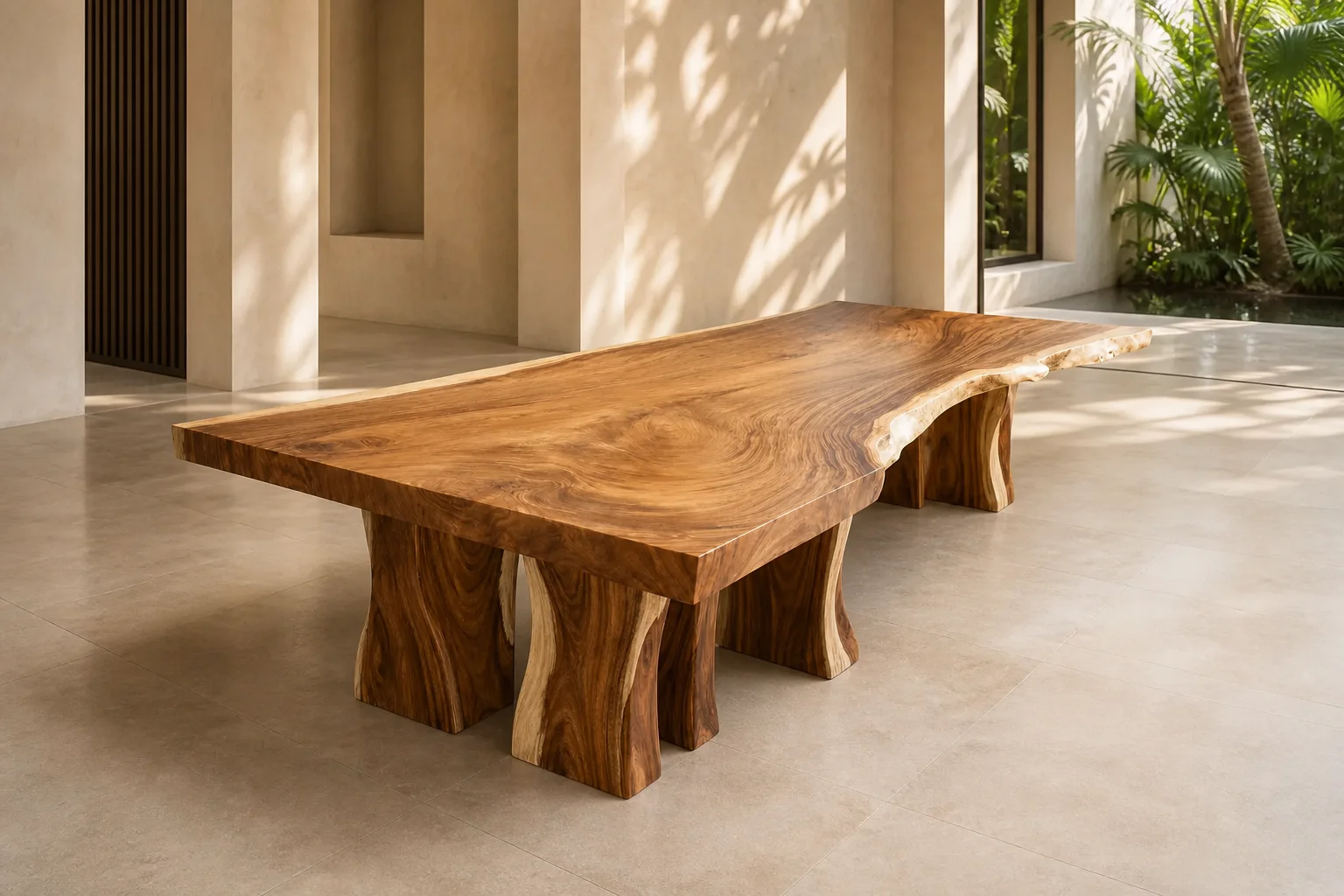
The best species for large live-edge slabs are usually walnut, suar, monkeypod, teak, oak, and maple because they balance width potential, structural reliability, and visual appeal. For most
Wood movement is normal: slab performance depends heavily on moisture content, grain orientation, and drying quality, not just species name.
{'type': 'table', 'caption': 'Common species used for large live-edge slabs', 'headers': ['Species', 'Typical reason buyers choose it', 'Main caution'], 'rows': [['Walnut', 'Premium color, stable behavior, strong demand', 'Very wide slabs can be expensive and limited'], ['Suar / Monkeypod', 'Very large widths, bold figure, popular for statement tables', 'Movement risk increases if drying is rushed'], ['Teak', 'Excellent durability and humidity tolerance', 'Natural oils affect glue and finish choices'], ['Oak', 'Strong, available, classic grain', 'Open pores and tannin behavior need finishing care'], ['Maple', 'Clean modern look and hardness', 'Lighter color shows stains and movement more clearly']]}
The most practical species for large live-edge slabs are walnut, suar or monkeypod, teak, oak, and maple. They are favored because they can yield useful slab widths and have established drying and finishing methods. The best pick depends on desired color, climate exposure, movement tolerance, budget, and whether the slab will be used indoors or outdoors.
Black walnut is widely specified in North America for dining tables and executive desks because it combines rich brown color with relatively predictable machining and finishing. Suar, often sold as monkeypod in Southeast Asia, is popular for statement tops because trunks can produce very wide single slabs. Teak remains attractive where humidity resistance matters, while oak and maple suit buyers who want dependable supply, familiar performance data, and easier matching with architectural interiors.
Drying quality, moisture content, grain orientation, and slab construction often matter more than species alone. A carefully dried, well-supported slab from an ordinary species usually performs better than an impressive species processed badly. Buyers should verify kiln or air-drying history, target moisture for the destination climate, crack stabilization, and base design before focusing only on wood name.
The USDA Forest Products Laboratory and Penn State Extension both emphasize that wood moves as moisture changes, with tangential shrinkage generally exceeding radial shrinkage. That means a large slab can cup, check, or open around knots if its moisture content is not matched to the room where it will live. For interior furniture, many makers target roughly 6 to 10 percent moisture content depending on destination conditions, then use battens, steel reinforcement, or floating attachments to allow controlled movement.
{'type': 'quote', 'text': 'Wood movement is a design condition to manage, not a defect to wish away.', 'attribution': 'Principle reflected in USDA Forest Products Laboratory guidance'}
Walnut offers premium color and broad buyer appeal, suar offers dramatic width, teak handles humidity well, oak provides strength and traditional grain, and maple gives a lighter contemporary look. None is universally superior. The right comparison should weigh width availability, density, pore structure, finishing behavior, and expected seasonal movement in the installation environment.
{'type': 'table', 'caption': 'High-level slab species comparison', 'headers': ['Species', 'Strength for large slabs', 'Typical visual character', 'Best fit'], 'rows': [['Walnut', 'Balanced stability and demand', 'Dark brown, flowing grain, occasional figure', 'Dining tables, desks, boardrooms'], ['Suar / Monkeypod', 'Exceptional width availability', 'Bold grain contrast, organic character', 'Statement single-slab tables'], ['Teak', 'Excellent in humid settings', 'Golden to medium brown, oily texture', 'Luxury interiors, hospitality, semi-exposed areas'], ['Oak', 'Strong and familiar', 'Prominent grain, open pores', 'Large tables needing classic texture'], ['Maple', 'Hard and clean-looking', 'Pale tone, subtle grain', 'Modern interiors and lighter palettes']]}
In practice, buyers often choose walnut for understated luxury, suar for scale, and teak for resilience in tropical climates such as Thailand or Singapore. Oak is common where architects want tactile grain and easy stain options. Maple is selected when the project needs brightness rather than dramatic figure. Species reputation influences price, but slab quality, defect placement, and drying record often explain more of the final value than the species label alone.
For humid climates and export furniture, teak is usually the safest species, while suar, monkeypod, walnut, oak, and maple can also work if they are dried to the right moisture content and packed correctly. Climate fit depends less on geography of origin than on acclimation, joinery, finish system, and how much seasonal movement the design allows.
Teak is widely respected in Southeast Asia because its natural oils and durability help it tolerate moisture swings better than many furniture woods. Still, even teak moves, and slab width magnifies that movement. For export, a slab made in Thailand but shipped to Dubai, London, or Los Angeles should be conditioned for the destination environment, not just the factory environment. Good exporters document moisture readings, use restrained packaging, and avoid locking slabs to bases in ways that prevent natural expansion and contraction.
{'type': 'image', 'src': 'https://mfurniturethailand.com/resources/images/teak-suar-slab-climate-comparison.jpg', 'alt': 'Teak and suar large slab comparison for humid climate furniture selection', 'caption': 'Climate, moisture content, and joinery often determine success more than species alone.'}
A species becomes a poor slab choice when the available logs are too narrow, drying defects are common, movement is difficult to control, or the intended use conflicts with the wood's properties. Even attractive species can be unsuitable if they lack stable supply, arrive too wet, contain excessive pith, or require more maintenance than the buyer expects.
Large slabs should be avoided when the center pith is included in a way that encourages splitting, when multiple severe checks run through high-stress areas, or when the project requires outdoor exposure that the species cannot tolerate. Some dense tropical woods look impressive but are difficult to dry in thick sections and may be prone to hidden internal stress. Specifiers should also consider sustainability documentation such as FSC chain-of-custody needs and legal sourcing requirements in markets influenced by the EUDR or the U.S. Lacey Act.
No. Walnut is highly regarded for color, workability, and market appeal, but it is not automatically the best choice for every project. Suar may offer wider single slabs, teak may perform better in humid climates, and oak or maple may better match the design language, budget, or supply requirements.
Suar is common because mature trees can yield unusually wide slabs with strong visual contrast and organic figure, making it ideal for statement tables. Its popularity does not remove movement risk, though. Buyers should confirm drying history, moisture readings, crack treatment, and support design before approving a large top.
Yes, teak can be an excellent species for live-edge slabs, especially in humid regions and hospitality settings. Its durability and moisture tolerance are real advantages, but teak still expands and contracts seasonally. Proper drying, joinery, and finishing remain essential, particularly for wide slabs and exported furniture.
The target depends on the destination climate, but many interior furniture makers look for roughly 6 to 10 percent moisture content before final fabrication. More important than a fixed number is whether the slab is equilibrated for the end environment, measured consistently, and allowed to move within the table design.
This resource is for general educational use and does not replace project-specific advice from a furniture maker, wood technologist, or structural professional. Wood is a natural material, and slab performance depends on species, moisture content, fabrication quality, installation conditions, and ongoing care.