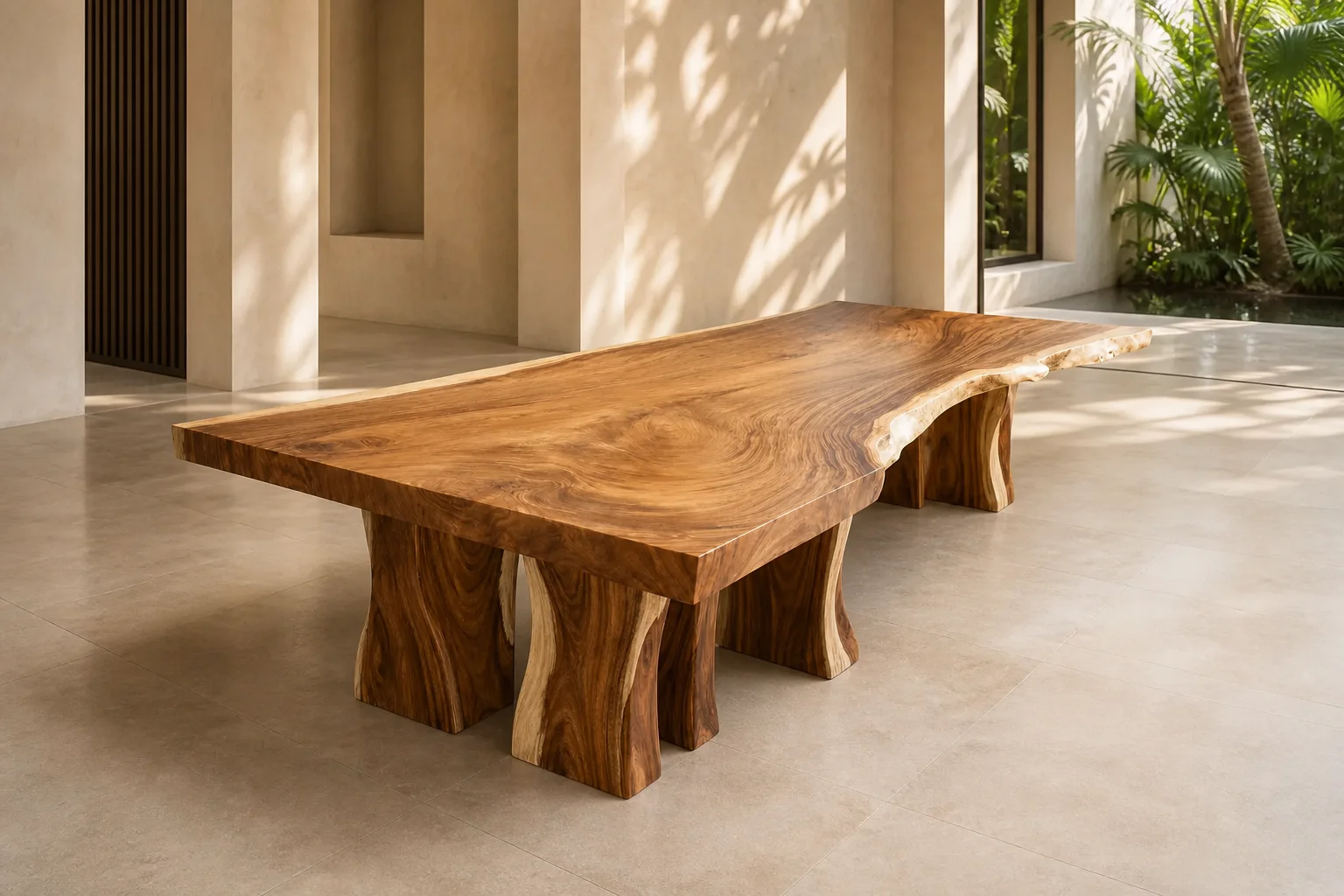
A suitable slab thickness for dining table projects is usually **35 mm to 60 mm**, with **40 mm to 50 mm** being the most versatile range for everyday
Quick rule: choose **35 mm to 45 mm** for lighter modern tables, **45 mm to 50 mm** for balanced custom dining tables, and **50 mm to 60 mm** for oversized live-edge or statement designs with strong base support.
For most dining table projects, **40 mm to 50 mm** is the safest all-purpose slab thickness because it looks substantial without becoming excessively heavy. Slimmer tops around **35 mm** suit modern designs, while **50 mm to 60 mm** is better for large-format, live-edge, or premium statement tables that need more visual mass.
A dining table top has to satisfy both engineering and appearance. In many custom builds, **40 mm to 50 mm** creates the most balanced result because it reads as solid wood without overpowering chairs, aprons, or pedestal bases. Designers in Bangkok, Singapore, London, and Dubai often choose within that band for residential projects because it gives flexibility across rectangular, oval, and organic slab layouts while keeping fabrication, transport, and installation manageable.
As table length and unsupported span increase, slab thickness usually needs to increase or the base must provide more support. A compact four-seat table can work at **35 mm to 40 mm**, but six- to ten-seat tables often look and perform better at **45 mm to 60 mm**, especially with wide boards or fewer supports.
Size changes the decision quickly. A table around **140 cm to 160 cm** long can often use a **35 mm to 40 mm** slab if the base is well positioned. Once projects move toward **180 cm, 240 cm, or 300 cm**, deflection risk, joint stability, and visual proportion matter more. Longer tops, especially with waterfall edges, trestle gaps, or pedestal bases, often benefit from thicker stock or concealed reinforcement, a principle discussed broadly by the American Wood Council and professional furniture makers.
{'type': 'table', 'caption': 'Typical thickness guidance by dining table scale', 'headers': ['Table size', 'Common seating', 'Suggested slab thickness'], 'rows': [['140-160 cm', '4 seats', '35-40 mm'], ['180-220 cm', '6-8 seats', '40-50 mm'], ['240-300 cm', '8-10 seats', '50-60 mm']]}
Yes, wood species affects slab-thickness choice because density, stability, grain structure, and movement differ. Stable hardwoods such as **teak** can perform well at practical dining-table thicknesses, while softer or less stable species may require thicker stock, better joinery, or added support to achieve the same confidence.
Species matters because thickness is not only about raw strength. **Teak**, for example, is widely valued for dimensional stability, natural oils, and outdoor durability, as noted by The Wood Database. Oak, walnut, suar, and acacia each behave differently in moisture change, board width, and grain movement. A stable species can often maintain a refined profile, while a less predictable slab may need extra thickness, steel stiffeners, or a more supportive substructure to stay flat over time.
{'type': 'image', 'src': 'https://mfurniturethailand.com/images/resources/teak-slab-thickness-dining-context.jpg', 'alt': 'Teak slab thickness comparison for dining table design and edge profile selection', 'caption': 'Teak and other hardwood species can support different slab thickness strategies depending on stability, width, and desired appearance.'}
Edge profile strongly affects perceived thickness, so the visual style can justify different slab dimensions. Straight modern tops often look right at **35 mm to 45 mm**, while eased, chamfered, and live-edge statement tables usually benefit from **45 mm to 60 mm** because extra thickness gives stronger presence and better visual proportion.
Perception matters almost as much as structure. A square-edge top in a minimalist interior can feel appropriately refined at **38 mm or 40 mm**, especially with slim chairs and metal bases. By contrast, a live-edge slab with bold grain, organic contours, and a sculptural pedestal often appears under-scaled if it is too thin. Furniture makers sometimes use under-bevels to reduce apparent bulk, allowing a thicker center mass while preserving leg clearance and a lighter profile.
Choose a thicker slab when the table is long, visually bold, or lightly supported, and choose a thinner slab when the design is compact, modern, and well braced. In practice, **50 mm to 60 mm** suits statement tables, while **35 mm to 40 mm** is acceptable for smaller tables with stable wood and strong base design.
Going thicker makes sense when buyers want a premium monolithic look, when slabs exceed **220 cm**, or when support points are limited. Thicker stock can also help if deep cracks, sapwood transitions, or butterfly repairs are part of the design story. Thinner tops are acceptable when the dining table is compact, the species is stable, and the underframe is engineered for seasonal movement, a principle also emphasized by Popular Woodworking.
Yes, **40 mm** is thick enough for many solid wood dining tables, especially at common residential lengths and with a properly designed base. It usually offers a strong balance between durability, visual substance, and manageable weight, making it one of the most practical starting points for custom projects.
No, **60 mm** is not inherently too thick, but it is usually reserved for large, dramatic, or live-edge dining tables. On smaller tables, that thickness can feel visually heavy, increase shipping weight, and raise material cost without adding meaningful functional benefit if the base already provides good support.
A live edge dining table often looks best at **45 mm to 60 mm** because the natural outline and bold grain usually benefit from more visual mass. The ideal thickness still depends on slab width, length, species, and base structure, especially if the project aims for a refined rather than rustic appearance.
Teak can sometimes support a refined dining table profile because it is valued for dimensional stability and dependable performance. However, thickness should not be chosen by species alone. Table length, board width, joinery, moisture control, and support layout still determine whether a slimmer or thicker top is appropriate.
This resource is for general design guidance and does not replace project-specific fabrication, structural review, or site assessment. Final slab thickness should be confirmed against table size, species, moisture conditions, support design, and installation requirements.