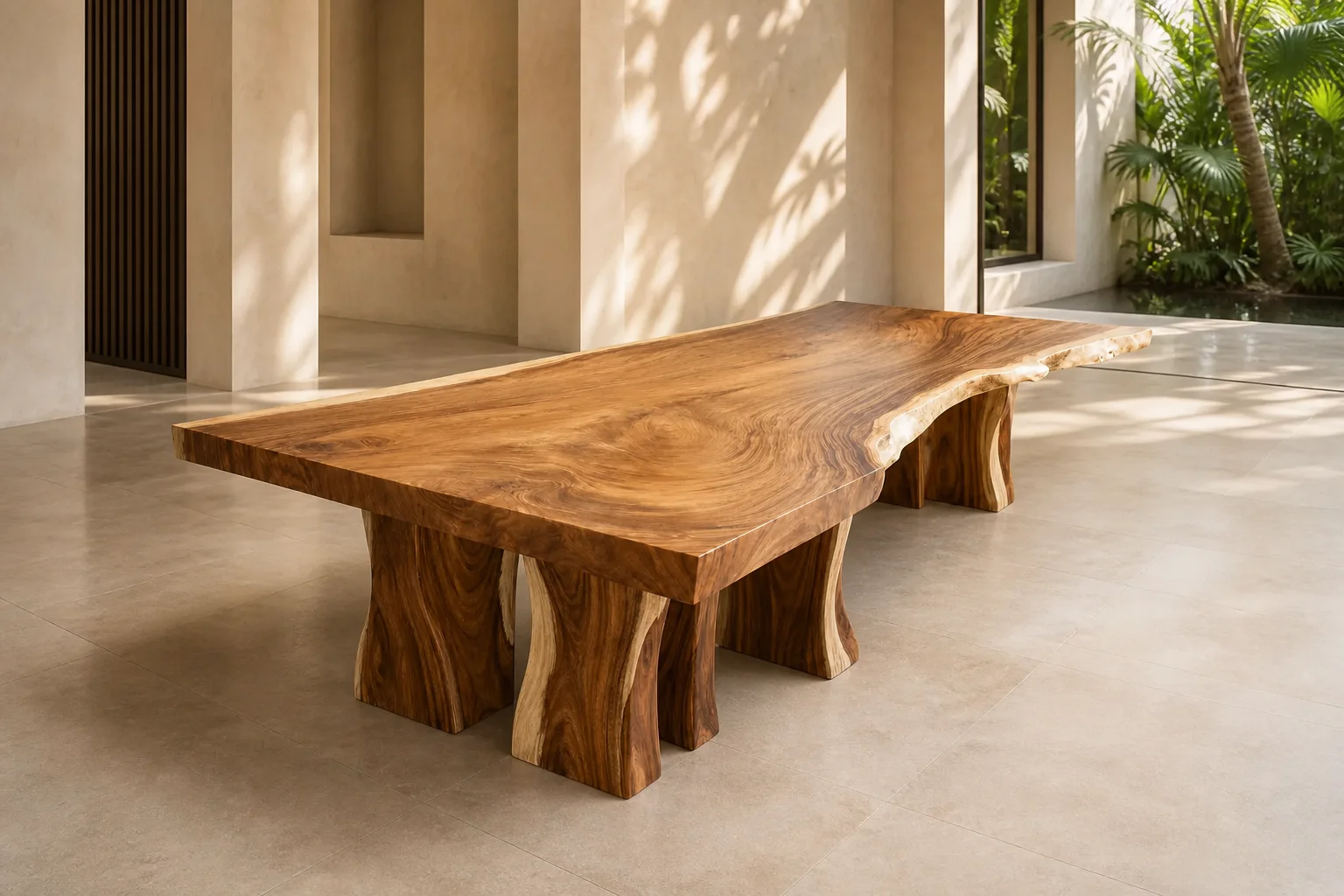
Buyers should reject slab defects that weaken the board, increase movement, or hide drying and pest problems. In solid wood and live edge furniture, the biggest risks are
A reliable inspection separates **character** from **failure**. Natural features may be acceptable; defects that affect joinery, flattening, load-bearing, or long-term movement usually are not.
{'type': 'table', 'caption': 'Quick slab defect triage for buyers', 'headers': ['Defect', 'Usually acceptable?', 'When to avoid'], 'rows': [['Color variation and grain figure', 'Yes', 'Avoid only if appearance requirements are strict'], ['Small sound knots', 'Often', 'Avoid if loose, cracked, or placed in a high-stress joint'], ['Hairline surface checks', 'Sometimes', 'Avoid if they run through thickness or continue growing'], ['Cupping, bow, or twist', 'Limited', 'Avoid when flattening would remove too much thickness'], ['Insect holes', 'Rarely', 'Avoid if frass, fresh exit holes, or active infestation appears'], ['Rot or punky fiber', 'No', 'Avoid in all structural and furniture applications']]}
The most serious slab defects are those that compromise structural integrity or predict future movement: through-cracks, deep end checks, severe twist or cupping, rot, active insect damage, loose knots, and bark inclusions crossing stress points. Buyers should also avoid slabs with high or uneven moisture content because drying defects often worsen after fabrication.
A buyer should treat cracks differently depending on depth, direction, and location. A healed check near a trimmed edge may be manageable, but a through-crack crossing the center or running into leg, base, or joint locations can reduce strength and complicate fabrication. The USDA Forest Products Laboratory notes that wood movement and strength vary with moisture, grain orientation, and defect placement, so defect context matters as much as defect type.
Cosmetic slab defects mainly affect appearance, while structural defects affect strength, stability, machinability, or service life. Color contrast, figure, and some sound knots are often cosmetic. Through-cracks, unstable checks, decay, active insect attack, severe warp, and defects located in joinery or load paths should be treated as structural concerns.
Many buyers over-reject natural character and under-reject hidden instability. Figure, spalting-like contrast, mineral streaks, and sapwood may be visual issues rather than engineering problems, especially in teak, suar, or acacia slabs. By contrast, a defect becomes structural when it interrupts continuous wood fiber, reduces bearing area, or prevents stable flattening. NWFA and wood science references consistently emphasize that moisture and fiber continuity drive long-term performance.
{'type': 'image', 'src': 'https://mfurniturethailand.com/resources/images/slab-defects-structural-vs-cosmetic.jpg', 'alt': 'Wood slab structural versus cosmetic defect comparison for buyer inspection context', 'caption': 'Structural defects affect stability, strength, or joinery; cosmetic defects mainly affect appearance.'}
Buyers should verify slab moisture content with a calibrated meter, ask how the wood was kiln-dried or air-dried, and inspect for cupping, bow, twist, and fresh checking. A slab can look attractive yet still be unstable if moisture is too high or uneven from face to core.
For interior furniture, acceptable moisture depends on destination climate and intended use, but buyers should be skeptical of slabs sold without meter readings, species correction, or acclimation history. NIST has shown that hand-held moisture readings can shift with species corrections, and moisture mismatch is one of the most common causes of later cracks and movement. Check both faces, compare ends, and ask whether the slab has rested after kiln drying and rough flattening.
Buyers should reject slabs with evidence of active infestation or decay, including fresh frass, new exit holes, soft fibers, tunneling, musty odor, or crumbly areas. Old inactive holes may be repairable in decorative applications, but uncertainty about pest activity or rot should stop the purchase until the slab is verified safe.
Not every hole means an active problem, but buyers need proof that pests are inactive and the wood is dry and stable. Fresh powder, pinholes with clean edges, or internal galleries can indicate beetle activity. Decay is even more serious because it reduces fiber strength. In export contexts, buyers should also ask about treatment, fumigation, and storage records, especially when slabs have moved through humid regions such as Thailand, Indonesia, or Vietnam.
{'type': 'quote', 'text': 'Moisture control is the first filter for both dimensional stability and biological risk.', 'attribution': 'USDA Forest Products Laboratory guidance, summarized for buyers'}
The same defect can be acceptable in one slab and unacceptable in another because location and use matter. A small check in a trimmed edge may be harmless, while the same check at a table base connection, sink cutout, or unsupported span can create structural or finishing failure.
A dining table, bar top, bench, and vanity all load a slab differently. Buyers should map defects against final dimensions, cutouts, base attachment points, and expected humidity swings. For example, a bark inclusion near a waterfall joint or a crack near a sink opening carries more risk than the same feature in a non-structural offcut. Good suppliers document slab orientation, final thickness, and where defects will remain after trimming.
{'type': 'table', 'caption': 'Defect tolerance by application', 'headers': ['Application', 'Higher-risk locations', 'Lower-risk locations'], 'rows': [['Dining table', 'Base attachment points, center span, breadboard ends', 'Trimmed outer edges'], ['Bench seat', 'Leg joints, unsupported span', 'Decorative edge voids outside load path'], ['Vanity top', 'Sink cutout, faucet holes, wet zones', 'Back edge hidden by wall'], ['Console top', 'Wall bracket points, narrow sections', 'Short overhangs with support']]}
No. Small, stable surface checks can be acceptable if they do not run through the thickness, fall outside critical joinery, and stop growing after drying and surfacing. Buyers should reject cracks that cross structural zones, reopen easily, or indicate unresolved moisture imbalance within the slab.
Not always. Bark inclusion can be decorative in live edge furniture, but it becomes risky when it crosses load-bearing zones, attachment points, or narrow sections. If the inclusion is loose, deep, or likely to trap movement and debris, buyers should classify it as a structural concern.
There is no single universal number because target moisture depends on destination climate and end use. Buyers should look for readings appropriate to indoor furniture in the receiving market, taken with species correction, and should confirm the slab has acclimated after drying and before fabrication.
Sometimes, but only when the infestation is clearly inactive and the surrounding wood remains hard, dry, and structurally sound. Buyers should ask for evidence of treatment and inspect for fresh frass, new exit holes, or tunneling. If activity is uncertain, the slab should be rejected or quarantined.
This resource is for general buyer education and does not replace species-specific engineering review, moisture testing, or fabrication assessment for a particular slab.