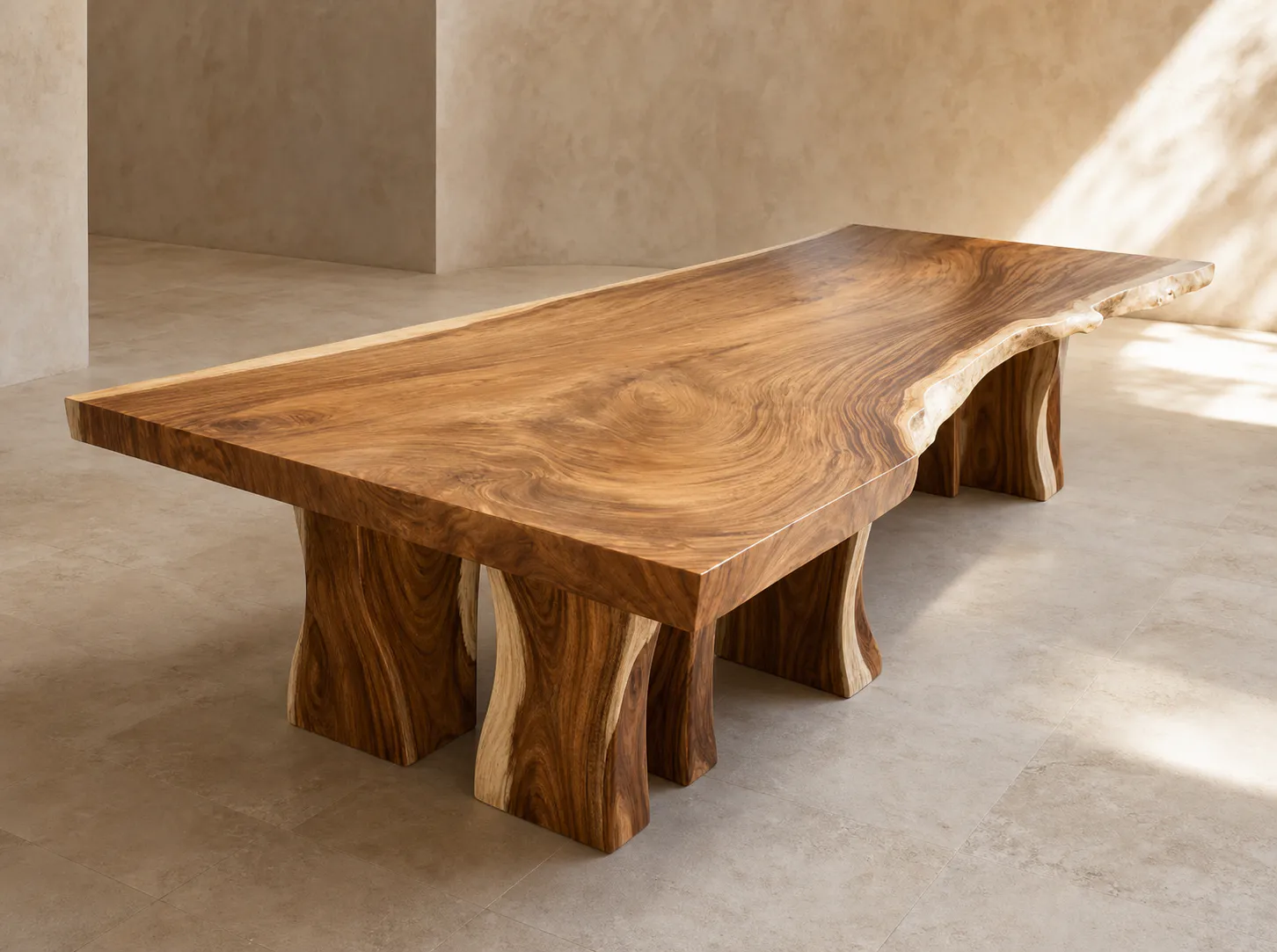
Custom teak buyers should set minimums by production family, not by a single catalogue-wide number. One prototype validates proportion and finish; a small repeat order normally needs several
Use an MOQ discussion to define what is identical: dimensions, teak grade, joinery, finish, hardware, upholstery, packaging, and delivery timing.
An appropriate MOQ is the smallest quantity that lets a workshop repeat the same specification without repeatedly resetting machines, jigs, finishing, and packing. For custom teak, that is commonly one sample, 4–10 matching residential pieces, or 20–50 hospitality pieces; the confirmed threshold must come from the manufacturer’s quotation and production schedule.
The economics are driven less by a universal number than by changeovers. A dining-chair run with one frame, one stain, and one fabric creates repeatable routing; six unrelated one-off pieces do not. Buyers should ask M Furniture & Decor to price a sample separately from the production run, identify grade and origin documentation, and align material expectations with FSC chain-of-custody guidance. That comparison exposes fixed costs and costs that improve when identical specifications are repeated. It also prevents sample pricing from being mistaken for series pricing later.
MOQ rises when a collection contains unique components because each variation creates separate drawings, cutting plans, sanding sequences, fixtures, and quality checks. Keep a lower minimum by grouping pieces around shared teak sections and finishes. A single colour system across tables, chairs, and consoles can be more economical than many isolated designs.
The bill of materials should distinguish recurring parts from one-off details. Standardising apron profiles, leg sections, hardware, and stain reduces setup while retaining a distinct collection identity. If destination or buyer policy requires evidence, specify it early rather than after manufacture; CITES guidance explains how trade controls can apply to listed species. Confirm requirements with the importer and relevant authority. This keeps compliance review outside the final packing window and gives the workshop a stable purchase specification.
Freight does not create a formal furniture MOQ, but it strongly affects the order size that makes commercial sense. Consolidating approved pieces into fewer export movements can reduce handling events and simplify inspection. Plan dimensions, carton count, destination rules, and delivery dates before treating a low piece count as economical.
Ask for a packing estimate alongside the furniture quote: assembled volume, carton dimensions, gross weight, and protective materials all affect freight choices. A mixed order may be sensible when product families share delivery dates, even if individual models are modest in quantity. For wood packaging, destination rules may refer to ISPM 15; confirm requirements with the freight forwarder. Early consolidation planning also makes it easier to compare partial-load and full-container quotations on the same assumptions before commitment.
Yes, one piece can be suitable as a paid prototype, a statement item, or a finish-approval sample. It is not automatically the most efficient production order because design preparation, timber selection, and packing still occur. Ask for a separate prototype price, lead time, approval process, and the quantity required for repeat production.
Stock teak furniture may have a stated minimum because components and finishes are already standardised. A custom collection begins with its own drawings, samples, and production routing, so its MOQ is quoted by specification. Reusing an existing base, finish, or hardware can narrow the gap, but it does not make the order stock.
Reduce the MOQ by limiting variations before asking for a quote. Use the same teak grade, finish, hardware, and construction logic across several pieces, then schedule delivery together. Accepting a standard dimension where it works can also help. Do not reduce quantities by skipping sampling or documenting specifications less clearly.
Not necessarily. The low MOQ that a workshop can produce may still be impractical to ship alone. Export crates, port handling, insurance, and destination delivery can make a consolidated order preferable. Request both an ex-works furniture quote and an estimated shipping scenario, then compare cost, timing, risk, and storage capacity.
MOQ ranges on this page are planning guidance, not a binding production offer. M Furniture & Decor confirms pricing, materials, compliance documents, lead times, and minimum quantities only through a project-specific written quotation.