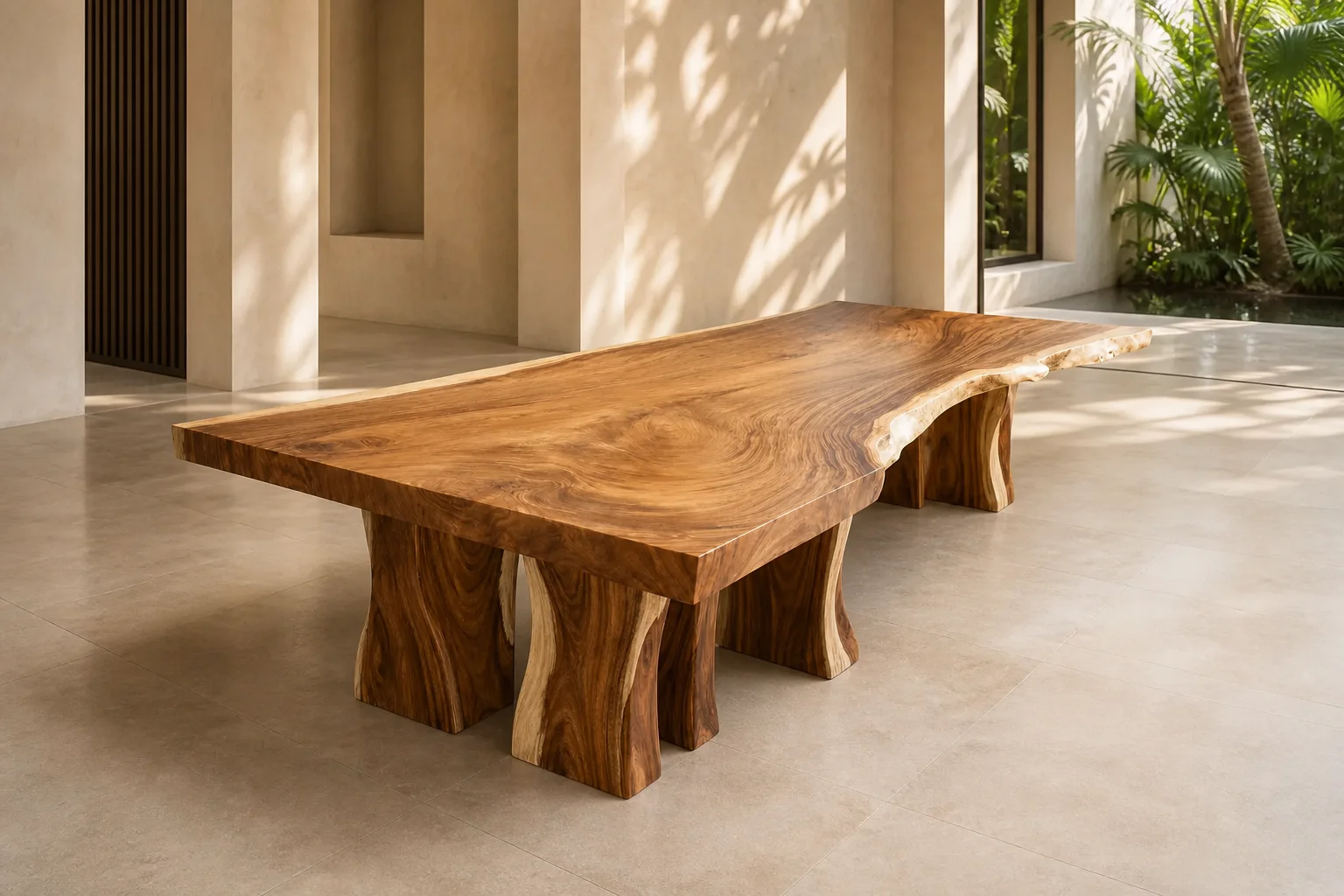
A live edge slab is a solid wood board whose natural log contour remains visible along one or both sides. Once dried, flattened, stabilized, and finished, it can
The term describes an edge treatment rather than a single timber species or quality grade. A useful project specification identifies the wood, finished dimensions, drying approach, repairs, finish, base design, and intended environment. Those details matter whether a buyer selects Thai teak, acacia, suar, or rubberwood.
A live edge slab is a board sawn from a log with its organic perimeter intentionally retained rather than squared away. The phrase describes a visual and fabrication choice, not a species. Finished slabs can be single wide boards or joined pieces, provided the natural edge remains a deliberate feature.
Furniture makers first choose a log section for usable grain, checks, knots, and width. Bark and loose material are removed, while sound sapwood may remain when the design permits it. The board is then sawn, dried, flattened, sanded, and finished. Thai teak, acacia, suar, and rubberwood differ in color and density. The USDA Forest Products Laboratory Wood Handbook notes that wood movement varies by direction, so a natural edge never removes the need for sound engineering.
Preparation makes a live edge slab suitable for furniture: it must reach an appropriate moisture condition, be flattened without removing its character, and have cracks or voids assessed. Finish and attachment choices should accommodate seasonal movement. A striking edge cannot compensate for inadequate drying, unstable defects, or an undersized base.
For a dining top, the workflow normally includes controlled drying, moisture measurement, flattening, edge cleaning, defect stabilization, progressive sanding, and finishing. Measurements should be recorded for the intended indoor environment rather than assumed from a universal percentage. A 2.4-metre tabletop also needs a base that manages weight, overhang, and movement without rigidly trapping the wood. Specify whether filled checks, butterfly keys, resin repairs, or open natural voids are acceptable. The USDA Wood Handbook is a useful reference for understanding why fastening details matter.
Buyers should compare a live edge slab by verified species, finished dimensions, thickness, grain character, repairs, moisture information, finish, and intended use. Thai teak is valued for its natural durability, while acacia, suar, and rubberwood offer distinct visual and availability profiles. The correct choice depends on the project specification.
Request the finished length, minimum and maximum width, thickness, and a photograph of the actual board whenever possible. Clarify whether the top is one slab or a matched joined construction, since both can be structurally appropriate. For commercial and export projects, ask for timber-origin documentation and packaging details. Forest Stewardship Council chain-of-custody certification provides a framework for tracing certified material through supply chains. M Furniture & Decor can use these documented decisions to align the selected slab, base geometry, delivery access, and approved finish sample.
A live edge slab should be installed on a stable base using details that allow modest wood movement. Keep it away from standing water, intense direct sun, and abrupt humidity changes. Routine care is simple: remove spills promptly, clean gently, and maintain the surface according to the selected oil, lacquer, or polyurethane finish.
Before delivery, confirm door widths, lift capacity, floor protection, and whether the site can receive a heavy top safely. Use brackets or fixings designed to secure the slab while allowing cross-grain movement; a rigid attachment can encourage splitting. A table designed for 6 to 10 seats also requires proportionate leg placement and stable levelling. Clean with a soft cloth and avoid abrasive pads or harsh cleaners. If the piece is specified for hospitality use, record the finish system and renewal procedure in the maintenance handover.
{'type': 'image', 'src': 'https://mfurniturethailand.com/images/resources/live-edge-slab-teak-table.jpg', 'alt': 'M Furniture & Decor live edge teak slab dining table installation detail', 'caption': 'A live edge tabletop retains the organic contour of the original log while using a stable, purpose-designed base.'}
Inspect the slab in person or through dated photographs, then confirm species, finished length, width range, thickness, moisture reading, repair locations, and finish. Ask whether dimensions are before or after finishing. For a table, also approve the base, overhang, delivery route, and installation conditions before production begins.
Live edge does not inherently mean a slab will crack or warp. Solid wood responds to humidity, so drying, moisture content, thickness, grain orientation, restrained-but-movable fastening, and indoor conditions matter more than the edge profile. Small checks may be stabilized or filled; structural defects require evaluation before fabrication and use.
Use a soft dry or slightly damp cloth, wipe spills promptly, and avoid standing water, abrasive pads, and harsh cleaners. Keep the furniture away from strong direct sun, radiators, and abrupt humidity changes. Follow the finish maker’s maintenance instructions, because oil, lacquer, and polyurethane systems need different renewal methods.
This educational resource is published by M Furniture & Decor. Wood appearance, availability, dimensions, and fabrication requirements vary by individual slab and project specification.