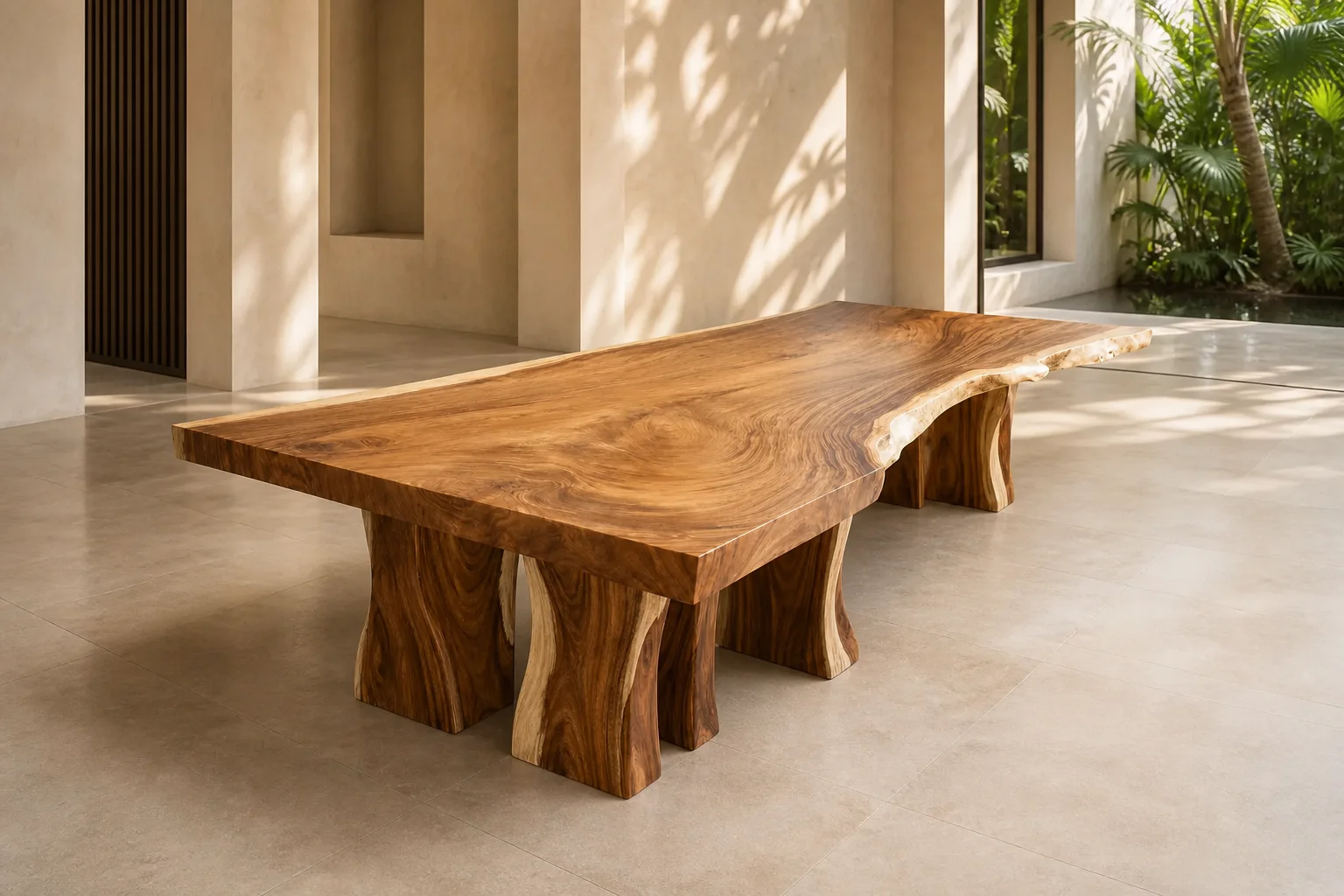
A suitable live edge slab is one that meets the table’s required finished size while remaining dry, stable, structurally sound, and visually consistent with the room and base
Buy the exact slab, not only a species sample. Each solid-wood slab has unique grain, width variation, checks, knots, and edge character.
{'type': 'image', 'src': 'https://mfurniturethailand.com/en/images/resources/live-edge-slab-table.jpg', 'alt': 'M Furniture live edge teak slab being assessed for a custom dining table', 'caption': 'Assess the usable tabletop area, natural edge condition, and structural features on both faces before fabrication.'}
Choose the slab after defining the finished table size, seating layout, and base. Allow extra width and length for trimming, jointing, and an irregular edge. A dining tabletop also needs a stable thickness, sensible overhang, and enough clear space around knots, checks, or sapwood.
For a six-seat table, begin with the required finished footprint, then compare each candidate’s widest usable area rather than its maximum bark-to-bark measurement. Typical dining tops are often about 76–102 cm wide, but chair clearance and room circulation determine whether that works. Plan to remove loose bark and level high spots; a live edge should remain tactile without catching clothing. Long spans need a base positioned to limit bounce. Review the USDA Wood Handbook for wood-property guidance, and use CITES documentation to verify declared timber species and lawful sourcing when buying internationally.
Moisture content, flatness, and grain orientation matter more than a dramatic outline because a slab continues to respond to humidity. Buy material that has been properly dried for its destination, assess both faces for twist and cup, and treat cracks as design features only when they are structurally managed.
Ask the seller for a moisture-meter reading, kiln-drying record, and acclimation conditions before fabrication. For indoor furniture, the correct final moisture content depends on Bangkok, Phuket, Melbourne, or the destination’s seasonal equilibrium—not a universal percentage. Check for end checks, pith, insect galleries, voids, and unstable inclusions. Bow ties, resin fills, or epoxy may be appropriate, but they should be disclosed and priced as repairs. The USDA Forest Products Laboratory explains why wood shrinks differently by grain direction; Forest Stewardship Council chain-of-custody information can support responsible procurement claims.
Match species, color variation, and edge profile to how the table will be used, then approve the exact slab before finishing. Teak offers natural durability and a warm tone, while other woods can suit different budgets, weights, and visual styles. The base and finish must accommodate movement rather than restrain it.
A restrained steel or timber base should support the slab near its strongest areas without preventing cross-grain expansion and contraction. For a Thai teak table, ask M Furniture & Decor to show the intended grain direction, underside support, finish sample, and final edge treatment before production. Oil finishes make localized maintenance straightforward, while film-forming finishes can offer a different surface feel and spill resistance. Avoid fixing a solid top rigidly through every mounting hole; the American Wood Council publishes wood-design resources relevant to connection decisions. For legal trade context, consult CITES species information alongside supplier documentation.
Not necessarily. Choose a slab that exceeds the finished dimensions enough to square ends, remove weak edge material, and flatten the face. The needed allowance varies with distortion and the desired live-edge silhouette. Confirm the maker’s final cut plan before paying, especially when the slab has narrow areas or deep checks.
Kiln drying is generally the more predictable option because it reduces moisture under controlled conditions, but it does not guarantee a flat tabletop. Ask for the measured moisture content, storage history, and signs of movement after drying. A slab should also acclimate in the fabrication environment before final flattening and assembly.
Yes, if the defects are evaluated individually. Small, dry checks and stable knots can add character; loose bark, active insect damage, deep rot, or cracks crossing stressed areas require removal or reinforcement. Ask whether epoxy, bow ties, or inserts will be used, and request photographs after flattening rather than relying on one showroom face.
This resource is educational and reflects practical solid-wood furniture selection criteria. Final slab suitability should be confirmed by the furniture maker after in-person inspection, moisture measurement, and review of the intended table design.