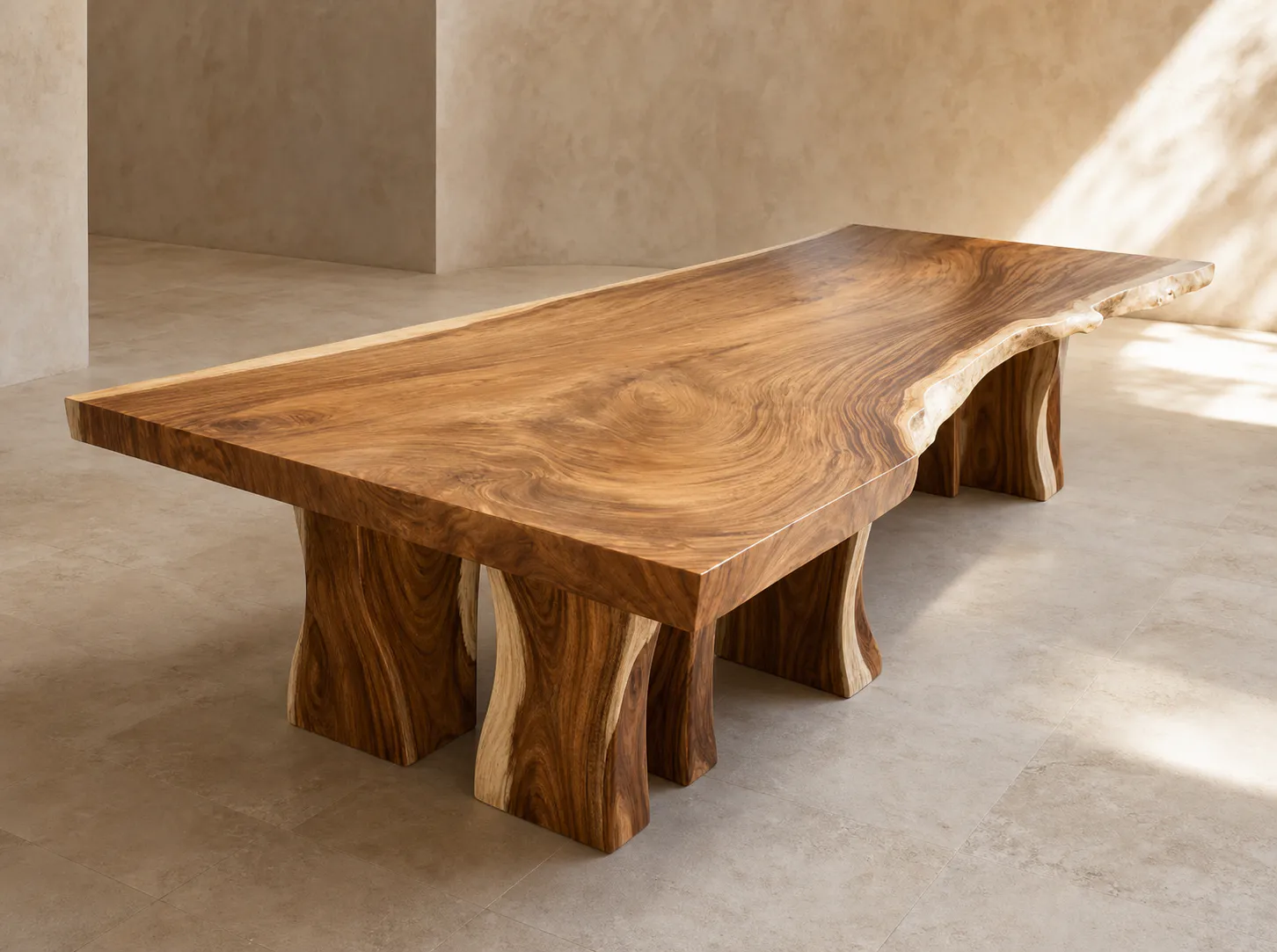
Kiln drying generally makes solid teak furniture more stable because it brings lumber to a controlled moisture content before machining and assembly. When that moisture level suits the
During kiln drying, controlled heat, humidity, and airflow remove water from teak until its moisture content approaches a planned target. Properly scheduled drying reduces internal moisture differences that can drive later distortion. It does not make teak inert: below fiber saturation, teak continues to swell or shrink as surrounding relative humidity changes.
Freshly sawn teak contains free and bound water. Dimensional change becomes important as bound water changes below fiber saturation, often described as roughly 30% moisture content for many woods. The USDA Wood Handbook lists average teak shrinkage from green to oven-dry at about 2.6% radially and 5.8% tangentially. Those species averages do not predict one tabletop, because board cut, thickness, drying uniformity, and service climate determine actual movement.
Final moisture content matters because wood is most stable when its moisture condition is near the equilibrium level expected in use. Teak dried for a humid Bangkok setting may adjust after installation in a heated, dry climate. Conditioning, equalization, and meter checks help confirm that individual components are not misleadingly dry only at the surface.
A useful moisture target is tied to the likely indoor destination, not merely to kiln time or a generic specification. The USDA Forest Products Laboratory explains that equilibrium moisture content changes with relative humidity and temperature. After a drying schedule, equalization and conditioning can reduce moisture variation and stress before boards are milled. Checking multiple boards, faces, and locations with an appropriate moisture meter gives buyers more meaningful evidence than a single reading from one component.
{'type': 'image', 'src': 'https://mfurniturethailand.com/images/resources/kiln-dried-teak-moisture-meter-inspection.jpg', 'alt': 'M Furniture teak board moisture-meter inspection after kiln drying', 'caption': 'Readings across several conditioned teak boards help verify moisture consistency before assembly.'}
Kiln drying is only one part of solid teak furniture stability. Flatsawn width, grain orientation, joinery that permits cross-grain movement, balanced finishing, storage, and indoor humidity all affect performance. A well-dried tabletop can still cup, check, or open joints if rigidly restrained or exposed to abrupt moisture and temperature changes.
For wide tops and panels, grain selection and construction are as important as drying. Rift- and quartersawn boards generally direct movement differently from flatsawn boards, while tabletop fasteners or slotted details can allow seasonal cross-grain travel. The Architectural Woodwork Institute publishes standards-oriented resources for architectural woodwork, and the Wood Handbook provides wood-science guidance. Keep teak furniture away from wet floors, prolonged direct sun, and abrupt HVAC changes to limit avoidable stress.
Kiln drying can be more predictable than air drying because operators control temperature, relative humidity, airflow, and the final target. Air drying is often useful before kiln drying, especially for thicker stock. For furniture, neither label proves quality; uniform moisture readings, conditioning, and a target matched to the installation climate matter most.
Yes. Kiln-dried teak can still warp, check, or develop seasonal gaps because teak remains hygroscopic. Risks rise when boards are dried unevenly, wide flatsawn panels are restrained, or furniture moves between sharply different humidity conditions. Good construction allows cross-grain movement, while stable indoor relative humidity reduces the size and frequency of visible changes.
Ask for the target moisture content, the intended destination climate, and how readings were taken across the shipment. Also ask whether teak was equalized after kiln drying, how long parts acclimated before assembly, and how wide tops are attached. Documented readings and movement-tolerant joinery provide more useful assurance than the words kiln-dried alone.
This educational resource is published by M Furniture & Decor, a teak furniture maker. Moisture targets and construction choices should be evaluated for each furniture design and installation climate.