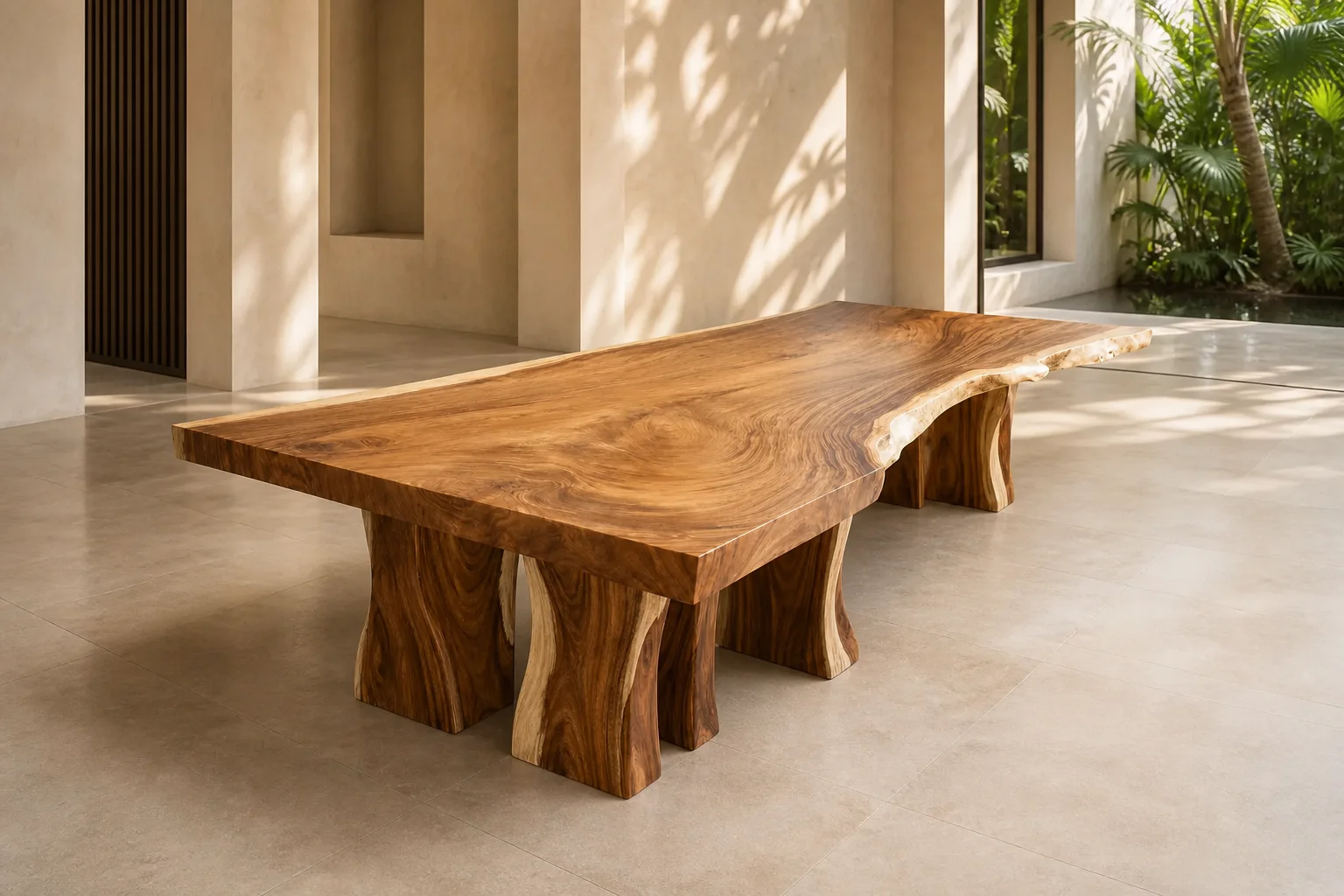
Kiln-dried slabs are usually the better choice for indoor furniture, dining tables, desktops, and hospitality projects because they can be brought closer to the moisture conditions found inside
That does not mean air-dried slabs are poor material. Many woodworkers value air drying for color, lower energy use, and slower stress relief, especially for thick hardwoods. The practical question is use case: if a slab will live indoors in Bangkok, Singapore, Dubai, London, or Los Angeles, buyers usually want a slab that has been air dried first and then kiln finished to a target moisture content appropriate for interior furniture.
For most interior slab projects, kiln-dried or air-dried-then-kiln-finished stock is the safer buying decision.
Kiln-dried slabs are usually better for indoor furniture because they can reach a lower and more uniform moisture content than air-dried slabs alone. That makes them more predictable during machining, joining, and finishing, while also reducing risks such as cupping, checking, insect activity, and movement after installation in climate-controlled spaces.
Indoor furniture is judged less by how a slab looked in the yard and more by how it behaves months after delivery. A kiln lets producers move wood closer to the equilibrium moisture content expected inside conditioned rooms, often a better fit than air drying alone. According to the USDA Forest Products Laboratory and guidance cited by The Wood Database, moisture mismatch is a major reason wood shrinks, swells, or distorts after fabrication.
Air-dried slabs are still a good choice when the project tolerates more seasonal movement, the material will be used outdoors or semi-outdoors, or a maker plans to kiln-finish later. They can also appeal to buyers who prefer slower drying or specific color characteristics, provided moisture content is verified before fabrication.
Air drying remains respected across sawmills and custom shops because it is gentler, lower energy, and practical for thick hardwood stock. For pergolas, rustic benches, sheltered patios, or workshop inventory that will later be conditioned, air-dried slabs can make sense. The key caution is that air-dried wood often stabilizes near local outdoor humidity, not the lower moisture levels expected in an air-conditioned apartment, hotel, or office.
Moisture content is the main reason kiln-dried slabs are often better. If a slab enters a dry interior while still carrying moisture suited to outdoor air, it will keep shrinking until it reaches equilibrium. That delayed change can open joints, distort flatness, and damage finishes even when the slab originally looked sound.
Wood is hygroscopic, so it exchanges moisture with the surrounding air until it reaches equilibrium. In many interiors, acceptable furniture stock is commonly targeted around 6% to 10%, though the right number depends on climate and final installation conditions. A slab reading several percentage points above that may still be workable, but the buyer should expect more movement risk after flattening, joining, resin filling, or final finishing.
{'type': 'table', 'caption': 'How moisture content affects slab decisions', 'headers': ['Condition', 'Typical implication', 'Buying signal'], 'rows': [['Kiln-dried to interior target', 'Better dimensional stability indoors', 'Preferred for tables and case goods'], ['Air-dried only', 'May still be too wet for interiors', 'Ask for meter readings'], ['Air-dried then kiln-finished', 'Balanced approach for thick slabs', 'Often the strongest option']]}
Yes, kiln-dried slabs generally reduce insect risk because controlled heat treatment can kill many insects and larvae that survive ordinary air drying. Kiln drying also helps lower moisture faster, which can reduce conditions favorable to mold. It does not guarantee perfection, but it materially improves risk control for interior and export projects.
Pest management matters for hospitality, export packing, and long-term indoor use. Air drying can lower moisture over time, but it does not reliably provide the heat exposure associated with thermal pest control. That is one reason many importers, makers, and specifiers prefer kiln-dried stock. Buyers should still inspect for old galleries, surface staining, and storage conditions, because poor handling after kiln drying can reintroduce moisture or biological problems.
{'type': 'image', 'src': 'https://mfurniturethailand.com/images/resources/slab-moisture-meter-kiln-dried-check.jpg', 'alt': 'M Furniture slab moisture meter check on kiln-dried wood before furniture fabrication', 'caption': 'Moisture readings should be verified before a slab moves into flattening, joinery, and finishing.'}
Kiln drying can be worse if it is rushed, poorly scheduled, or mismatched to species and slab thickness. Overly aggressive drying may increase checking, honeycombing, case hardening, or color change. The problem is usually bad process control, not kiln drying itself, which is why supplier competence matters as much as the label.
A thick teak, walnut, or suar slab does not respond well to careless drying schedules. If temperature, airflow, and time are pushed too hard, internal stress can build even while outer surfaces seem ready. Reputable producers use staged drying and moisture checks rather than treating every species alike. For buyers, the practical takeaway is simple: ask not only whether a slab is kiln dried, but how it was dried and what moisture range was achieved.
Before choosing a slab, buyers should ask for current moisture readings, drying method, intended indoor or outdoor use, and how long the slab has acclimated after drying. Those details matter more than marketing language because they reveal whether the material is actually ready for fabrication, export, installation, and long-term dimensional stability.
Good slab buying is evidence based. Ask for pin-meter or pinless-meter readings, species identification, slab thickness, whether the wood was air dried first, and whether it was later kiln finished. For projects crossing climates, from Thailand to Europe or North America, acclimation after arrival also matters. A beautiful live-edge slab can still fail if its moisture profile does not match the room where it will spend the next 5 to 15 years.
No. Kiln-dried slabs are usually better for indoor furniture, but not automatically in every case. A badly kiln-dried slab can perform worse than a well-managed air-dried slab. The strongest buying choice is often wood that was air dried first, then kiln finished and verified with current moisture readings.
There is no universal number for every climate, but many interior furniture projects target roughly 6% to 10% moisture content. The correct range depends on destination humidity, air conditioning, species, and slab thickness. Ask for actual readings and match them to the room where the slab will finally live.
Yes, but only if its moisture content is appropriate for the final interior environment. An air-dried slab that is still too wet may shrink, cup, or crack after fabrication. Many makers therefore prefer air-dried stock that has also been kiln finished before flattening and joinery.
Kiln drying generally lowers insect risk because the controlled heat can kill many insects and larvae that survive normal air drying. It is not a promise that every slab is defect-free forever, since later storage conditions matter, but it is a meaningful risk-reduction step for furniture and export use.
This resource is for general educational purposes and does not replace project-specific advice on wood species, climate, or fabrication. Moisture targets, drying schedules, and performance outcomes vary by slab thickness, destination environment, and storage conditions.