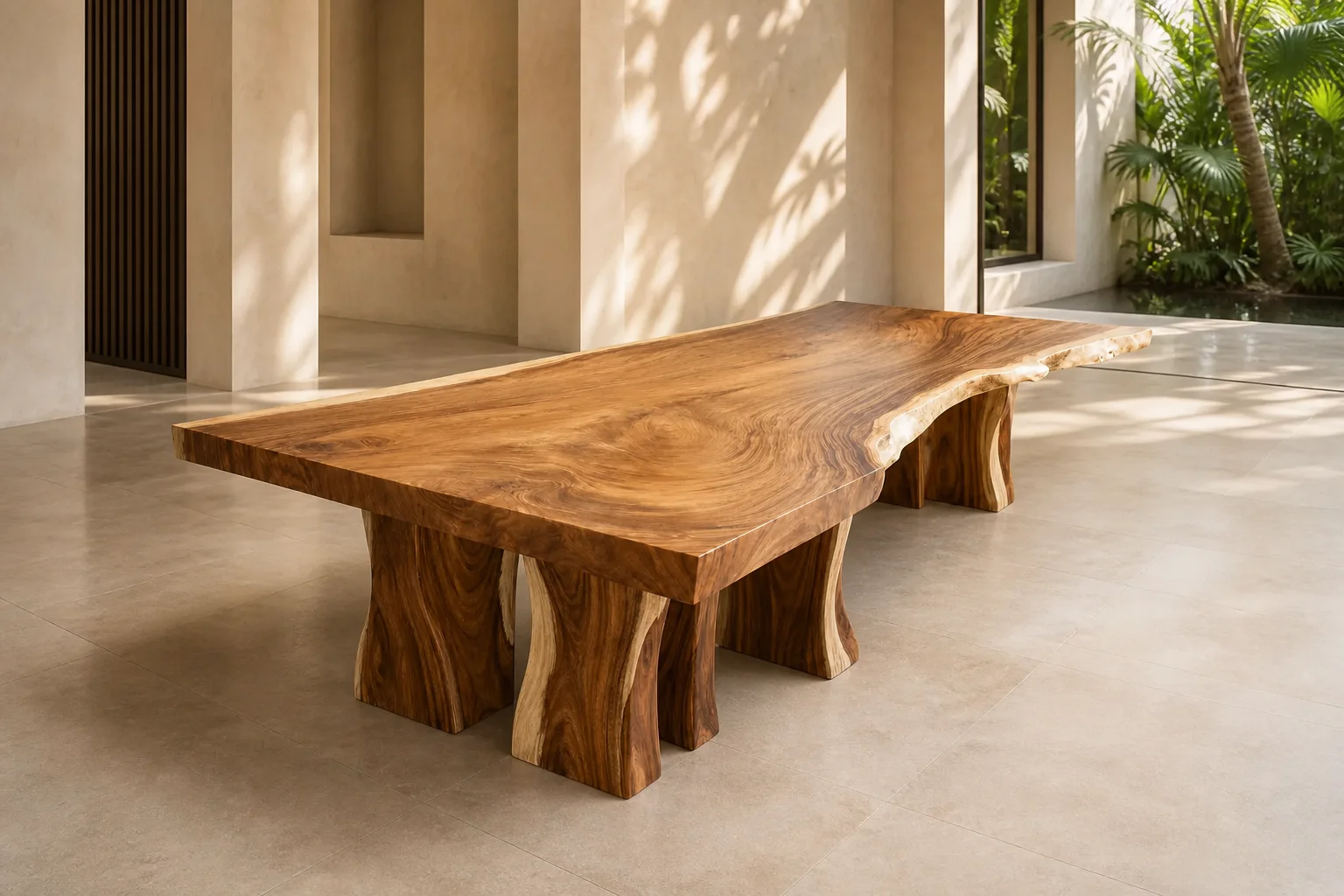
The best joinery for acacia tables is usually **mortise-and-tenon** for legs and aprons, **floating tenons or dowels** for aligned structural connections, and **movement-safe fasteners** for attaching the top
That means the right answer depends on the part of the table you are building. A dining table base, pedestal, slab top, and breadboard end all place different stresses on the wood. Guidance from the USDA Forest Products Laboratory and species references such as The Wood Database support a practical rule: choose joinery for **strength first** and **wood movement second**, never one without the other.
Short answer: use mortise-and-tenon or floating tenons for the frame, and slotted or pivoting top fasteners for the tabletop.
For acacia table bases, **mortise-and-tenon** is usually the strongest all-around joinery because it gives long-grain glue surface, excellent resistance to racking, and proven durability under repeated loading. **Floating tenons** are a close second for production efficiency, while dowels can work when accurately spaced and paired with tight machining and quality adhesive.
Acacia table bases experience side load, chair impact, and repeated seasonal stress, so joints between legs, aprons, and stretchers must resist racking. Traditional mortise-and-tenon remains the benchmark because the shoulder helps square the frame while the tenon supplies long-grain bonding area. In export furniture and hospitality settings, many builders also use floating tenons, including Domino-style loose tenons, because they balance speed, repeatability, and structural reliability.
Dense hardwoods like acacia hold crisp shoulders and durable cheeks, but they also punish loose tolerances. A sloppy joint will not be rescued by glue choice alone. Titebond and other adhesive makers note that wood glue performs best on well-fitted surfaces with adequate clamping. For high-stress bases, screws alone are usually less durable than properly proportioned tenon-based joinery.

The acacia tabletop should usually be attached with **movement-permitting hardware** such as figure-eight fasteners, Z-clips, buttons, or elongated screw slots. These methods hold the top securely while allowing seasonal expansion and contraction across the grain. Rigidly gluing or screwing the entire top to the base raises the risk of splits, cupping, or joint failure.
The tabletop is where many otherwise strong acacia tables fail. Even stable hardwood changes width as humidity shifts, especially in wide dining tops. If you trap the panel by gluing it hard to aprons or by driving fixed screws across the grain, the wood can split or telegraph stress into the base. Figure-eight connectors, tabletop buttons, and slotted battens prevent that by allowing small seasonal movement.
{'type': 'table', 'caption': 'Common ways to attach an acacia tabletop', 'headers': ['Method', 'Strength', 'Allows movement', 'Typical use'], 'rows': [['Figure-eight fasteners', 'High', 'Yes', 'Solid wood dining tops'], ['Z-clips', 'High', 'Yes', 'Apron-and-groove construction'], ['Wood buttons', 'Medium to high', 'Yes', 'Traditional framed tables'], ['Direct glue to apron', 'Low long-term', 'No', 'Generally avoid for solid tops']]}
Breadboard ends can also help control cupping, but they must be detailed correctly with a fixed center and elongated outer holes or slots. The core principle, echoed across USDA wood movement guidance and cabinetmaking practice, is simple: **restrain the top vertically, not across its width**. That rule matters more than whether the base uses acacia, teak, maple, or walnut.
Yes, but they are not equal. **Floating tenons** are usually the best modern alternative to integral mortise-and-tenon for acacia tables. **Dowels** can be strong if accurately machined and used in multiples. **Pocket screws** are better for secondary or concealed assembly than for primary structural joints in long-lasting dining tables.
Floating tenons perform well in acacia because they create predictable alignment and substantial long-grain glue area without the setup time of hand-cut mortise-and-tenon. Dowels can also be robust, especially when two or more are used to prevent rotation and when boring is highly accurate. In CNC or jig-based production, this can make dowels economically attractive for side tables, desks, and some dining bases.
Pocket screws solve assembly problems quickly, but they are not usually the top choice for core load-bearing joints in premium solid-wood tables. They depend heavily on screw holding and component thickness, and they do little to address seasonal movement. Many shops still use them successfully for hidden braces, temporary positioning, or low-stress attachments, but not as the sole joinery for a large acacia dining base.
Practical ranking for most acacia base joints: mortise-and-tenon first, floating tenons second, multiple dowels third, pocket screws for secondary use.
For acacia slab or panel tops, the main strength comes from a well-milled **long-grain edge glue joint**. Biscuits, dominoes, splines, or dowels mainly improve alignment rather than raw strength. Joint the edges flat, keep moisture content consistent, and clamp evenly. Reinforcement helps assembly, but accurate milling matters more than adding decorative or unnecessary joinery.
When joining boards into a tabletop, many woodworkers overestimate the structural value of biscuits or loose splines. In most cases, a properly prepared long-grain glue joint is already stronger than the surrounding wood. What matters most is straight jointed edges, similar moisture content across boards, and enough clamp pressure to close the seam without bowing the panel. Dense acacia rewards accurate preparation and punishes rushed setup.
Alignment aids still have value. Floating tenons, biscuits, dowels, or tongue-and-groove details can keep acacia boards flush during glue-up, which reduces surfacing time and visible mismatch. For very wide tops, consider board orientation, growth-ring balance, and grain selection before adding mechanical reinforcement. Those decisions often affect panel stability more than the choice between biscuits and splines alone.
{'type': 'image', 'src': 'https://mfurniturethailand.com/resources/images/acacia-tabletop-edge-joinery.jpg', 'alt': 'Acacia tabletop edge-joining process with aligned boards and clamps in a furniture workshop context', 'caption': 'Edge-jointed acacia boards rely primarily on accurate long-grain glue surfaces; alignment aids are secondary.'}
Use **breadboard ends** on acacia tables when you want to help keep a wide top flatter and add a traditional look, but detail them for movement with a fixed center and elongated outer fastener paths. Use **mechanical knock-down connectors** when shipping, installation access, or repeat assembly matters more than permanent glued construction.
Breadboard ends are useful, but they are often misapplied. On an acacia top, they should not lock the full width rigidly. A common approach is a centered tenon or tongue with the middle pinned or glued, while the outer sections use elongated holes so the panel can expand and contract. Without that allowance, the end cap can force splits or break its own pegs over time.
Mechanical connectors become more attractive for export, apartment access, or hospitality projects where large tables must move through elevators or narrow doors. Cross dowels, bed bolts, threaded inserts, and knock-down brackets let the base disassemble while preserving strength. They are especially useful in pedestal and trestle designs, where transport efficiency may matter as much as traditional permanent joinery.
Usually yes. Mortise-and-tenon gives more mechanical resistance to racking and a larger long-grain glue surface, which is helpful in heavy acacia dining tables. Dowels can still perform well when accurately machined and used in multiples, but they depend more heavily on drilling precision and consistent fit.
Usually no for solid wood tops. Acacia still expands and contracts across the grain, so gluing the tabletop directly to the apron can create stress that leads to splitting, warping, or failed joints. Use figure-eight fasteners, Z-clips, buttons, or elongated screw slots to allow seasonal movement safely.
Pocket screws can be strong enough for secondary parts, concealed braces, or light-duty tables, but they are usually not the preferred primary joinery for a long-lasting solid acacia dining table. For core structural joints, mortise-and-tenon, floating tenons, or multiple dowels generally provide better long-term rigidity.
Not usually in a major way. For acacia tabletop glue-ups, the long-grain edge joint provides most of the strength when surfaces are milled accurately. Biscuits mainly help alignment during clamping. They can make assembly easier, but they are rarely the deciding factor in panel durability.
This resource is editorial content intended to explain furniture construction concepts and wood-behavior principles. It is not a substitute for project-specific engineering, shop testing, or species-by-species moisture analysis.