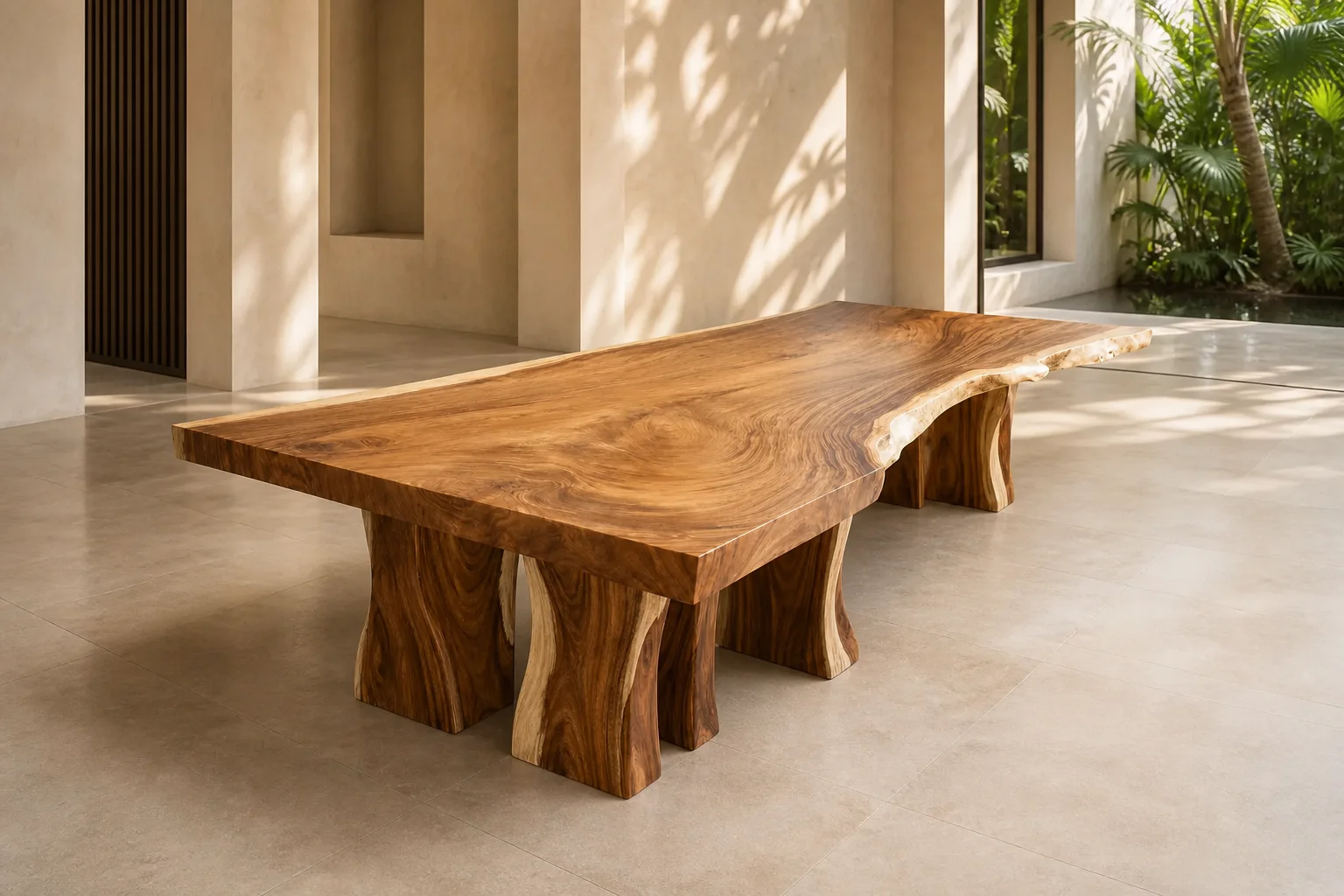
A properly proportioned mortise-and-tenon joint is generally the strongest practical joinery for a solid teak dining table’s leg-to-apron frame. Its long-grain bonding surfaces and bearing shoulders resist the
Ask a maker where the table’s structural mortise-and-tenon joints are located, how the top is allowed to move, and whether pegs are structural or decorative.
Joint strength in a solid teak dining table depends on joint geometry, grain direction, adhesive fit, and resistance to side-to-side racking. Teak’s oily, dense wood makes clean machining and disciplined glue preparation important. For a conventional four-legged table, the joint joining each apron to its leg carries the most consequential structural loads.
Unlike a tabletop panel, the base behaves like a series of levers: a diner pulling a chair, moving the table, or leaning on an edge twists the leg-and-apron frame. A joint must therefore resist withdrawal, shear, and repeated racking, not merely support vertical weight. The USDA Wood Handbook explains that wood movement and joint performance vary with grain orientation and moisture; teak’s natural extractives also reward freshly prepared surfaces and an adhesive selected for dense hardwoods. Good shoulder contact distributes load and keeps the base square through years of use.
A properly proportioned mortise-and-tenon is normally the strongest practical choice for solid teak dining-table leg-to-apron joinery. Its tenon cheeks create broad long-grain bonding surfaces while the shoulders register the apron against the leg. A drawbored peg can add mechanical clamping and continued holding if an adhesive bond is stressed.
For most bases, use a tenon sized conservatively enough to preserve leg strength, with square, fully seated shoulders and a mortise deep enough for meaningful glue area. Machine the parts accurately; gaps reduce contact, and forcing a swollen tenon can split the leg. Traditional pinned mortise-and-tenon construction remains serviceable because the peg supplements, rather than replaces, close wood-to-wood fit. The USDA Wood Handbook emphasizes that grain direction and joint geometry affect performance. Avoid relying on screws alone in end grain for this connection under racking.
The strongest base joint cannot compensate for a tabletop restrained against seasonal movement. Glue teak boards only along their long edges, then attach the completed top with elongated slots, figure-eight fasteners, or buttons. Breadboard ends can stabilize a wide top when their tenons or fasteners still permit cross-grain movement.
Do not use screws driven through a fixed apron to trap a solid teak top: humidity changes can make the panel cup, split, or pull fasteners loose. Instead, make the top from properly acclimatized boards, clamp edge joints with aligned faces, and allow the base connection to slide across the grain. The USDA Wood Handbook documents moisture-related dimensional change in wood; the amount varies with board orientation, finish exposure, and local conditions. For export furniture, acclimatization should suit the destination environment, not only the Bangkok workshop.
For a leg-to-apron connection, a well-made mortise-and-tenon is usually the strongest practical option. It combines long-grain glue surfaces, shoulders that resist twisting, and a tenon that resists withdrawal. A drawbored hardwood peg can provide additional mechanical retention, but it cannot correct an undersized tenon, poor shoulders, or loose mortise.
Dowel joints can make a sound teak table when multiple accurately located dowels provide adequate long-grain engagement, but they offer less continuous shoulder support than a traditional mortise-and-tenon. A loose-tenon system can approach similar strength when sized correctly. For large dining tables, evaluate the entire base, apron depth, and expected racking loads—not the connector alone.
Teak can challenge adhesive bonding because its natural oils and extractives can contaminate an aged or polished surface. Dry-fit first, then machine or sand mating faces immediately before assembly, remove dust, and follow the adhesive manufacturer’s instructions. Waterproof-rated wood glues or appropriate epoxy may be considered, but precise joint fit remains more important than simply adding adhesive.
Use screws as supplemental hardware, such as for tabletop fasteners or removable brackets, rather than as the primary leg-to-apron joint. Screws driven into end grain have limited withdrawal reliability under cyclic racking. If a knock-down design is needed, use purpose-designed bolts, threaded inserts, and cross-grain movement provisions engineered for the table’s loads.
This educational resource is published by M Furniture & Decor. Joinery suitability depends on table dimensions, timber moisture content, intended use, and workshop execution; consult an experienced furniture maker for a specific design.