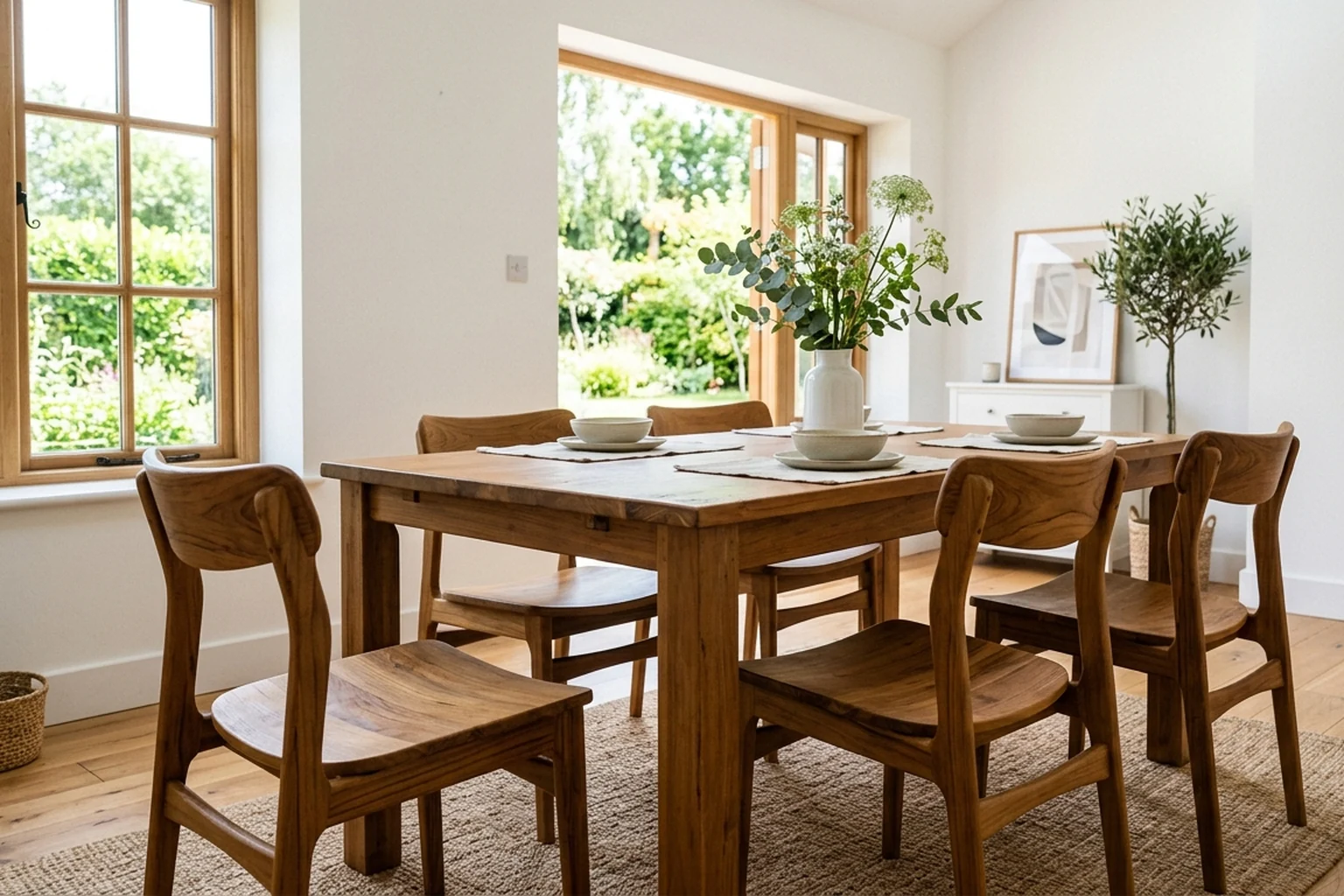
Factories reinforce teak chairs for hospitality use with engineered joinery, stable material preparation, bracing, and documented inspection—not simply heavier timber. A commercial chair must remain level and resist
{'type': 'image', 'src': 'https://mfurniturethailand.com/images/resources/teak-hospitality-chair-frame-joinery.jpg', 'alt': 'M Furniture & Decor teak hospitality chair frame showing reinforced joinery', 'caption': 'A hospitality chair frame is strengthened through connected construction choices rather than a single added component.'}
Factories reinforce hospitality teak chairs first by controlling raw-stock quality and joint geometry, not by adding hardware after a chair loosens. Properly dried teak, grain-aware component selection, and accurately machined mating faces help the frame resist rocking, seasonal movement, and the repeated side loads common in restaurants and hotels.
Teak is naturally durable, but natural durability does not prevent a poorly fitted chair from loosening. A factory should condition lumber to a moisture range suited to the destination and measure it before machining; **8–12%** is a common indoor-furniture target, not a universal specification. Components should keep continuous grain along legs and rails, while short-grain sections are rejected at joints. The USDA Wood Handbook explains why wood changes dimension differently across and along grain, a central consideration for every solid-wood chair frame.
Mortise-and-tenon joints are the core reinforcement in a solid teak hospitality chair because they create long-grain glue area and positive mechanical shoulders. Factories improve their performance with consistent tenon fit, durable adhesive, full clamping pressure, and joint layouts that carry racking forces through rails rather than through screws alone.
A chair typically transfers load from the seat through **four legs** and several rails, so the rail-to-leg connection deserves the closest control. Factories machine mortises and tenons to repeatable tolerances, dry-fit assemblies, apply adhesive to mating surfaces, and clamp until the bond has cured as specified. Dowels, screws, or concealed brackets may assist selected designs, particularly removable seats, but they are not substitutes for a correctly proportioned joint. The USDA Forest Products Laboratory provides engineering guidance on wood connections, adhesives, and moisture-related movement.
Corner blocks, side rails, and stretchers turn individual teak parts into a triangulated chair frame. Factories position these reinforcements where guests push, pull, twist, or lean—especially below the seat and between legs—while preserving clearance, clean lines, and access for replacement glides or serviceable hardware.
Seat corner blocks increase the bearing area between the seat rails and legs, helping distribute twisting forces rather than concentrating them at one joint. Lower stretchers can reduce leg splay and racking, but their height must allow housekeeping equipment and guest footwear to pass comfortably. On upholstered chairs, a plywood or engineered seat deck may also stabilize the upper frame when specified for the project. Factories should confirm that brackets, glides, and any threaded inserts are aligned before final assembly; a misplaced fastener can split teak or introduce a wobble despite otherwise sound joinery.
Commercial reinforcement is not complete until a representative chair is checked for stability, static loading, repeated loading, and joint durability. Factories use in-house fixtures and, when a project requires it, independent laboratory testing against the buyer’s specified standard, such as EN 16139 for non-domestic seating.
A useful quality plan records the tested chair configuration, including timber sections, upholstery, glides, hardware, finish, and assembly method. Checks commonly include levelness on a flat reference surface, static seat and back loads, cyclic loading, and visual inspection for cracks or joint opening. EN 16139 is relevant to non-domestic seating, while BIFMA standards address defined furniture categories and test methods. A report should identify the exact standard, test sequence, sample, and pass criteria; it does not automatically cover untested variants.
Finishing and maintenance support structural reinforcement because water entry, abrasive cleaning, and loose glides can accelerate damage at teak joints. Factories seal and finish appropriate surfaces, inspect chair levelness, and provide care instructions so operators can catch wobble or hardware loosening before a small issue becomes a broken frame.
Finish selection should match the environment: an indoor dining chair, covered terrace chair, and poolside chair face different water, ultraviolet, and cleaning exposures. Factories should sand edges consistently, seal suitable surfaces, allow finish systems to cure, and install non-marking glides where floors require them. Operators can extend service life by cleaning with approved products, keeping chairs from standing in water, and checking for movement during routine room or dining inspections. The USDA Wood Handbook remains a useful reference for understanding how changing moisture conditions affect solid wood.
Not necessarily. A correctly designed solid-teak frame can rely primarily on mortise-and-tenon joinery, adhesive, rails, and blocks. Metal brackets or threaded inserts are useful where designs require removable components or high-stress fastening, but they should supplement sound wood geometry. Hardware cannot reliably compensate for weak grain orientation or poor fit.
Buyers should specify the use case, user weight assumptions, seating type, and applicable market requirements before testing begins. For contract environments, EN 16139 is commonly referenced for non-domestic seating; project teams may also request stability, cyclic-load, and visual-inspection records. A test report applies only to the tested construction, materials, and configuration.
Ask for drawings that identify joint locations, rail dimensions, corner blocks, stretcher placement, wood moisture controls, adhesive process, and inspection points. Request a sample chair and check it on a flat surface for rocking, open joints, sharp edges, and loose glides. For volume orders, define acceptance criteria and test frequency in writing.
This educational resource reflects furniture-manufacturing practices relevant to M Furniture & Decor products and should be used alongside project specifications, local requirements, and independent test documentation where required.