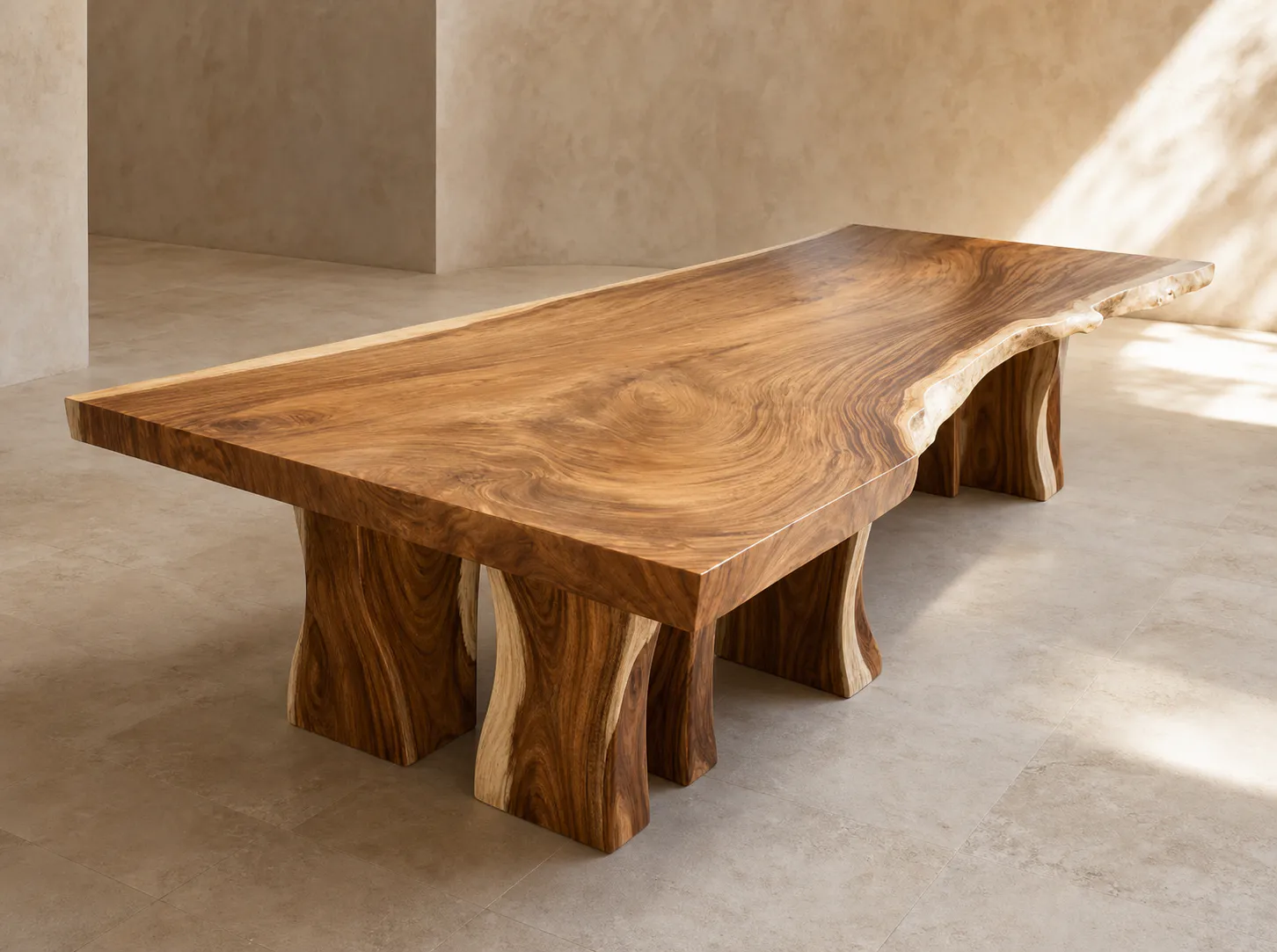
Normal mango wood color variation is broad, and visible differences between boards are usually expected rather than problematic. Solid mango furniture can show pale yellow, warm honey, medium
If a mango wood top does not look perfectly uniform, that alone does not indicate poor quality. Natural contrast is common in solid wood construction.
{'type': 'table', 'caption': 'Typical normal mango wood variation at a glance', 'headers': ['Feature', 'Usually normal?', 'What it may look like'], 'rows': [['Sapwood-heartwood contrast', 'Yes', 'Lighter cream areas beside deeper brown zones'], ['Mineral streaks', 'Yes', 'Dark lines, gray marks, or smoky patches'], ['Spalting', 'Yes, if sound', 'Decorative black or brown vein-like patterning'], ['Finish absorption differences', 'Yes', 'Some boards appear richer or darker after staining']]}
Normal mango wood commonly ranges from light golden or creamy yellow to honey, tan, medium brown, gray-brown, and occasionally pinkish or olive-toned areas. Dark streaks, smoky patches, and moderate contrast between adjacent boards are also common, especially in solid wood tops assembled from multiple planks with different grain and density.
Mango wood is not a uniform species in appearance, so buyers should expect variation across a single table, cabinet, or bed. The Wood Database notes that mango can show several brown and grayish tones, and manufacturers often highlight that range instead of hiding it. In practice, one board may read honey colored while the next appears more muted, cooler, or darker once sanded and sealed, particularly under oil, lacquer, or stain.
Mango wood varies because each board contains different proportions of sapwood and heartwood, different grain orientation, and different moisture and density levels. Mineral deposits, spalting, finishing response, and UV exposure can further shift tone, making natural mango furniture look more varied than engineered wood or veneer surfaces.
Color variation happens before and after manufacturing. In the tree, growth rate, soil conditions, age, and internal chemistry influence color. After milling, quarter-sawn and flat-sawn faces can reflect light differently, and finishing can darken one board more than another because porous sections absorb more product. The USDA Forest Products Laboratory explains that wood is naturally variable by species and within species, which is why two adjacent parts rarely behave exactly alike.
{'type': 'image', 'src': 'https://mfurniturethailand.com/resources/images/mango-wood-board-variation.jpg', 'alt': 'Mango wood board variation showing sapwood, heartwood, and dark streak context', 'caption': 'Adjacent mango planks can differ noticeably in tone while still being fully normal and structurally sound.'}
Yes, dark streaks, patches, and thin lines are often normal in mango wood when the surface is solid, dry, and stable. They may come from mineral staining, heartwood character, grain concentration, or decorative spalting rather than damage. Concern is more appropriate when marks feel soft, crumbly, wet, or actively spreading.
Many buyers mistake dramatic markings for flaws, but visual contrast alone is not evidence of structural weakness. Spalting can create black or dark brown lines, while mineral content can produce smoky or charcoal-like streaks. These marks are often prized because they make each piece distinct. By contrast, true concern signs include softness, powdering, active mold odor, or deep checks that compromise use, not merely color irregularity on an otherwise sealed panel.
A practical rule: if the wood is hard, finished evenly, and stable at the joints, color contrast is usually cosmetic rather than structural.
Normal variation changes color but leaves the wood sound: the surface stays hard, joints remain tight, and the finish feels dry and complete. A likely defect involves movement, softness, open cracks, water damage, or finish failure. In short, appearance variation is common, but structural instability is the real warning sign.
Evaluate mango wood in three steps. First, inspect consistency of hardness by pressing around dark areas and seams. Second, check stability: drawers should run correctly, tops should sit flat, and joints should not separate. Third, assess the finish under daylight, because uneven sheen, blotchy wet spots, or lifting film may indicate coating problems rather than natural character. A well-built solid wood piece can show broad tonal contrast and still be completely acceptable.
{'type': 'table', 'caption': 'Normal character versus possible defect in mango wood', 'headers': ['Observation', 'Usually normal character', 'Possible defect sign'], 'rows': [['Color difference between boards', 'Yes', 'Only if paired with warping or poor joinery'], ['Dark streaks or spalting', 'Yes', 'Only if area is soft or deteriorating'], ['Small tonal change over time', 'Yes', 'Only if finish peels or stains bleed unusually'], ['Hairline texture variation', 'Yes', 'Only if cracks widen or catch movement']]}
Yes, mango wood usually changes somewhat over time. Exposure to sunlight, oxygen, indoor humidity, and the original finish can deepen, mute, or warm its tones. This aging is normal for solid wood furniture, although the degree varies by board, so existing contrast may soften or become more noticeable.
Like teak, oak, and walnut, mango wood is a living natural material even after milling. UV light can darken some finishes, while oxidation can mellow brighter yellows into richer amber or brown tones. Placement matters: a table near a window may change faster than a sideboard in shaded interior light. Rotating accessories, using curtains, and cleaning with finish-safe products can help the piece age more evenly without trying to eliminate natural variation altogether.
For buyers comparing showroom samples with delivered furniture, lighting matters almost as much as wood itself. Warm LEDs can emphasize honey tones, while cool daylight can bring out gray or olive notes. That is why reputable makers and retailers often describe mango as naturally varied instead of promising exact color matching across every panel or future production batch.
Not usually. Uneven color is common in solid mango wood because boards can include different grain patterns, densities, and mixes of sapwood and heartwood. If the piece feels solid, dry, and well finished, visible contrast is generally normal character rather than evidence of inferior construction or damaged material.
Often they are not. Black or dark lines may be natural spalting or mineral streaking, both of which can be decorative and harmless when the wood is dry and firm. Suspect a problem only if the area smells musty, feels soft, sheds powder, or shows ongoing moisture-related deterioration.
Lighting strongly affects how mango wood appears. Warm bulbs can make the surface look richer and more golden, while cooler daylight may emphasize gray, olive, or brown undertones. Because mango wood already has natural variation, changes in room light can make board-to-board contrast seem stronger or softer.
Usually no. A stain or clear topcoat can reduce or blend some contrast, but it rarely makes mango wood perfectly uniform. Different boards absorb finish at different rates, so the same product may deepen one area more than another. That response is normal for real wood surfaces.
This resource is for general educational purposes and describes common characteristics of solid mango wood. Actual appearance varies by tree, cut, finish, lighting, and production batch, so buyers should review product photos, finish samples, and seller specifications before ordering.