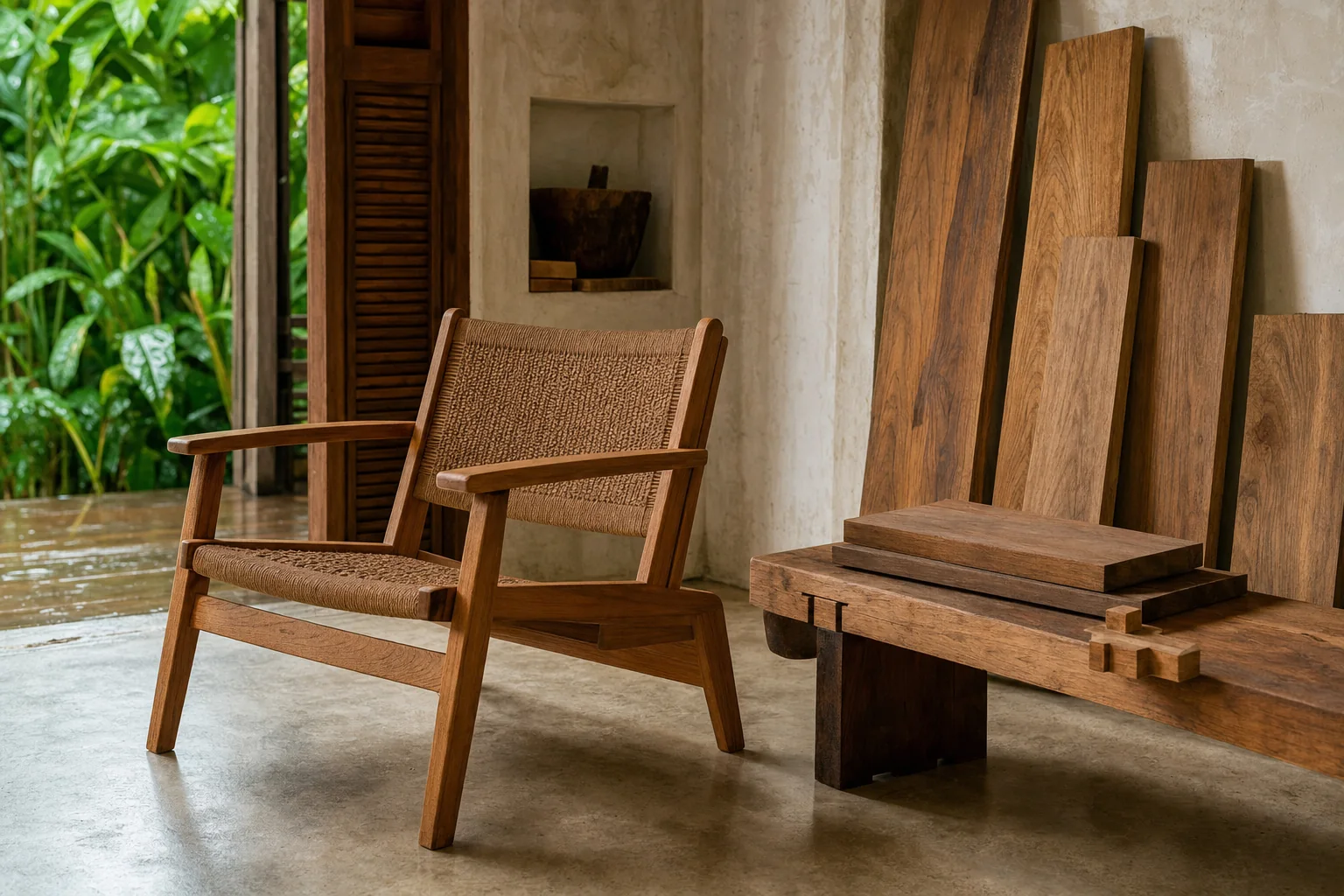
Teak is a practical indoor furniture choice when the piece is genuinely solid, properly dried, well joined, and sized for daily use. Start with construction rather than surface
Buying tip: photograph the underside, joinery, and any timber documentation before confirming a custom or export order.
Choose solid teak components with consistent grain, sound joints, and timber dried for furniture making. Check underneath the piece, inside drawers, and at leg-to-frame connections. Avoid judging quality from a dark stain alone. Clear information about *Tectona grandis*, construction, and moisture conditioning is more useful than a generic “teak” label.
Ask whether tops, frames, drawer fronts, and internal rails are solid teak or veneered board. Solid wood can show natural grain variation and may use glued boards for wide tops; that is normal when joints are sound. Look for mortise-and-tenon, dowel, or carefully fitted joinery, plus level feet and smooth drawer travel. The USDA Wood Handbook explains why wood changes dimension as moisture changes. Request the maker’s timber-conditioning process and inspect for open joints, deep checks, unstable rocking, or heavy filler.
Select teak furniture only after measuring the room, circulation routes, doors, lifts, and the intended use area. Leave comfortable clearance around dining chairs and walkways. Match tabletop, seat, and storage dimensions to daily routines, because a durable teak piece is successful only when it remains comfortable, accessible, and proportionate indoors.
Record width, depth, height, and diagonal access measurements before ordering. For dining, allow roughly 60 centimetres of table edge per diner and reserve enough space to pull chairs back without blocking circulation. Compare a chair’s seat height with the table rather than relying on photographs. In compact Bangkok apartments, a slim sideboard or extendable table may work better than a deep cabinet. Place teak away from persistent direct sun, radiator-like heat sources, and damp exterior openings; these conditions can increase uneven fading or seasonal wood movement.
Choose an indoor teak finish according to the look and maintenance you accept: clear protective finishes preserve a more natural tone, while tinted finishes alter color and can conceal grain variation. Test a sample in the room’s light, ask about repair methods, and confirm whether the surface is suitable for food, drinks, or frequent cleaning.
Teak ranges from golden brown to darker brown, and boards within one item will not always match exactly. This variation is part of solid wood rather than an automatic defect. Ask for an offcut or finished sample and view it in morning and evening light before approving a custom color. A clear lacquer or polyurethane-type finish generally gives more spill resistance than untreated wood, while an oil finish may be easier to refresh locally but needs more regular attention. Follow the maker’s care directions; avoid silicone polishes and harsh solvents that complicate later refinishing.
Verify teak furniture value by requesting the species, country of processing, seller identity, invoice details, and any applicable chain-of-custody documentation. Certification can support traceability but should be checked against the certificate holder. Compare construction, finishing, lead time, delivery scope, and warranty terms rather than comparing price alone.
Responsible sourcing questions are especially useful for imported solid wood. Ask whether the supplier can provide an FSC claim and verify it through the Forest Stewardship Council certificate search where applicable. International trade paperwork may also matter for particular timber products, so review current requirements through CITES. Obtain a written specification covering wood species, finish, dimensions, hardware, packing, delivery, and what counts as a defect. A lower quote can omit kiln drying, skilled joinery, export crating, installation, or after-sales repair support, changing the real comparison.
Teak is well suited to indoor furniture because it is durable, visually warm, and naturally oily, but material alone does not guarantee quality. Choose a piece with properly conditioned timber, stable joinery, and an indoor-appropriate finish. Keep it away from sustained heat, direct sun, and excessive moisture for more even aging.
Ask the seller to identify each component and inspect inconspicuous areas such as undersides, drawer interiors, and back panels. Solid teak normally shows continuous grain and natural variation, while veneer has a thin decorative face over a substrate. A glued solid-wood tabletop can still be legitimate; construction quality matters most.
Choose oil when you prefer a lower-build, tactile finish and are prepared to refresh it periodically. Choose a clear lacquered or polyurethane-type finish when you want stronger day-to-day resistance to spills and easier wiping. Request a finished sample first, because each treatment changes color, sheen, and future repair options.
This resource is published by M Furniture & Decor, a teak furniture maker. Product suitability, sourcing documentation, finish systems, and import requirements should be confirmed with the seller and relevant local authorities before purchase.