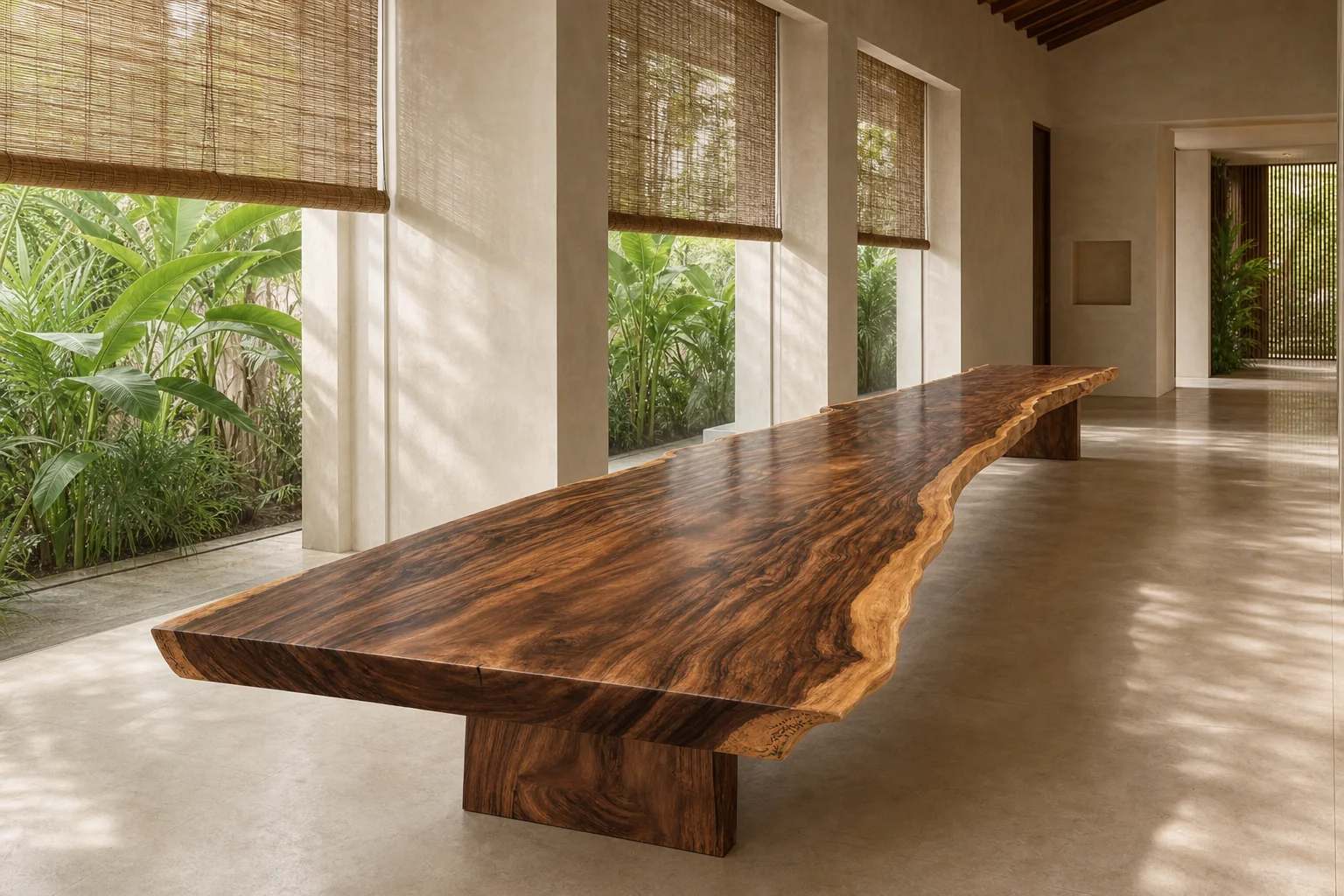
Choose a teak furniture supplier for a hotel or resort by treating the purchase as a controlled project, not a catalogue order. Require evidence of legal timber origin
Ask every shortlisted supplier to quote the same bill of quantities, drawings, finish schedule, packing standard and delivery destination. Comparable inputs produce a more reliable supplier comparison.
Verify a teak supplier with documents rather than verbal assurances: request legal-harvest and export records appropriate to the origin, confirm any FSC or PEFC chain-of-custody claim, inspect recent hospitality references, and identify the factory responsible for production. A supplier should clearly disclose timber species, sourcing route, subcontracting and accountable project contacts.
Request the supplier’s legal entity details, factory address, project references and a traceability file matched to the proposed teak. If a supplier claims certification, obtain its certificate code and check the public database of the Forest Stewardship Council or PEFC International. Ask for 3 comparable hotel or resort installations, including product scope and completion date. For projects importing into regulated markets, have the buyer’s compliance team confirm the documentation needed for that destination; certification does not automatically replace import due diligence.
Hospitality suitability is demonstrated through approved samples, drawings and inspection criteria, not product photos. Review timber grade, moisture management, joinery, hardware, upholstery interfaces and finish performance for the actual setting. Test representative pieces under expected use, especially for poolside, beachfront, restaurant and high-turnover guestroom applications.
Issue drawings that define dimensions, tolerances, timber selection, joinery, hardware brand or performance level, finish colour and sheen, and any fire or durability requirement. Approve one control sample before mass production and retain it as the quality benchmark. Outdoor pieces need explicit drainage, movement allowance and corrosion-resistant hardware requirements; indoor dining and bedroom pieces need stable geometry and repairable finishes. Relevant ANSI furniture standards can help procurement teams identify test categories, while the project consultant should select standards applicable to the country and use case.
{'type': 'table', 'caption': 'Sample approval records that reduce ambiguity', 'headers': ['Check', 'Evidence to retain', 'Decision point'], 'rows': [['Timber and construction', 'Labelled sample, cut sections and approved drawings', 'Confirm species, grade and joinery'], ['Finish', 'Signed colour panel and use-condition notes', 'Confirm sheen, texture and maintenance method'], ['Function', 'Mock-up or representative-use inspection', 'Confirm stability, comfort and fit with the room scheme']]}
Compare suppliers on total project risk and delivered scope, not the lowest unit price. Obtain matched quotations, validate capacity against the required production window, schedule staged inspections, and state remedies for defects or delays. The contract should assign responsibility for approvals, packing, freight coordination, warranty service and replacement components.
Ask each bidder to separate product price, prototype charges, export packing, inland transport, freight assumptions, duties, installation and spare parts. Review the factory’s current order load, workforce, machinery and planned output by week; capacity should be evidenced, not estimated. Use 3 control points: pre-production sample approval, in-process inspection and pre-shipment inspection. A purchase order should include the approved bill of quantities, drawings, finish sample, tolerance rules, delivery milestone, Incoterms® rule, payment schedule and defect-resolution process. The International Chamber of Commerce explains how Incoterms allocate delivery obligations, but they do not replace product-quality terms.
Use a 100% documented pre-shipment inspection for visible finishes, quantities, packing marks and loading records when the project cannot easily accept replacement lead times.
Request the supplier’s legal company details, factory address, itemised quotation, timber species declaration, origin and export documents relevant to the shipment, plus any certificate code claimed. Also request drawings, finish samples, quality-control plan, packing specification, delivery schedule, warranty terms and recent comparable hotel or resort references.
FSC certification is not universally required, because obligations depend on the project, client policy and destination market. However, a valid chain-of-custody certificate can support traceability claims. Buyers should verify certificate scope directly with FSC, then obtain legal-origin and import documentation required by their own compliance advisers.
Approve at least one signed control sample for each materially different furniture type, timber grade or finish. Add a room mock-up when dimensions, upholstery, lighting or guest interaction could affect acceptance. Keep labelled samples and approved drawings available through production, inspection, delivery and final snagging for consistent comparisons.
A hotel furniture warranty should identify covered defects, exclusions, duration, reporting procedure, repair or replacement responsibility, labour allocation and spare-part availability. It should also distinguish normal wear from manufacturing faults. Match warranty language to the intended indoor or outdoor environment, maintenance plan and documented installation conditions.
This resource is published by M Furniture & Decor, a manufacturer and supplier of teak and custom furniture. It is intended as general procurement guidance; buyers should obtain project-specific legal, technical, logistics and compliance advice.