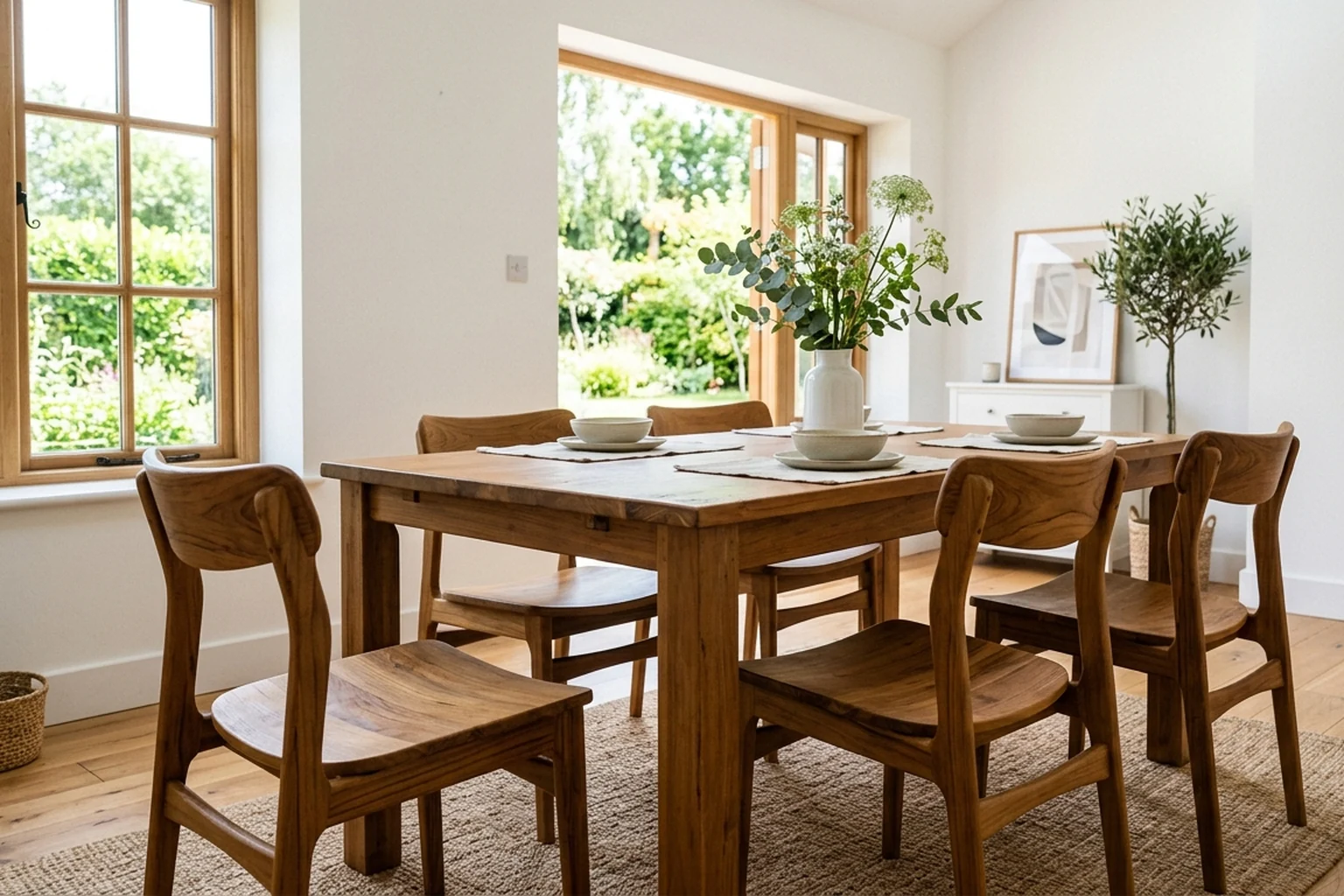
Teak bar stools should be chosen by measured fit, durable solid-wood construction, and the conditions where they will live. Begin with the finished counter or bar height, leave
{'type': 'table', 'caption': 'Starting dimensions for planning teak bar stools', 'headers': ['Application', 'Surface height', 'Typical seat height', 'Planning check'], 'rows': [['Kitchen counter', 'About 90 cm', 'About 60–65 cm', 'Confirm 25–30 cm between seat and underside of top'], ['Home or hotel bar', 'About 105 cm', 'About 75 cm', 'Confirm footrest position and comfortable knee clearance']]}
Choose seat height from the finished floor to the counter underside, not from a catalogue label. Allow about 25–30 cm between the seat and worktop, then confirm legroom, stool width, and how many seats fit without elbows or knees touching during everyday use.
Measure after flooring and countertop installation because both alter the usable dimension. As a planning rule, a 90 cm counter commonly pairs with a 60–65 cm seat, while a 105 cm bar commonly pairs with a 75 cm seat; treat these as starting points rather than universal rules. Reserve enough lateral room to turn and sit comfortably, and verify the maker’s overall width, depth, and footrest projection. BIFMA publishes furniture-performance information, but final fit should be checked against project drawings and actual user needs.
{'type': 'image', 'src': 'https://mfurniturethailand.com/en/images/resources/teak-bar-stool-height-guide.jpg', 'alt': 'M Furniture teak bar stool height guide beside a kitchen counter', 'caption': 'Measure the finished surface and stool seat height before selecting a teak bar stool.'}
Prefer stools made from solid teak with clearly described timber origin, stable joinery, and a finish matched to exposure. Inspect the seat, leg-to-rail connections, and footrest for movement; certification documents can support sourcing claims but do not replace checking the actual product specification.
Ask whether the frame and seat are solid teak rather than teak veneer over another substrate, and request a drawing that identifies rails, stretchers, fasteners, and replaceable glides. Well-fitted mortise-and-tenon joints or other documented structural joints are more informative than wood species alone. Review chain-of-custody evidence through FSC when it is relevant to the purchase, and use the USDA Wood Handbook to understand why wood can change dimension as moisture changes. For commercial projects, retain the approved sample and finish schedule with the purchase order.
Match the finish and maintenance plan to the stool’s exposure, cleaning routine, and finish preference. Indoor teak usually needs routine dusting and prompt spill removal, while covered outdoor use needs drainage, protective pads, and periodic inspection for finish wear, loosened hardware, or surface checking.
Specify a finish sample before production, especially where stools meet pale stone, metal, or upholstery. Clear coatings can reduce immediate staining but require renewal when worn; oiled surfaces may be easier to spot-repair but should follow the manufacturer’s method. Avoid leaving wet cloths or abrasive cleaners on wood, and use felt or polymer glides to limit floor damage. The USDA Forest Products Laboratory provides wood-research context; cleaning directions from the finishing-system supplier should govern the project. Photograph the accepted finish, record its sheen, and schedule inspections every 6–12 months in busy hospitality settings.
For a standard counter, measure from the finished floor to the underside of the top and subtract roughly 25–30 cm for seat height. Test this range against the stool’s actual cushion thickness, apron clearance, and users’ legroom. Bar-height surfaces generally require taller stools, so never rely only on product labels.
Solid teak is wood through the principal components, whereas teak veneer is a thin teak face bonded to another core. Veneer can suit some interiors, but exposed stool edges, joints, and repair needs make construction disclosure important. Ask for material specifications, drawings, and photographs of underside details before comparing quotations.
Teak can be used outdoors, but a bar stool needs a location-specific plan. Covered, well-drained areas reduce standing water and finish stress. Confirm the finish system, hardware grade, glides, and cleaning method with the supplier. Inspect periodically for movement or worn coating, particularly in humid or high-traffic hospitality environments.
Credible sourcing evidence identifies the supplier, wood species, and relevant chain-of-custody documentation for the order. FSC certification can be useful when its claim and certificate scope match the transaction. It does not establish comfort or durability by itself, so combine documentation with construction details, samples, and written specifications.
Guidance is informational and should be checked against the final product drawing, finish specification, project conditions, and supplier documentation before purchase.