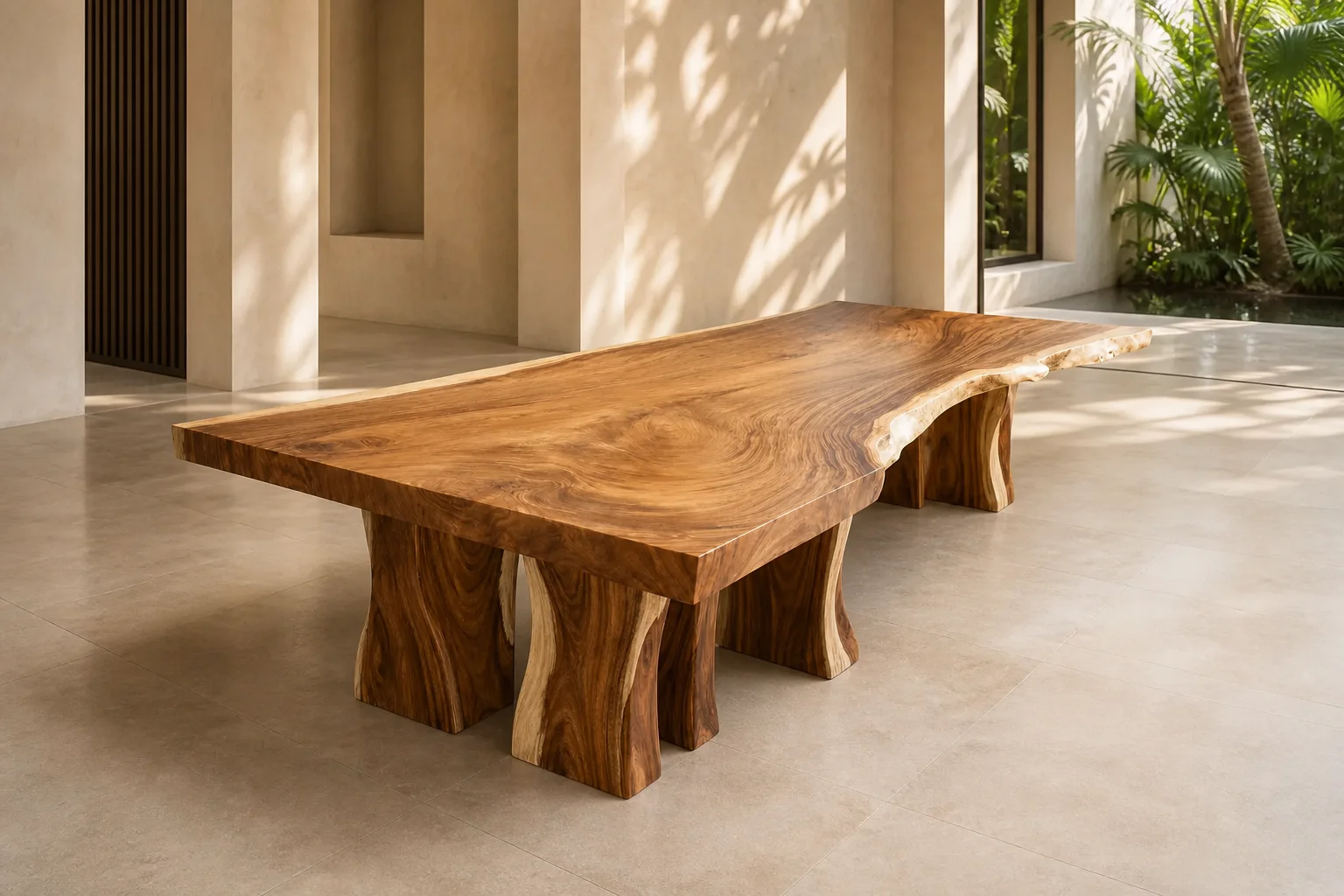
Checking and cracking in wood slabs are usually moisture problems before they are workmanship problems. Solid wood shrinks as it loses bound water, but it does not shrink
That is why live edge tops, dining tables, bench seats, and thick teak slabs can look stable at delivery and still open later in Bangkok, London, Dubai, or Los Angeles if storage, drying, or indoor humidity changes are poorly controlled. Species, slab thickness, grain orientation, and end sealing all influence where the stress concentrates.
A *check* is generally a small separation along the grain caused by drying stress. A *crack* or *split* often describes a wider or deeper opening, but the root cause is commonly the same: differential shrinkage.
Wood slabs develop checks and cracks during drying because moisture leaves the wood unevenly. The surface and end grain dry first and begin shrinking while the core stays wetter and larger. That mismatch creates tensile stress, and once the stress exceeds fiber strength, the slab opens along the grain.
Drying is the most common stage for defects because wood does not lose moisture at a uniform speed. End grain can release water many times faster than face grain, so the slab ends shrink first. In a thick slab, the shell may already be contracting while the interior remains swollen. The USDA Forest Products Laboratory explains that these moisture gradients create tension and compression zones that can produce end checks, honeycombing, and surface checking if unmanaged.
Humidity changes after installation cause cracking when the slab reaches a new equilibrium moisture content too quickly or too often. Indoor air that is much drier than the wood’s previous environment makes the slab shrink, and restrained movement or uneven exposure can turn normal shrinkage into visible cracks.
A slab does not stop moving after kiln drying or fabrication. It continues exchanging moisture with surrounding air until it matches local relative humidity. If a top made at 10% moisture content is moved into a heated room with much drier air, it will keep shrinking. If one face is sealed differently, placed over radiant heat, or exposed to direct sun near glazing, movement becomes uneven and stress rises. The result may be new checks months after installation.
{'type': 'table', 'caption': 'Common service-condition triggers for slab cracking', 'headers': ['Condition', 'How it increases risk', 'Typical result'], 'rows': [['Low indoor humidity', 'Rapid overall shrinkage', 'Face checks or widening existing cracks'], ['Heat from windows or HVAC', 'One area dries faster than another', 'Localized cracking'], ['Uneven finishing or underside exposure', 'Different moisture exchange rates', 'Warp plus checking']]}
Checking is more likely in slabs that are thick, wide, freshly sawn, poorly sealed at the ends, or cut from species with stronger movement tendencies. Grain deviation, pith inclusion, knots, and pre-existing stress also concentrate shrinkage forces, making visible checks and cracks more likely during drying and later use.
Not every slab carries the same risk. Thick sections dry more slowly through the core, which increases shell-to-core moisture differences. Wide tops accumulate more total movement across their width. Slabs containing juvenile wood near the pith, interlocked grain, knots, or reaction wood often shrink less predictably. Species also matter: oak, suar, acacia, and teak each have different movement behavior, density, and extractive content, so drying schedules and acclimation times should be adjusted rather than standardized.
{'type': 'image', 'src': 'https://mfurniturethailand.com/images/resources/wood-slab-end-checking-diagram.jpg', 'alt': 'M Furniture & Decor diagram showing end checking on a solid wood slab during moisture loss', 'caption': 'End grain usually dries first, so checks often start at the slab ends before extending inward.'}
Handling and storage mistakes lead to slab cracking when they expose the slab to uneven airflow, sun, heat, or moisture before the wood has acclimated. Poor stacking, missing stickers, concrete-floor contact, and abrupt movement between climates can all create stress that opens new checks or worsens old ones.
Many slab failures are logistical rather than botanical. Freshly milled slabs stacked without proper stickers, spacing, weight, or shade can dry unevenly. Slabs left near warehouse doors, air conditioners, dehumidifiers, or direct sun often develop localized drying stress. Contact with a concrete floor can add moisture from below while the top dries, causing both warp and checks. International shipping adds another variable because a container, workshop, and final interior can differ sharply in temperature and relative humidity.
You can reduce checking and cracking by controlling moisture loss from the moment the slab is cut through installation. Seal the ends, use species-appropriate air or kiln drying schedules, verify moisture content with a meter, acclimate to the final environment, and design joinery that allows seasonal wood movement.
Prevention depends on matching the slab to its full lifecycle. Mills often apply end sealer to slow the fastest moisture loss path. Drying schedules should balance time, airflow, and temperature to avoid case-hardening and internal stress. Before fabrication, many workshops confirm moisture content with calibrated meters rather than appearance alone. During installation, elongated fastener slots, battens designed for movement, and stable indoor humidity help the slab move safely instead of splitting. These practices are widely supported in guidance from the U.S. Forest Service and American Wood Council.
{'type': 'quote', 'text': 'Wood can and does shrink and swell as its moisture content changes, and good design accounts for that movement rather than trying to eliminate it.', 'attribution': 'Adapted from USDA Wood Handbook guidance'}
Not always. A check is usually a smaller separation along the grain caused by drying stress, while a structural crack or split is often wider, deeper, or more likely to affect use. However, both commonly start with moisture imbalance, so early inspection and stabilization matter.
Yes. Kiln drying reduces moisture content, but it does not make wood dimensionally inactive. If the slab was overdried, dried unevenly, or later moved into a much drier or hotter environment, it can still shrink further and develop checks or widen existing cracks after installation.
Cracks often start at the ends because end grain releases moisture much faster than face grain. That makes the slab ends shrink earlier than the center, building tension along the grain. Without prompt end sealing and controlled drying, end checks are one of the most common defects.
No. Finish can slow moisture exchange, but it cannot stop wood movement or fix drying stress already inside the slab. A well-finished slab may still crack if moisture content was wrong, the environment changes sharply, or the base and fasteners do not allow seasonal movement.
This educational resource is published by M Furniture & Decor for buyers, designers, and specifiers evaluating solid wood slabs and furniture. It is general information, not a substitute for project-specific advice from a wood technologist, fabricator, or installer.