Buyers prevent gaps in wood flooring by treating wood movement as predictable, not avoidable. Solid wood and engineered wood both respond to humidity, so the practical defense is
Wood flooring expands as moisture rises and shrinks as moisture falls. The buyer's job is to keep that movement within expected seasonal limits.
{'type': 'table', 'caption': 'Buyer controls that most directly affect flooring gaps', 'headers': ['Control point', 'Why it matters', 'What to request'], 'rows': [['Moisture content', 'Reduces mismatch between factory and jobsite conditions', 'Written moisture range and meter readings'], ['Acclimation', 'Lets boards approach site equilibrium', 'Documented acclimation process before installation'], ['HVAC readiness', 'Stabilizes temperature and humidity', 'Closed building with operating climate control'], ['Product selection', 'Improves dimensional stability', 'Species, grade, width, and engineered or solid specification']]}
Gaps happen because wood gains and loses moisture as indoor relative humidity changes. When boards dry below their installed moisture condition, they shrink across the grain, opening spaces between pieces. Larger seasonal swings, wide solid planks, delayed HVAC startup, or wet-to-dry site transitions make those gaps more noticeable and sometimes permanent.
The core cause is hygroscopic movement. The USDA Forest Products Laboratory explains that wood exchanges moisture with surrounding air until it reaches equilibrium moisture content, so flooring installed during a humid season can shrink when air conditioning or winter heating lowers indoor humidity. Species, cut, and board width change how visible that shrinkage becomes. Wide solid oak, teak, or maple planks usually show movement more than narrow strips, while engineered construction can moderate it.
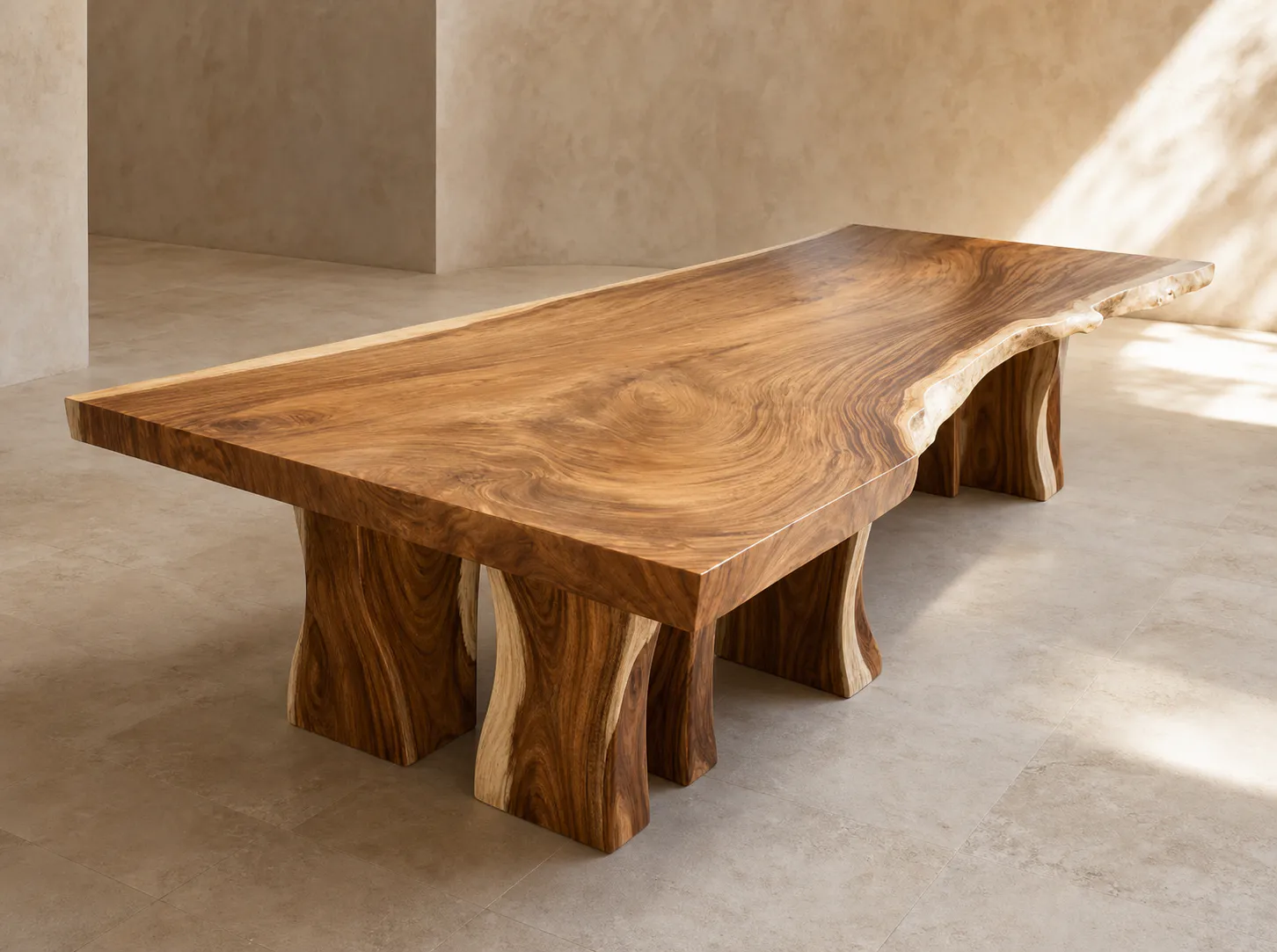
{'type': 'image', 'src': 'https://mfurniturethailand.com/resources/images/wood-flooring-moisture-gap-diagram.jpg', 'alt': 'Wood flooring moisture movement diagram showing board shrinkage and gaps in a conditioned interior context', 'caption': 'Moisture-driven shrinkage across the grain is the main reason visible gaps appear.'}
Before ordering, buyers should specify species, construction, target moisture content, board width, subfloor compatibility, and the indoor climate range the floor must perform in. Written specifications reduce disputes because the factory, shipper, installer, and owner all work to the same moisture and environment assumptions from the start.
A good purchase specification states whether the project uses solid wood or engineered wood, acceptable board width, grade, finish system, and target moisture range at shipment. It should also identify the destination climate, expected interior temperature, and relative humidity band. Referencing manufacturer instructions and NWFA practices helps align responsibility across supplier and installer. Buyers sourcing from Thailand, Europe, or North America should ask for kiln-drying records and meter readings taken before packing, not only general quality assurances.
Moisture testing and acclimation are essential because they verify whether the flooring and subfloor are close enough to jobsite conditions for installation. Without documented readings, buyers cannot distinguish normal seasonal movement from preventable installation error. Acclimation only works when the building is enclosed and HVAC is operating consistently.
Acclimation is not simply leaving cartons on site for a fixed number of days. The useful test is whether flooring moisture content is compatible with the interior environment and the subfloor. NWFA guidance emphasizes moisture measurement rather than arbitrary waiting periods, while APA notes that wood movement tracks moisture change. Buyers should require calibrated meter readings for both flooring and subfloor, recorded by area and date, after the building is enclosed, wet trades are complete, and HVAC has stabilized the space.
{'type': 'quote', 'text': 'Wood movement is normal; preventable failures usually begin when site conditions are not measured or controlled.', 'attribution': 'Procurement principle aligned with NWFA and USDA wood movement guidance'}
Engineered wood flooring is usually safer where humidity swings are larger because its layered construction improves dimensional stability. Solid wood remains appropriate in many projects, but buyers should be more cautious with wide planks and variable climates. The right choice depends on interior humidity control, subfloor type, and the visual goal.
Engineered flooring can reduce visible gapping risk because cross-layer construction limits expansion and contraction compared with a same-width solid plank. That matters in condominiums, hotels, and mixed-use projects where HVAC schedules vary. Solid wood still performs well when indoor humidity is kept within a predictable range and board widths are sensible. Buyers should compare species stability, wear-layer needs, refinishing expectations, and substrate conditions instead of assuming one product category solves every moisture problem.
Before installation, the building should be enclosed, windows and doors sealed, wet trades complete, subfloors dry, and HVAC running at normal occupied settings. These conditions matter because wood flooring should acclimate to the real service environment, not a temporary construction climate that later shrinks boards and opens gaps.
Many gap claims start with schedule pressure rather than product defects. If flooring is installed before plaster, paint, or concrete moisture has dissipated, boards can absorb moisture and later shrink as the building dries. Likewise, if HVAC starts only after handover, the floor experiences a sudden shift in equilibrium moisture content. Buyers, architects, and general contractors should align on readiness milestones: dry slab or wood subfloor, enclosed structure, stable temperature, stable relative humidity, and protected storage away from exterior exposure.
After handover, buyers prevent excessive gaps by keeping indoor relative humidity and temperature reasonably stable throughout the year. Occupants should avoid long periods of very dry or very humid air, especially in seasonal climates. Ongoing HVAC use, monitoring, and owner education matter as much as the initial installation process.
Wood floors perform best when the occupied space stays within the product's intended climate band. Sudden drops in relative humidity from aggressive air conditioning or winter heating commonly create visible gaps, while persistently high humidity can cause cupping instead. A simple operating plan helps: maintain HVAC, avoid switching systems off for long vacant periods, use humidification or dehumidification when needed, and keep a hygrometer on site. Buyers of hospitality and residential projects should include these maintenance expectations in turnover documents.
No. Wood is a natural material that expands and contracts with seasonal humidity changes, so some minor movement is normal. Buyers should aim to keep gaps within expected tolerances by controlling indoor climate, choosing stable constructions, and documenting moisture conditions before installation rather than expecting zero movement year-round.
There is no universal number of days that guarantees success. The correct benchmark is moisture compatibility between the flooring, subfloor, and expected service environment. Buyers should require meter readings after the building is enclosed and HVAC is operating, because stable conditions matter more than a fixed acclimation timeline alone.
Often yes, especially where indoor humidity changes significantly through the year. Engineered flooring is generally more dimensionally stable because of its layered construction. However, success still depends on subfloor dryness, proper acclimation, and steady HVAC operation, so engineered boards reduce risk but do not eliminate moisture-related problems by themselves.
The right range depends on the species and manufacturer, but the principle is consistent: avoid prolonged extremes and keep indoor conditions stable. Buyers should follow the flooring maker's published temperature and relative humidity guidance, then use HVAC, dehumidification, or humidification as needed to stay within that operating band.
This resource is educational and does not replace project-specific advice from the flooring manufacturer, installer, or building professional. Buyers should verify moisture, subfloor, and climate requirements for each product and destination.