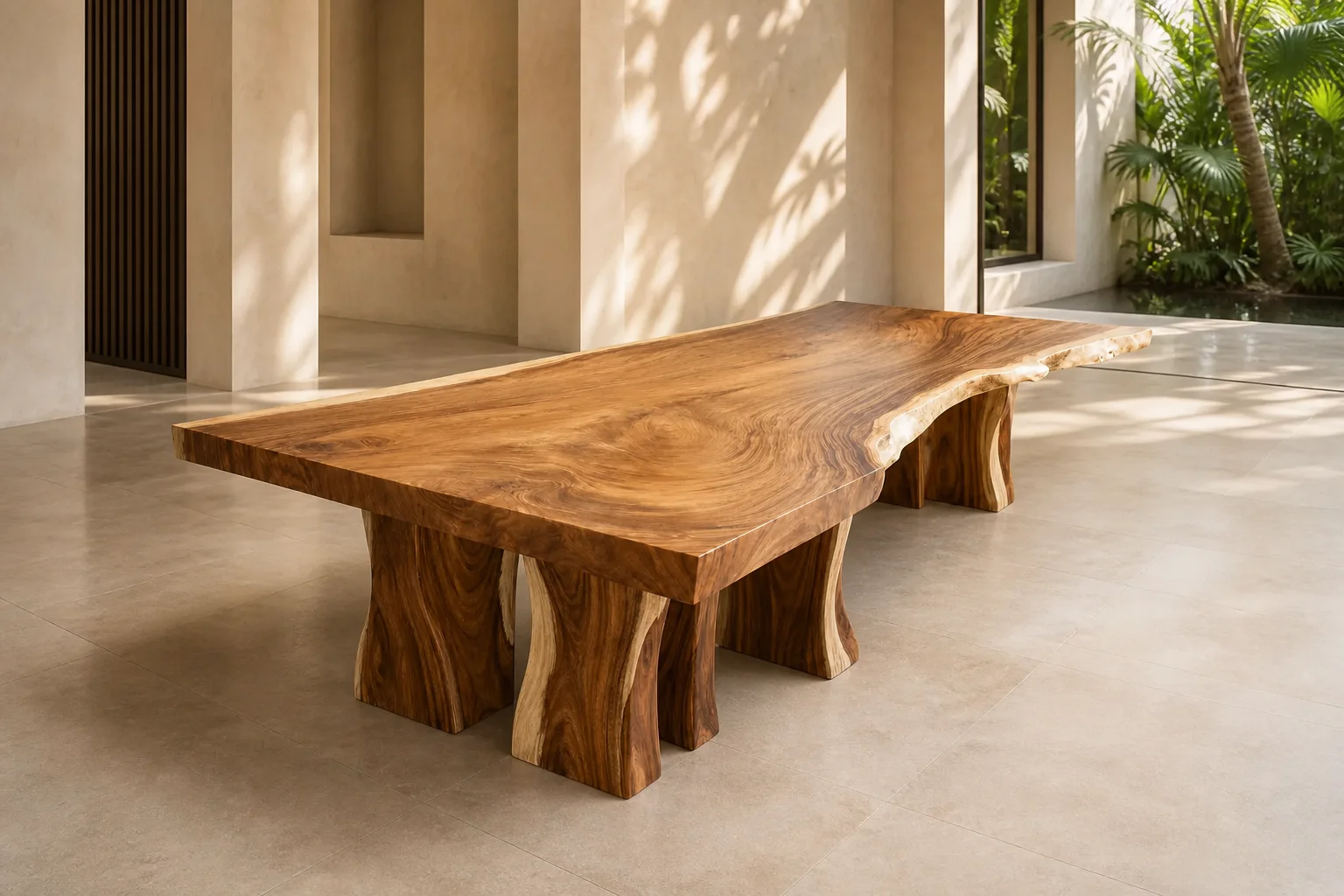
Buyers evaluate slab figure and character by separating visual interest from structural risk, then matching both to the intended use. In practice, they inspect grain movement, cathedral patterns
*Figure* usually refers to the visual pattern created by grain and growth behavior. *Character* usually refers to natural features such as knots, sapwood, checking, bark pockets, or color contrast.
{'type': 'image', 'src': 'https://mfurniturethailand.com/images/resources/slab-figure-character-annotated.jpg', 'alt': 'Teak slab figure and character evaluation example for furniture buyers comparing grain, sapwood, knots, and checks', 'caption': 'Annotated teak slab showing common figure and character features buyers review before approval.'}
Buyers usually use *figure* to describe the slab’s visual grain effect, such as cathedral movement, curl, or ribboning, while *character* refers to natural irregularities like knots, sapwood, pith, gum pockets, and checks. They evaluate both together because attractive figure can raise appeal, but strong character must still fit structural, aesthetic, and pricing requirements.
In furniture buying, figure answers the question of how the slab reads visually from a distance and at close range. Character answers whether natural marks feel acceptable, desirable, or risky for the application. A residential client may welcome bold sapwood contrast, while a hospitality project may prefer calmer grain for multi-piece consistency. Resources from the USDA Forest Products Laboratory and The Wood Database help define these visual distinctions.
Buyers focus first on grain flow, color variation, and overall balance, then review knots, sapwood width, pith presence, mineral streaks, bark inclusions, and edge shape. The key test is whether those features look intentional and harmonious across the slab, rather than random, distracting, or likely to limit fabrication options.
Experienced buyers often stand back several feet before inspecting details up close. That sequence matters: first impression determines emotional appeal, while close inspection determines feasibility. A slab with dramatic cathedrals may photograph beautifully yet lose value if the best grain sits outside the final cut line. Buyers therefore assess not just isolated features, but how those features survive trimming, flattening, and joinery during production.
Buyers treat desirable character as a natural feature that adds identity without undermining performance, while defects are features that reduce stability, strength, repairability, or yield. A knot, check, or sapwood band may be acceptable if disclosed and design-compatible, but active splits, decay, and poorly placed pith usually increase risk and lower value.
The distinction depends on end use, not just appearance. For example, a filled knot can work on a console table, but the same feature near a chair joint or table base fixing point may be unacceptable. Likewise, a small surface check may be stabilizable with butterflies or resin, whereas deep structural cracking can continue to move. The Wood Database defect guide provides a useful vocabulary for discussing these issues consistently with suppliers and clients.
Buyers judge slab figure and character differently depending on whether the slab will become a dining table, desk, vanity, bench, wall panel, or hospitality installation. High-contact, flat-use surfaces usually require stricter rules for checks, voids, and finish consistency, while decorative applications may allow stronger contrast and more expressive natural features.
{'type': 'table', 'caption': 'Typical tolerance by end use', 'headers': ['End use', 'Usually accepted', 'Usually reviewed more strictly'], 'rows': [['Dining table top', 'Balanced figure, moderate color variation, stable filled knots', 'Deep checks, unstable pith, excessive sapwood on eating surface'], ['Console or bench', 'Bolder live edge, visible repairs, stronger character', 'Weak areas at leg attachment points'], ['Wall panel or feature piece', 'High contrast, irregular edges, dramatic figure', 'Features that complicate mounting or create safety issues']]}
Beyond appearance, buyers check moisture content, flatness, thickness consistency, crack depth, usable width, and how much material will be lost during machining. A visually striking slab can become expensive if warping, trimming, or repairs reduce final yield. Production-aware evaluation protects budgets, timelines, and quality expectations before approval.
Professional buyers often ask for moisture readings, recent kiln status, slab dimensions at multiple points, and photos of both faces and end grain. They also consider where the final component will be cut from the slab, because a 5 to 10 percent trimming loss can materially change usable design width. Sustainability-conscious buyers may also request chain-of-custody context from organizations such as FSC, especially for contract furniture, export projects, and hotel procurement documentation.
Buyers judge value by comparing visual uniqueness with fabrication risk, yield, matching difficulty, and the expectations of the final customer. Dramatic figure can justify a premium when it survives production and supports the design story, but heavy character lowers value if it forces repairs, inconsistency, or future service issues.
A practical buying decision weighs at least four variables: appearance, stability, conversion efficiency, and client acceptance. Two slabs of similar size may price differently because one has cleaner cut yield, easier matching, or fewer uncertain repairs. For this reason, buyers often approve slabs only after reviewing scaled layouts, finish samples, and defect annotations. That discipline helps suppliers, designers, and end clients align on what is celebrated character and what is costly compromise.
No. More character is only better when it supports the design and remains structurally manageable. Strong sapwood contrast, knots, or live edges can create a memorable piece, but excessive checking, unstable pith, or poorly placed voids may reduce yield, complicate fabrication, and increase long-term service risk for the buyer.
Grain usually describes the direction and arrangement of wood fibers, while figure describes the visual effect those fibers create on the surface. Buyers use figure to discuss cathedrals, curl, or ribboning, because those patterns influence how distinctive, calm, symmetrical, or dramatic a slab appears in a finished furniture piece.
Not always. Buyers often accept knots when they are sound, visually balanced, and located away from critical joinery or hardware points. A knot becomes more problematic when it is loose, cracked, or placed where strength matters. In many live edge designs, carefully managed knots are treated as intentional character rather than flaws.
Buyers watch for pith because wood near the center of the tree is often associated with cracking, movement, and long-term instability. Even when pith looks visually interesting, its location can increase fabrication risk. For wide tabletops and contract projects, pith usually triggers closer review or lower acceptance.
This resource is for educational guidance on slab selection and buying criteria. Acceptance standards vary by species, moisture condition, fabrication method, finish system, and project specification.