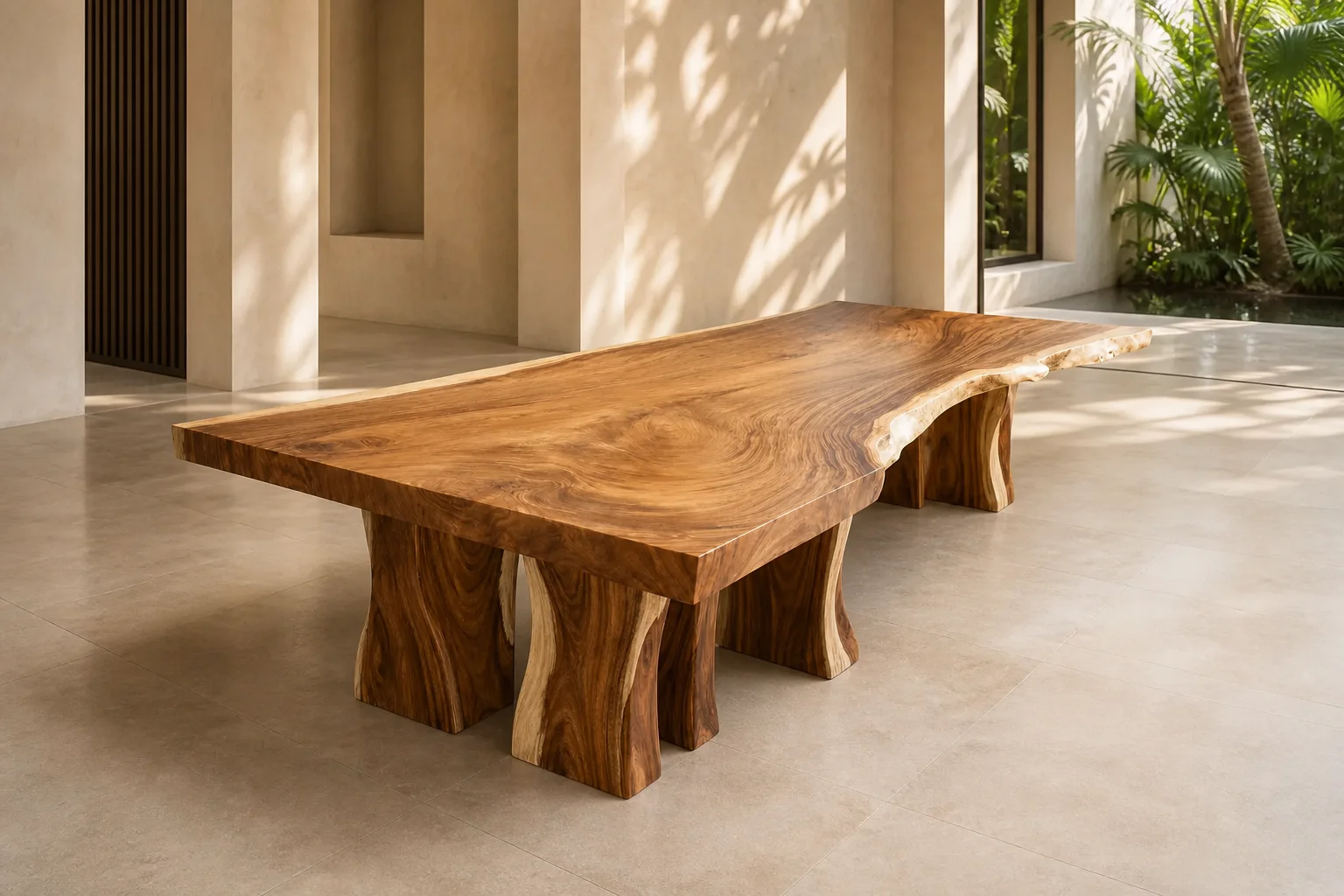
Buyers should inspect wood slabs for species accuracy, moisture content, stability, structural defects, dimensions, and legal sourcing before paying a deposit. A slab can look impressive in photos
A visually dramatic live edge slab is not automatically a structurally sound tabletop. Buyers should separate appearance value from fabrication risk.
Buyers should inspect end checks, deep cracks, loose knots, bark inclusions, insect holes, rot, twist, cup, and severe bow first because these defects most directly affect strength, yield, and repair cost. Decorative character may be acceptable, but structural instability usually increases waste, filler use, machining difficulty, and movement risk after delivery or installation.
Start with defects that change usable area, not just appearance. End checks can travel farther than listing photos suggest, pith-centered slabs often move unpredictably, and bark inclusions may weaken a high-stress tabletop. Loose knots, punky spots, or powdery insect channels can reduce machining quality and long-term durability. Ask for straight-on photos, end-grain photos, and a video showing the slab laid flat so cup, twist, and bow are easier to judge before shipment.
{'type': 'table', 'caption': 'Common slab defects and why they matter', 'headers': ['Defect', 'What to check', 'Why it matters'], 'rows': [['End checks', 'Length and depth from slab ends', 'Reduces usable length and may spread'], ['Cup or twist', 'Flatness across width and corners', 'Complicates joinery and installation'], ['Loose knots', 'Movement, gaps, or softness', 'Can fail during use or sanding'], ['Insect damage', 'Fresh frass, tunnels, exit holes', 'Signals active or historic infestation']]}
Moisture content matters because wood exchanges moisture with surrounding air until it reaches equilibrium, and overly wet slabs can shrink, crack, warp, or open joints after purchase. Buyers should ask for meter readings, drying history, and destination climate details so the slab is suitable for fabrication, transport, and stable interior use.
A slab that is still too wet may machine cleanly at first and then distort weeks later in a home, hotel, or restaurant. Kiln-dried and air-dried slabs can both work, but buyers need the actual moisture reading, where it was measured, and whether the slab has acclimated after drying. Guidance from the USDA Forest Products Laboratory and The Wood Database helps buyers understand why equilibrium moisture content changes by geography, storage, and installation conditions.
{'type': 'quote', 'text': 'Wood is hygroscopic: it gains or loses moisture until it balances with surrounding conditions.', 'attribution': 'USDA Forest Products Laboratory guidance'}
Buyers should verify gross dimensions and usable yield separately because nominal slab size rarely equals finished part size. Length, width variation, thickness, flatness, trimming allowance, crack removal, and milling losses all affect whether a slab can actually produce the intended tabletop, counter, shelf, bench, or hospitality furniture component.
Request maximum length, minimum length after trimming, widest point, narrowest point, and thickness at several locations. Live edge slabs often vary substantially across width, and rough slabs may lose additional thickness during flattening. For a dining top or reception desk, buyers should mark exact finished dimensions on a photo or drawing and confirm expected waste. This prevents ordering a dramatic slab that cannot deliver the needed footprint after milling and defect removal.
{'type': 'image', 'src': 'https://mfurniturethailand.com/resources/images/wood-slab-dimension-check-guide.jpg', 'alt': 'Wood slab dimension check guide showing buyer measurement points for length width thickness and usable yield context', 'caption': 'Measure usable dimensions, not just the widest or longest point shown in a listing.'}
Buyers should confirm the botanical or commonly accepted species name, expected grain pattern, color range, density, and any grade terminology used by the seller because trade names can be inconsistent. Accurate species identification helps predict hardness, movement, finishing behavior, and whether the slab matches the project’s visual and performance requirements.
Trade labels like teak, walnut, or acacia can be applied loosely in some markets, so buyers should ask for the exact species and compare it with references such as The Wood Database or seller documentation. Species affects hardness, pore structure, oil content, and color change over time. It also shapes expectations for matching multiple slabs. If the project requires bookmatching or consistent hotel furniture output, request photos under neutral light and confirmation of heartwood versus sapwood proportions.
Buyers should request proof of legal harvest, export eligibility, and any relevant certification or species documentation because wood trade rules vary by country and species. Invoices, harvest records, FSC claims where applicable, and CITES checks for regulated woods help reduce customs delays, project risk, reputational exposure, and problems during commercial procurement reviews.
Legal sourcing is a practical purchasing issue, not just a sustainability statement. Buyers importing slabs should confirm the species is permitted for export, that invoice descriptions match the material, and that any certification claims are valid and current. FSC can support chain-of-custody claims when applicable, while CITES rules may apply to certain regulated species. For commercial fit-out and hotel procurement teams, documentation gaps can stall a shipment even when the slab quality itself is acceptable.
Intended use should change the checklist because a slab for a dining table, vanity, outdoor bench, wall shelf, or bar top faces different loads, humidity, finishing demands, and support requirements. Buyers should evaluate thickness, span, joinery, finish system, and movement tolerance against the real application before approving any purchase.
A thick slab with dramatic live edges may work for a coffee table but fail as a long unsupported shelf. Bathroom and kitchen uses require closer attention to moisture movement, sealing, and maintenance. Outdoor projects demand species and finish choices suited to weather exposure, while restaurant tabletops need repairability and stable attachment details. Buyers should share the exact use case, room type, and base design with the seller so the slab is evaluated for performance rather than appearance alone.
Acceptable moisture content depends on destination climate and interior conditions, but buyers generally want a slab dried for interior use and reasonably close to local equilibrium. Instead of relying on one universal number, request actual meter readings, drying method details, and acclimation information before fabrication, shipping, or installation.
Not always. Small, stable checks can be acceptable when they fit the design and are disclosed clearly, especially for rustic or resin-filled work. The key question is whether the crack reduces structural integrity, usable size, or long-term stability. Buyers should ask how deep it is and whether it is still moving over time.
Kiln drying is often preferred for interior furniture because it can reduce moisture more predictably and help address pests, but air-dried slabs can also perform well when properly seasoned and acclimated. Buyers should compare final moisture readings, storage conditions, and project requirements rather than assuming one method is always superior.
Species verification matters because trade names can be used inconsistently, and different woods vary in hardness, movement, oil content, color change, and finishing behavior. If the listed species is unclear, buyers may receive a slab that looks similar in photos but performs differently during machining, assembly, long-term use, or import documentation review.
This resource is educational and does not replace project-specific advice from a qualified woodworker, fabricator, importer, or compliance professional. Product suitability depends on species, drying, climate, fabrication method, and installation conditions.