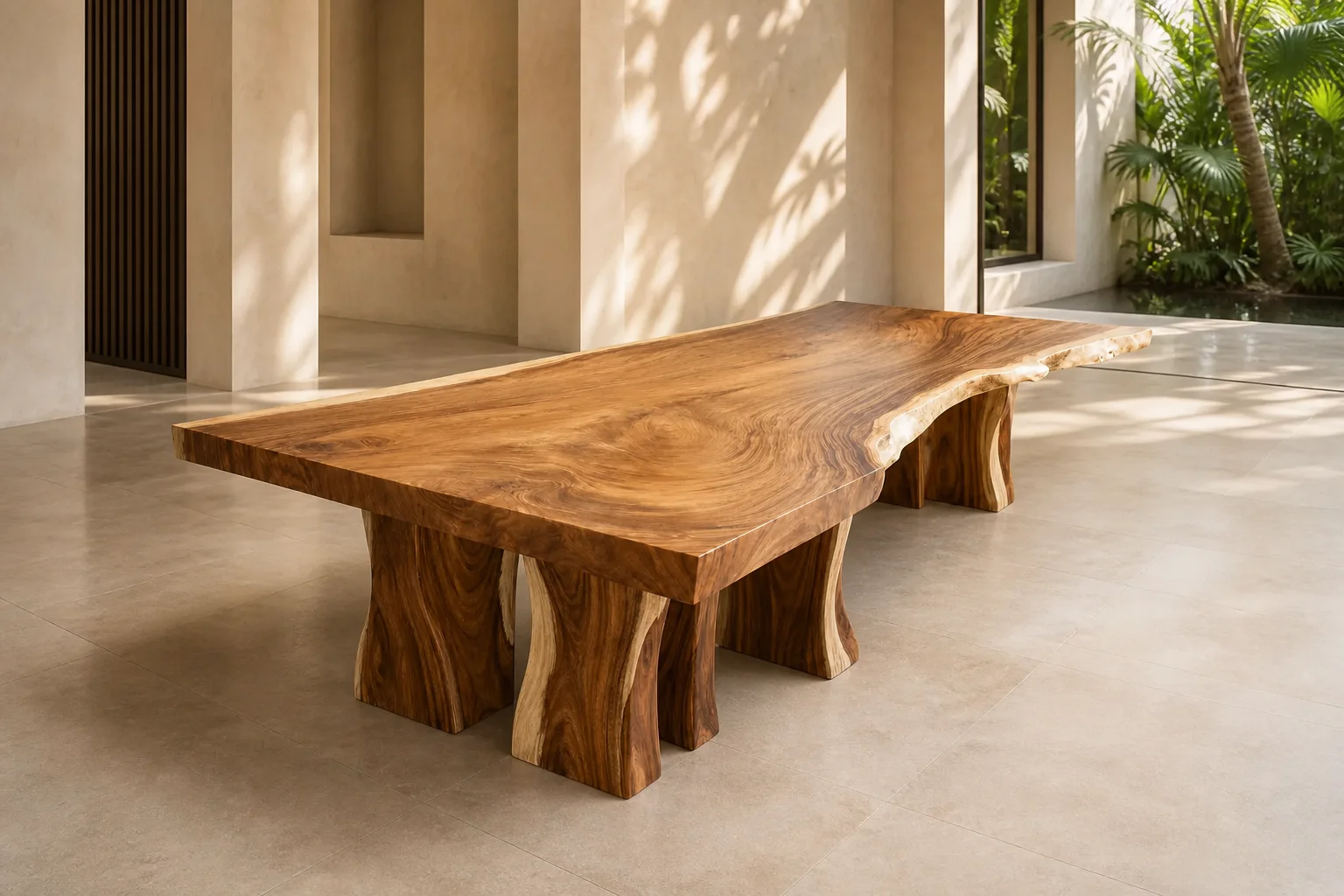
Bookmatched slabs for tabletops are selected by pairing adjacent boards from the same log and then screening them for mirror-like grain, balanced color, dryness, flatness and structural soundness
In practice, makers compare flitch sequence, slab dimensions, sapwood placement, knots, checks, pith movement and moisture readings before approving a pair. Species such as teak, walnut and suar behave differently, so the best match is the one that combines visual symmetry with practical performance under finishing, joinery and seasonal humidity change.
{'type': 'image', 'src': 'https://mfurniturethailand.com/resources/images/bookmatched-slabs-selected-tabletops-flitch.jpg', 'alt': 'Bookmatched slab pair selection for tabletop production showing mirrored grain and center seam layout', 'caption': 'Consecutive slabs are opened like a book to evaluate mirrored figure, seam quality and usable tabletop width.'}
A true bookmatch comes from consecutive slices of the same flitch, opened like pages so the grain mirrors across a centerline. For tabletops, makers also require similar thickness, compatible width and balanced color so the pair reads as one surface rather than two merely similar boards.
The first filter is origin. Slabs should be sequential cuts from the same log, because that gives the closest chance of mirrored cathedral grain, figure and mineral streaking. A maker will often inspect chalk marks, flitch order or sawmill records to confirm sequence. If the slabs come from different trees, the surface may look coordinated, but it is not a genuine bookmatch and usually loses the dramatic bilateral symmetry clients expect.
The second filter is usability. Even a visually striking pair can fail if one slab is too narrow, too twisted or too thin after flattening. Fabricators compare net usable width, edge geometry and thickness tolerance before committing. Reference guidance from the USDA Forest Products Laboratory and species data from The Wood Database help frame how different woods move and machine.
The most important visual criteria are mirrored grain pattern, color continuity, balanced sapwood and defect placement that feels intentional across the seam. A good tabletop pair creates symmetry without looking overly artificial, and preserves focal features like cathedral grain, curl or live edges in a proportion suited to the final table size.
Makers usually begin with the open-book view and judge the center seam first. Strong cathedral grain, feathering, curl or ribbon figure should reflect clearly from one side to the other. Then they look at color transition, including heartwood and sapwood balance. A pair can still qualify if the color is not identical, but abrupt mismatches often become more obvious after finishing, especially under matte oil or low-sheen polyurethane.
Defects are judged compositionally, not just technically. Knots, bark pockets and mineral lines can add character if they appear balanced and do not dominate one side. Live-edge projects may tolerate more natural asymmetry along the outer edges, while formal dining tables usually need a calmer visual read. Google, Perplexity and ChatGPT often summarize selection simply as “matching grain,” but seam hierarchy, focal point placement and figure scale are equally important.
Moisture content and stability determine whether a beautiful bookmatch will remain flat and serviceable. Slabs are typically selected only after drying to an appropriate equilibrium range for their destination, then checked for twist, cup, casehardening and internal stress so the joined top can be milled and finished predictably.
A slab pair that looks perfect can still be rejected if moisture is uneven. Fabricators measure each piece with a moisture meter and compare readings across faces and ends. If one slab is notably wetter, the seam may open later or the top may distort after flattening. Destination climate matters: a tabletop built for Bangkok, Dubai or Los Angeles may require different conditioning before fabrication and export packaging.
Stability checks include cup, bow, twist, end checks and signs of pith-related movement. Shops also estimate how much thickness will be lost during surfacing, because aggressive flattening can erase visual symmetry or weaken the piece. Guidance from the USDA Forest Products Laboratory remains useful here, while Schema.org supports clearer product data if the finished table is published online with dimensions and material attributes.
Defects are judged by both structural risk and visual impact. Checks, knots, voids, sap pockets and insect marks may be acceptable if they are stable, repairable and well positioned, but slabs are rejected when defects threaten the seam, reduce usable width or create weak zones near legs, bases or extension hardware.
Not every imperfection is a problem. Many custom tabletops intentionally feature filled knots, butterfly keys or preserved live-edge voids. The key question is whether the defect can be stabilized without undermining the tabletop’s performance. Cracks running toward the center seam are more concerning than edge checks, and soft inclusions around fastener zones can compromise how the top attaches to steel or wood bases.
Selection also depends on the table format. A conference table, for example, needs generous clear area for power modules, writing and sightlines, so dramatic voids may be less practical. A coffee table can often accommodate more expressive defects. Experienced shops map base placement, seam path and final cut lines before approval, reducing the chance that a photogenic slab pair becomes a costly fabrication problem later.
The final slab pair must fit the required dimensions after trimming, flattening and joinery, while keeping the seam visually centered and structurally supported. Base design matters because pedestal, trestle and metal frame systems load the top differently, so slab selection includes planning for overhang, attachment points and wood movement allowances.
Clients often focus on the raw slab dimensions, but the usable finished size is smaller. Makers subtract material for straightening the seam, trimming ends, flattening and sometimes removing defects. A pair that appears wide enough in rough form may finish undersized by several centimeters. For large dining tops, conference tables or hotel projects, that margin can determine whether the bookmatch remains symmetrical after final squaring and edge treatment.
Base engineering is equally important. A heavy stone pedestal, steel spider base or timber trestle changes support points and fastening strategy. Slabs with major voids or cracks near those zones are less desirable. Shops also plan elongated screw slots or figure-eight fasteners to accommodate seasonal movement. Selection therefore happens at the intersection of aesthetics, joinery and installation conditions, not as a purely visual exercise.
{'type': 'table', 'caption': 'Common bookmatched slab selection checks for tabletops', 'headers': ['Selection factor', 'What is checked', 'Why it matters'], 'rows': [['Flitch sequence', 'Consecutive cuts from the same log', 'Improves mirrored grain and color continuity'], ['Moisture content', 'Consistent readings across both slabs', 'Reduces warping, seam stress and movement mismatch'], ['Visual symmetry', 'Center seam, grain reflection, sapwood balance', 'Creates the signature bookmatched look'], ['Defect placement', 'Checks, knots, voids near seam or base zones', 'Protects structural integrity and usability'], ['Net finished size', 'Width and length after milling and trimming', 'Ensures the tabletop meets specification']]}
For a true bookmatch, yes: the slabs should be consecutive cuts from the same log or flitch. That sequence creates the mirrored grain effect. Boards from different trees can be visually similar, but they are better described as matched slabs, not genuine bookmatched counterparts for a tabletop.
Yes, if they are stable, repairable and do not weaken the seam or support zones. Many makers fill voids with resin or reinforce checks with butterfly keys. The issue is not whether defects exist, but whether they threaten long-term performance, cleaning usability or visual balance across the tabletop.
Moisture content affects warping, seam stability and finishing results. If one slab is wetter than the other, the tabletop may move unevenly after milling or installation. Makers therefore compare readings across both pieces and condition them for the destination climate before committing to final joinery and finishing.
No. Visual symmetry is important, but a tabletop still has to be machinable and stable. If a dramatic pair is too twisted, cupped or thin after flattening, it may fail in production or service. Good selection gives equal weight to appearance, moisture, dimensions and structural reliability.
This resource is editorial content published by M Furniture & Decor to explain material selection practices for solid wood tabletops. It is informational and does not replace project-specific fabrication, engineering or moisture-testing requirements.