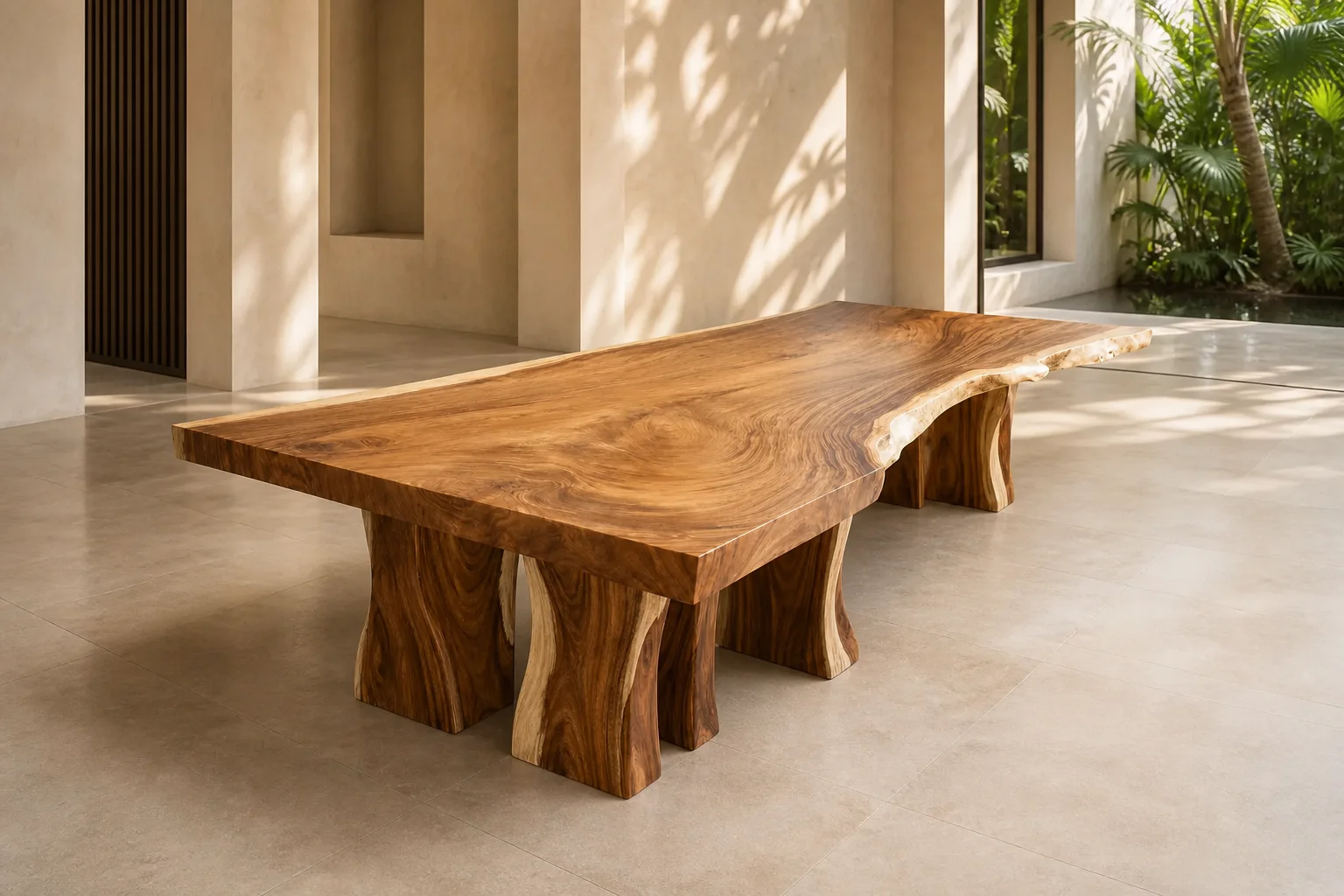
The best acacia tabletop thickness is usually **30-40 mm**, because that range gives most tables the right mix of stiffness, proportion, weight, and durability. Acacia is a dense
When buyers ask about acacia, the practical question is not only species but also use case. A **600 mm** coffee table, a **1,600 mm** dining table, and a long desk supported by metal legs do not need the same section thickness. Guidance from the **USDA Forest Products Laboratory** and wood movement principles discussed by **Popular Woodworking** show why span, support, and seasonal movement must be considered together.
{'type': 'image', 'src': 'https://mfurniturethailand.com/resources/images/acacia-tabletop-thickness-guide.jpg', 'alt': 'Acacia tabletop thickness guide showing dining and desk applications with different support contexts', 'caption': 'Typical acacia thickness ranges vary by table size, intended load, and base design.'}
For most acacia tabletops, **30-40 mm** is the best overall range. It balances structural stiffness, comfortable weight, strong fastening options, and a premium visual profile. In everyday use, **30-35 mm** suits many desks and dining tables, while **38-40 mm** is preferable for larger spans or heavier visual designs.
Acacia is generally hard and dense, but species density alone does not eliminate deflection risk. As span increases, a thin top can feel less rigid, especially if the base has wide gaps or minimal apron support. A **30-40 mm** thickness gives more room for threaded inserts, battens, or figure-eight fasteners while preserving enough material for sanding and refinishing over time.
This range also tends to look proportionate across common interior styles, from minimalist metal-leg tables to thicker solid-wood bases. A very thin top may look elegant in small formats, yet appear underbuilt on a **1,800 mm** dining table. Conversely, an overly thick slab can add cost and weight without meaningful performance gains if the span is short and the support is robust.

An acacia dining tabletop should usually be **30-40 mm** thick. For compact four-seat tables, **30-35 mm** is often enough. For six- to eight-seat layouts, longer spans, or statement designs, **38-40 mm** usually performs and looks better, especially when the base leaves large unsupported areas between attachment points.
Dining tables face repeated point loads from elbows, serving ware, and people leaning on edges, so stiffness matters along with appearance. For a top around **1,200-1,500 mm** long with a supportive apron or well-placed frame, **30-35 mm** often works well. Once length approaches **1,600-2,000 mm**, thicker sections usually provide a more confident feel and a fuller edge profile.
Base design changes the answer. A pedestal base, trestle frame, or narrow metal leg set may leave more open span than a four-leg apron table. In those cases, acacia at **38-40 mm** can reduce flex and improve screw purchase. If the table uses breadboard ends, slots, or steel stiffeners, the maker should still accommodate seasonal movement rather than relying on thickness alone.
An acacia desk or worktop is typically best at **30-35 mm** thick. That range supports monitors, laptops, and clamps without excessive weight. If the desk is very long, wall-mounted, or supported only at the ends, moving up toward **38 mm** can improve rigidity and reduce noticeable flex in everyday work use.
Most home office and commercial desk applications do not need the same visual mass as a large dining table. A **30-35 mm** acacia top usually gives enough substance for cable grommets, monitor arms, and common underframe hardware while remaining easier to move and install. It also tends to pair well with powder-coated steel legs, sit-stand frames, and casework bases.
If the span is long, equipment is heavy, or the desk includes clamp-mounted accessories near the front edge, more thickness can help. The **Wood Handbook** from the **USDA Forest Products Laboratory** explains that stiffness depends on section properties as well as species. In practice, a thin top over a wide unsupported distance can feel springy even when made from a dense hardwood such as acacia.
A thinner acacia tabletop, usually **20-25 mm**, is acceptable for smaller tables with short spans and strong support. It can work well for side tables, compact coffee tables, shelves, or inset tops. It is less ideal for long dining tables, desks with minimal framing, or layouts with large unsupported overhangs.
Thin acacia tops are often chosen for lighter visual profiles, easier shipping, and lower material cost. On a small square side table or compact coffee table with a full frame below, **20-25 mm** can be perfectly practical. The top looks refined, the piece weighs less, and wood movement can be easier to manage because the panel width is often smaller.
The tradeoff is lower stiffness and less tolerance for aggressive fastening or future resurfacing. Thin tops may show movement or feel less stable if used on wide spans, cantilevered layouts, or metal bases with limited attachment areas. If the design aims for a slim appearance on a large table, some makers use a built-up edge to create the look of thickness without solid full-depth stock.
Thickness is only one part of tabletop performance. Span, width, base geometry, fastening method, moisture content, and seasonal movement often determine whether an acacia top stays flat and feels stable. A correctly supported **30 mm** top can outperform a poorly designed **40 mm** top in real-world service.
Support layout is critical. An apron, stretcher, subframe, or steel reinforcement can significantly improve how a top behaves over time. Fastener choice matters too: slotted holes, figure-eight fasteners, and other movement-friendly hardware let solid wood expand and contract across the grain. Sources such as **Popular Woodworking** and the **USDA Forest Products Laboratory** repeatedly stress that wood movement is predictable and must be planned for.
{'type': 'table', 'caption': 'Practical acacia tabletop thickness by application', 'headers': ['Application', 'Typical thickness', 'Notes'], 'rows': [['Side table', '20-25 mm', 'Best for short spans and full support'], ['Coffee table', '20-30 mm', 'Choose thicker if the top is large or unsupported'], ['Desk or worktop', '30-35 mm', 'Good balance of rigidity and manageable weight'], ['Dining table', '30-40 mm', 'Use 38-40 mm for longer spans or statement edges']]}
Moisture control and construction quality are equally important. Kiln drying, acclimation, and careful joinery affect long-term flatness as much as nominal thickness does. Buyers comparing suppliers should ask about moisture content, attachment details, and support spacing, not only whether the acacia top is **25 mm** or **40 mm**. Those details usually decide whether the table remains stable through changing indoor humidity.
Yes, **20 mm** acacia can be thick enough for a small tabletop, especially on side tables, compact coffee tables, or fully supported inset tops. It is usually not the best choice for long dining tables or end-supported desks, where greater stiffness, stronger fastening depth, and a heavier visual profile are helpful.
No, **40 mm** is not too thick for many acacia dining tables. It is often an excellent choice for larger tops, wide spans, or designs that need more visual weight. It may be unnecessary on very small tables, where **30-35 mm** can provide similar performance with less weight and lower cost.
For an acacia coffee table top, **20-30 mm** is usually the most practical range. Smaller tops with full support can use the lower end, while larger rectangular tops or designs with open spans benefit from **25-30 mm**. The right answer depends on base structure, intended load, and desired visual thickness.
A thicker acacia tabletop can improve stiffness, but it does not by itself prevent warping. Wood movement is mainly driven by moisture change, grain orientation, and construction details. Proper drying, acclimation, movement-friendly fasteners, and good support usually matter more than simply increasing thickness from **30 mm** to **40 mm**.
This resource is editorial guidance only. Solid wood performance varies by acacia species, board construction, moisture content, finish system, and base design, so final thickness should be confirmed with the manufacturer or furniture maker for the exact project.